
What is the Multiply Complex Numbers Calculator?
A complex number has the form \(a + bi\), where \(a\) is the real part, \(b\) is the imaginary part, and \(i\) is the imaginary unit defined by \(i^2 = -1\). This calculator multiplies two complex numbers, \((a + bi)\) and \((c + di)\), and returns the result in standard \(a + bi\) form. It is handy for algebra, electrical engineering (phasors and impedance), signal processing, and physics.
How to use it
Enter the real and imaginary parts of the first number (\(a\) and \(b\)) and the second number (\(c\) and \(d\)). The calculator instantly displays the product, separated into its real and imaginary components. Negative values and decimals are fully supported.
The formula explained
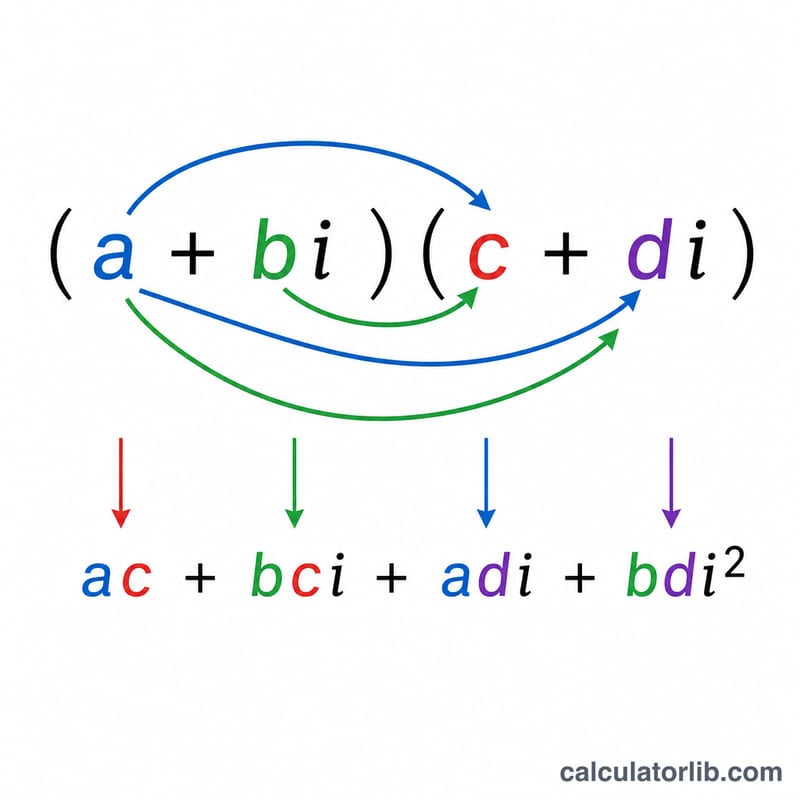
Multiplying complex numbers uses the distributive (FOIL) method:
$$(a + bi)(c + di) = ac + adi + bci + bdi^2$$
Since \(i^2 = -1\), the term \(bdi^2\) becomes \(-bd\). Grouping the real and imaginary terms gives:
$$(a + bi)(c + di) = (ac - bd) + (ad + bc)i$$
So the real part of the product is \(ac - bd\) and the imaginary part is \(ad + bc\).
Worked example
Multiply \((3 + 2i)\) by \((1 + 4i)\):
- Real part: $$ac - bd = (3)(1) - (2)(4) = 3 - 8 = -5$$
- Imaginary part: $$ad + bc = (3)(4) + (2)(1) = 12 + 2 = 14$$
The product is \(-5 + 14i\).
FAQ
What does \(i^2\) equal? By definition, \(i^2 = -1\), which is exactly why the product of the imaginary parts subtracts from the real part.
Can I multiply a real number by a complex number? Yes — set \(b\) or \(d\) to 0. For example, multiplying \((5 + 0i)\) by \((2 + 3i)\) gives \(10 + 15i\).
What if both numbers are purely imaginary? Multiplying \((0 + 2i)\) by \((0 + 3i)\) gives \(6i^2 = -6\), a real number.