
What this calculator does
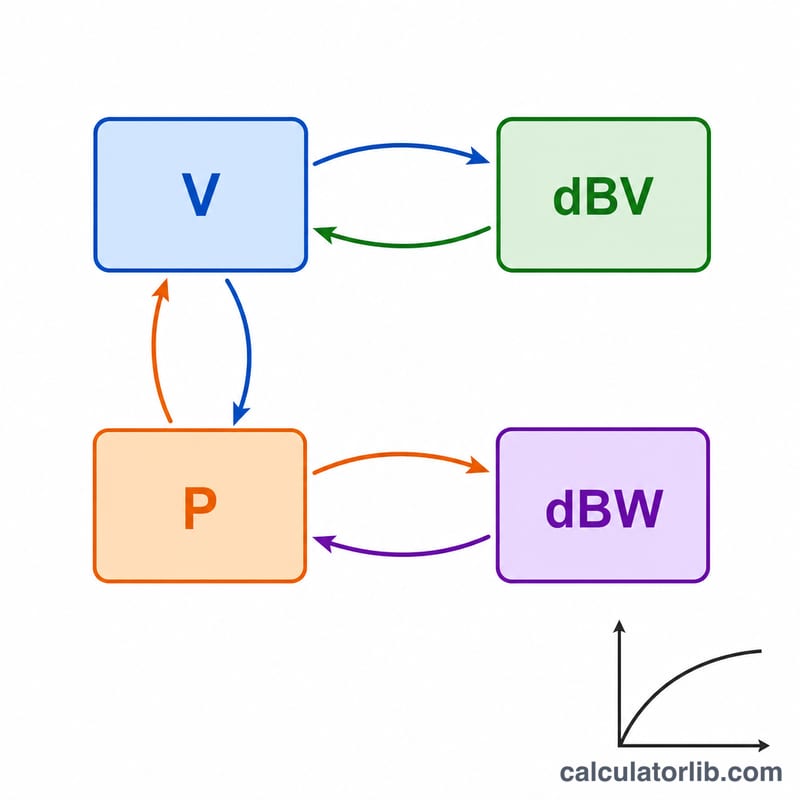
This Voltage / Power Decibel Conversion Calculator takes a single electrical quantity — a voltage (V), a power (W), a decibel-voltage (dBV, relative to 1 V), or a decibel-power (dBW, relative to 1 W) — measured in a chosen load-impedance system (50, 75, or 600 ohms) and converts it into all four equivalent quantities. It is pure electrical engineering and applies identically everywhere; there are no region-specific rules.
How to use it
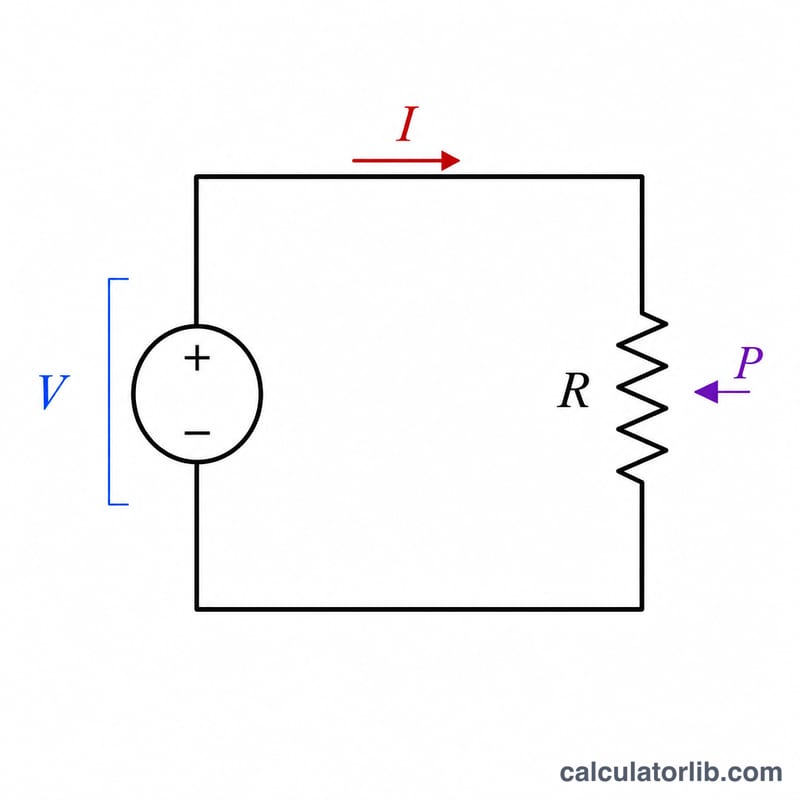
Choose the load impedance R (50 Ω for RF, 75 Ω for video, 600 Ω for audio lines). Pick the data type you are entering, select the matching unit, and type the value. The tool reports the equivalent voltage, power, dBV and dBW.
The formulas
With R the load impedance in ohms, power across the load is $$P = \frac{V^{2}}{\text{R}}$$ and the inverse is $$V = \sqrt{P \times \text{R}}.$$ The decibel references used here are $$\text{dBV} = 20\,\log_{10}\!\left(\frac{V}{1\ \text{V}}\right) \qquad \text{and} \qquad \text{dBW} = 10\,\log_{10}\!\left(\frac{P}{1\ \text{W}}\right).$$ The inverses are $$V = 10^{\frac{\text{dBV}}{20}} \qquad \text{and} \qquad P = 10^{\frac{\text{dBW}}{10}}.$$ The voltage is the potential difference across the load when terminated by the load impedance.
Worked example
\(R = 50\ \Omega\), input = 1 mV (voltage). $$V = 0.001\ \text{V}, \qquad P = \frac{0.001^{2}}{50} = 2.0\times10^{-8}\ \text{W}\ (20\ \text{nW}),$$ $$\text{dBV} = 20\,\log_{10}(0.001) = -60\ \text{dB}, \qquad \text{dBW} = 10\,\log_{10}(2.0\times10^{-8}) \approx -76.9897\ \text{dB}.$$
FAQ
Why does the result depend on impedance? Power depends on both voltage and the load it drives (\(P = V^{2}/R\)), so converting between voltage and power requires \(R\).
What reference is used for dB? dBV is relative to 1 V and dBW is relative to 1 W — absolute references, not the common dBm (re 1 mW).
Why can dB be undefined? The logarithm of zero or a negative number is undefined; a voltage or power of 0 corresponds to \(-\infty\) dB, so the tool reports it as undefined.