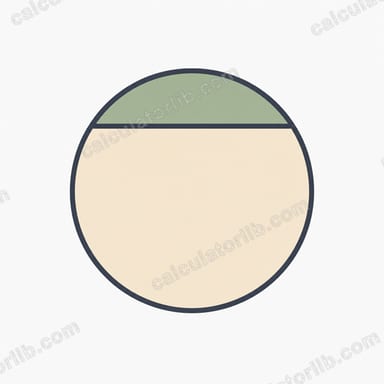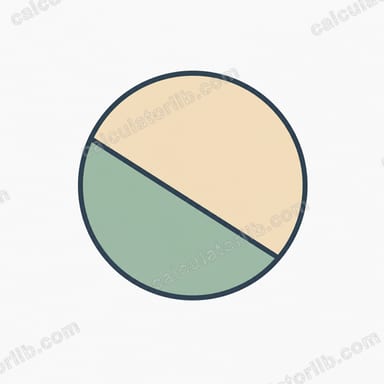

What the Elliptical Segment Area Calculator does
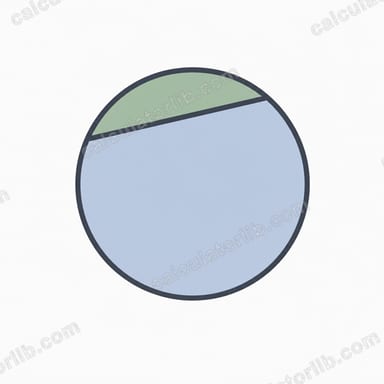
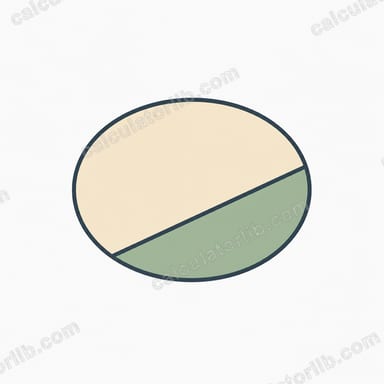
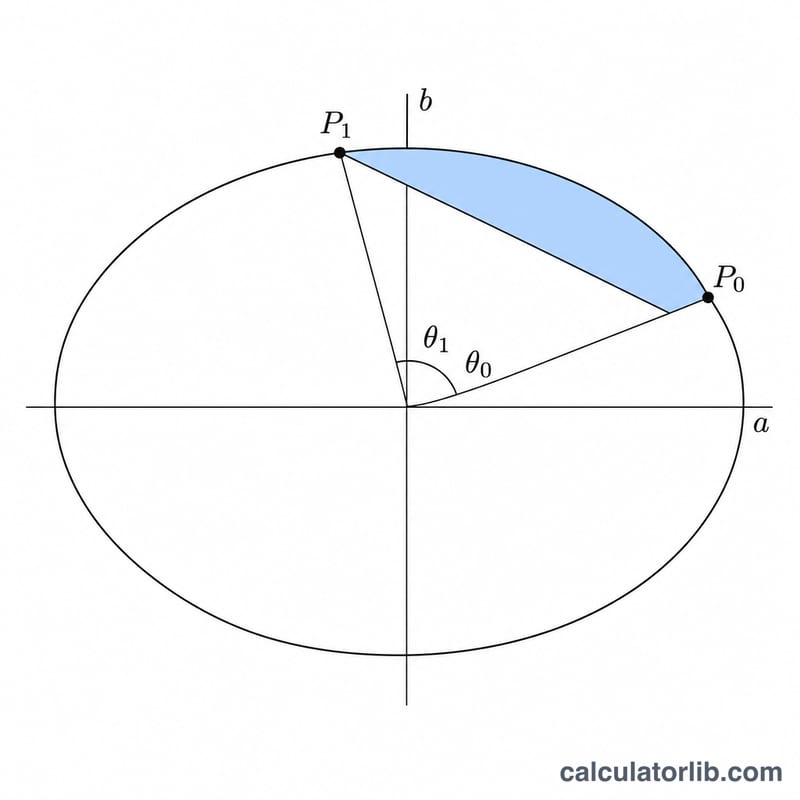
This universal geometry tool works on an ellipse with semi-axes a (along x) and b (along y). You pick two points by giving their polar angles theta0 and theta1, measured from the center. The calculator returns the area S of the elliptical segment bounded by the elliptic arc and the chord between the two points, the straight chord length c, and the elliptic arc length L between the points.
How to use it
Enter the semi-axes a and b, the start angle theta0 and the end angle theta1, and choose whether the angles are in degrees or radians. Both angles use the same unit. The angle here is the polar (central) direction, not the parametric/eccentric angle, so a point sits at \(P(\theta) = (r(\theta)\cos\theta, r(\theta)\sin\theta)\), where \(r(\theta)\) is the center-to-ellipse distance along that ray.
The formulas
Central radius:
$$r(\theta) = \sqrt{\frac{a^2 b^2}{b^2 \cos^2\theta + a^2 \sin^2\theta}}$$With \(r_0 = r(\theta_0)\), \(r_1 = r(\theta_1)\):
Chord:
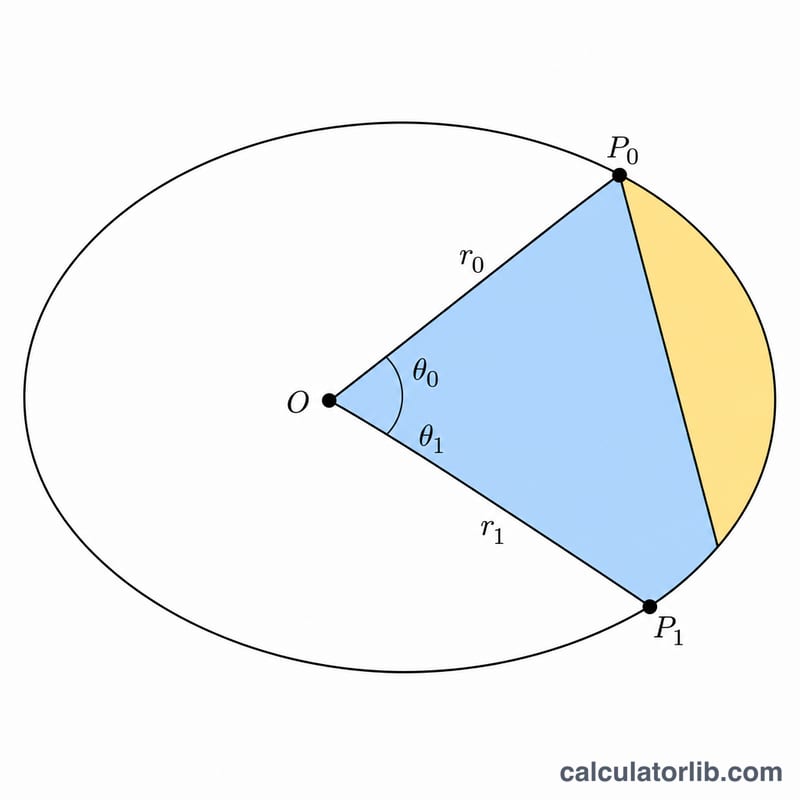
$$c = \sqrt{r_0^2 + r_1^2 - 2 r_0 r_1 \cos(\theta_1 - \theta_0)} \quad (\text{law of cosines}).$$Segment area:
$$S = F(\theta_1) - F(\theta_0) - \frac{r_0 r_1}{2} \sin(\theta_1 - \theta_0),$$where the sector primitive is
$$F(\theta) = \frac{ab}{2}\left[\theta - \arctan\frac{(b-a)\sin 2\theta}{(b+a)+(b-a)\cos 2\theta}\right].$$The sector minus the central triangle leaves the segment.
Arc length: \(L\) is the elliptic arc length, computed by numerically integrating \(ds = \sqrt{r^2 + (dr/d\theta)^2}\, d\theta\) from \(\theta_0\) to \(\theta_1\) (composite Simpson, 2000 steps), which matches the incomplete elliptic integral of the second kind to display precision.
Worked example
For \(a = 3\), \(b = 2\), \(\theta_0 = 0\) deg, \(\theta_1 = 90\) deg: \(r_0 = 3\), \(r_1 = 2\). Chord
$$c = \sqrt{9 + 4 - 0} = \sqrt{13} = 3.6055512755.$$Sector area = quarter ellipse
$$= \frac{\pi a b}{4} = 1.5\pi = 4.7123889804,$$triangle = 3, so \(S = 1.7123889804\). The quarter-ellipse arc length \(L = 3.9663598973\).
FAQ
Is theta the parametric angle? No — it is the polar angle from the center, so \(r(\theta)\) is the actual center-to-curve distance.
What if a = b? The ellipse is a circle: \(L = a|\theta_1 - \theta_0|\) and \(S = \frac{a^2}{2}(|\theta_1 - \theta_0| - \sin|\theta_1 - \theta_0|)\).
Why is the arc length numeric? Elliptic arc length has no elementary closed form; numeric integration reproduces it to many digits without a special-function library.