
What this calculator does
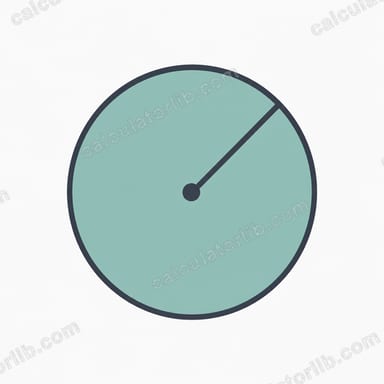
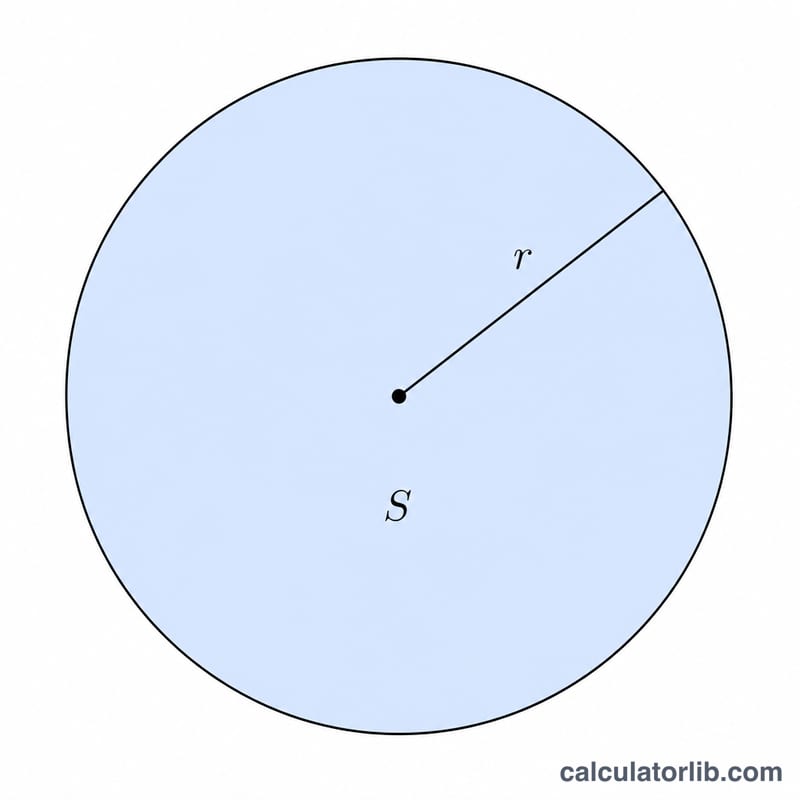
Given the area S of a circle, this tool computes the three other key measurements: the radius r, the diameter R, and the circumference L. It is a pure geometry tool, so it works with any consistent units — if you enter the area in square centimetres, the results come back in centimetres; square inches give inches, and so on. No unit conversion is performed.
How to use it
Type the circle's area into the Area S field and read off the radius, diameter and circumference. The area must be zero or positive. If you enter 0, all three outputs are 0. A negative area is rejected because there is no real circle whose area is negative (it would require the square root of a negative number).
The formula explained
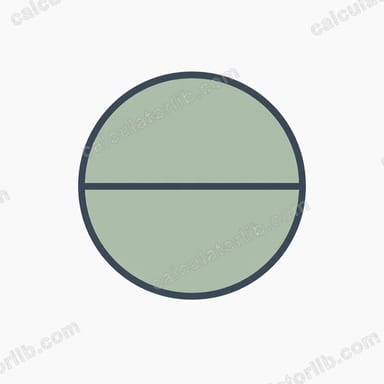
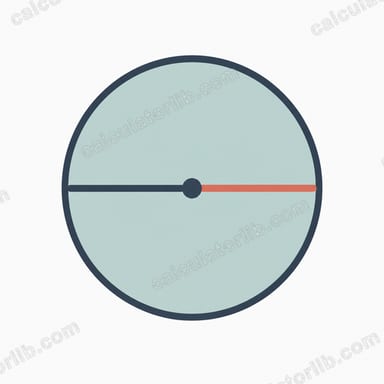
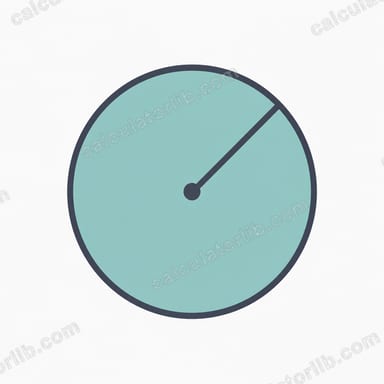
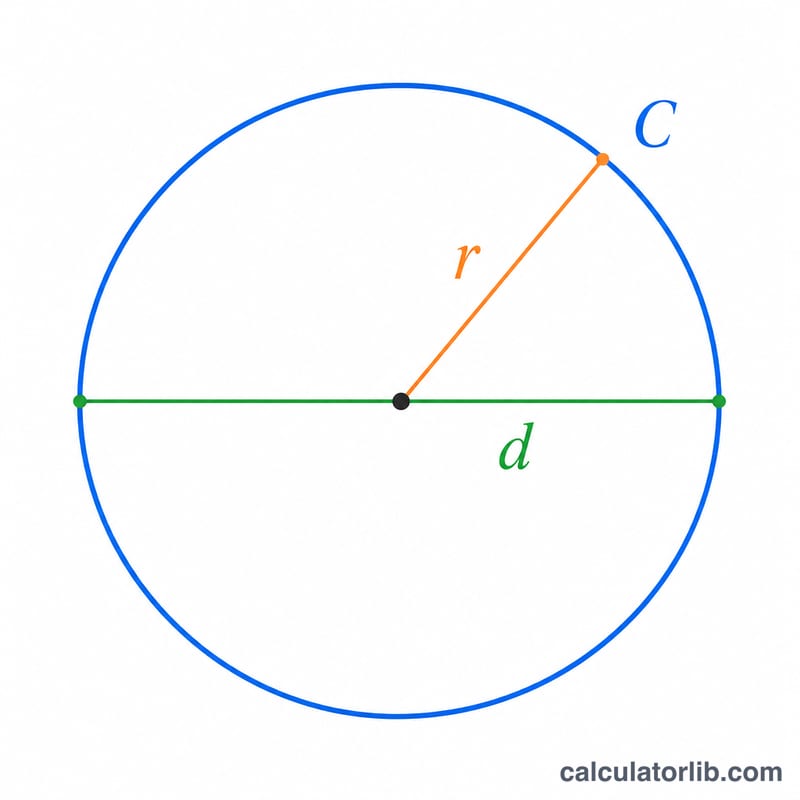
The area of a circle is $$S = \pi r^2.$$ Solving for the radius gives $$r = \sqrt{\frac{S}{\pi}}.$$ Once the radius is known, the diameter is simply twice the radius, \(R = 2r\), and the circumference is \(L = 2\cdot\pi\cdot r\), which is the same as \(L = \pi\cdot R\). We use \(\pi = 3.141592653589793\).
Worked example
Suppose the area is \(S = 1\). Then $$r = \sqrt{\frac{1}{3.14159265}} = \sqrt{0.31830989} \approx 0.564190.$$ The diameter is \(R = 2 \times 0.564190 \approx 1.128379\), and the circumference is \(L = 2 \times \pi \times 0.564190 \approx 3.544908\). For an area of 100, the radius is about 5.641896, the diameter about 11.283792, and the circumference about 35.449077.
FAQ
What units do the answers use? The same linear unit implied by your area unit. Area in m² yields radius, diameter and circumference in metres.
Why is a negative area invalid? The formula requires the square root of \(S/\pi\); a negative \(S\) has no real square root, so no real circle exists.
What if I only know the diameter or circumference? This calculator starts from area. If you have the diameter, halve it for the radius; if you have the circumference, the radius is \(L / (2\cdot\pi)\).