
What is error propagation?
Every physical measurement carries an uncertainty. When you combine measured quantities through arithmetic, those uncertainties must be carried through to the final result. This error propagation calculator handles the four basic operations — addition, subtraction, multiplication and division — for two values A and B, each with its own uncertainty \(\delta A\) and \(\delta B\), assuming the errors are random and independent.
How to use it
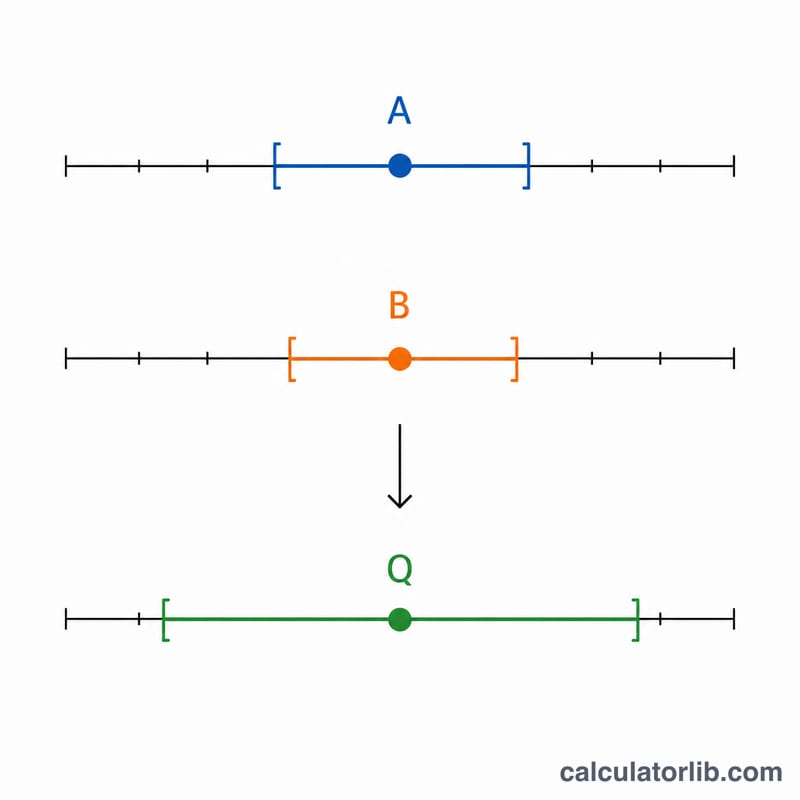
Pick the operation, enter value A and its uncertainty \(\delta A\), then value B and its uncertainty \(\delta B\). The calculator returns the combined value Q, its absolute uncertainty \(\delta Q\), and the relative (percentage) uncertainty.
The formulas
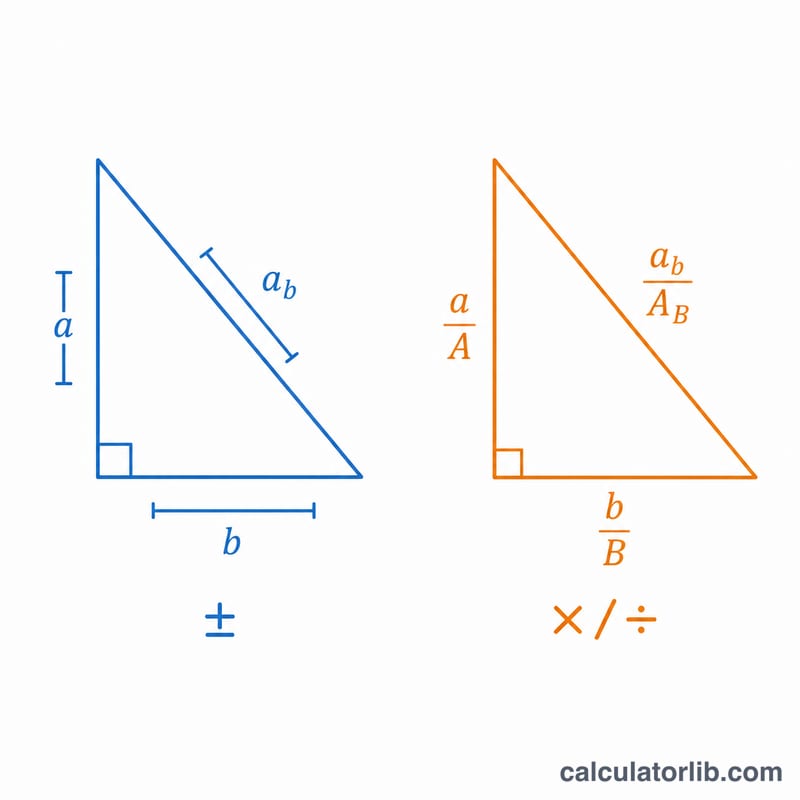
For sums and differences, the absolute uncertainties combine in quadrature: $$\delta Q = \sqrt{\delta A^{2} + \delta B^{2}}$$ For products and quotients, the relative uncertainties combine in quadrature: $$\frac{\delta Q}{\lvert Q \rvert} = \sqrt{\left(\frac{\delta A}{A}\right)^{2} + \left(\frac{\delta B}{B}\right)^{2}}$$ and the absolute uncertainty is then \(\delta Q = \lvert Q \rvert \cdot\) that relative value.
Worked example
Multiply A = 10 ± 0.5 by B = 4 ± 0.3. The product is \(Q = 40\). The relative uncertainties are \(0.5/10 = 0.05\) and \(0.3/4 = 0.075\). Combining: $$\sqrt{0.05^{2} + 0.075^{2}} = \sqrt{0.0025 + 0.005625} = \sqrt{0.008125} \approx 0.090139$$ So \(\delta Q = 40 \times 0.090139 \approx 3.61\), giving Q = 40 ± 3.61 (about 9.0%).
FAQ
Why add in quadrature instead of just summing? Independent random errors partially cancel on average, so the statistically correct combination is the square root of the sum of squares rather than a simple sum.
Does subtraction reduce uncertainty? No — for A − B the absolute uncertainty is the same \(\sqrt{\delta A^{2} + \delta B^{2}}\) as for A + B, even though Q gets smaller. This is why subtracting nearly equal numbers is numerically dangerous.
What if a value is zero? Relative uncertainty is undefined when the value is zero, so the calculator treats that term as zero to avoid division by zero.