
What is the Copper Wire Weight Calculator?
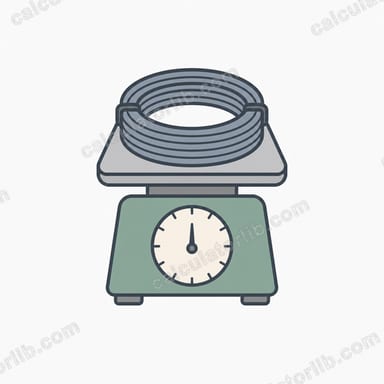
This tool estimates the mass of a length of solid round copper wire from two simple measurements: its diameter and its length. It is useful for electricians, cable manufacturers, hobbyists, scrap-metal estimators and engineers who need to know how much a spool of wire weighs without putting it on a scale.
How to use it
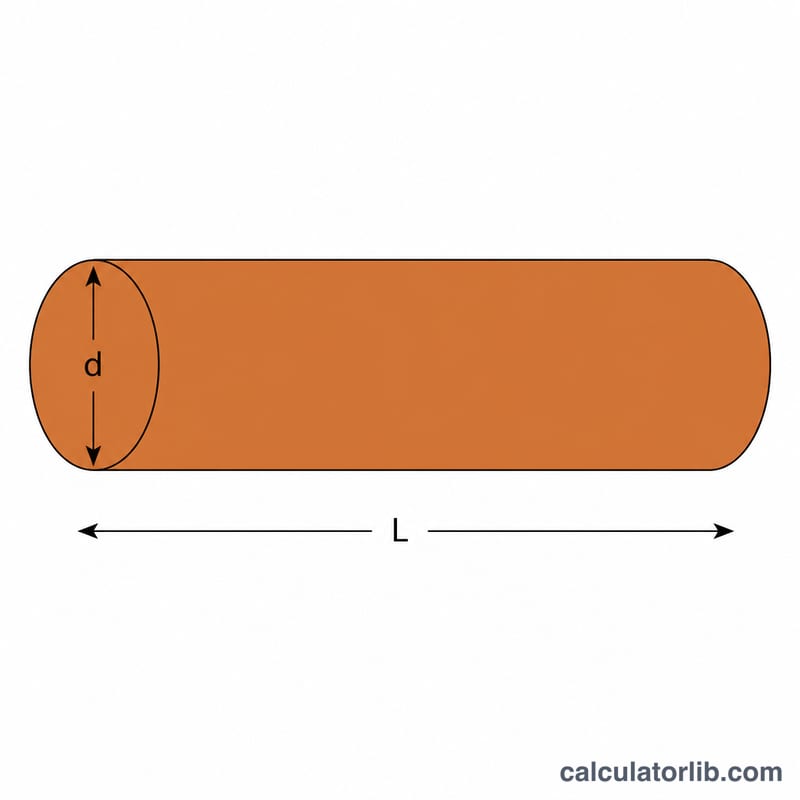
Enter the wire diameter in millimetres (the bare conductor diameter, not including insulation) and the total length in metres. The calculator returns the weight in kilograms and grams, along with the cross-sectional area and volume. The result assumes a solid, pure copper conductor at a density of 8960 kg/m³.
The formula explained
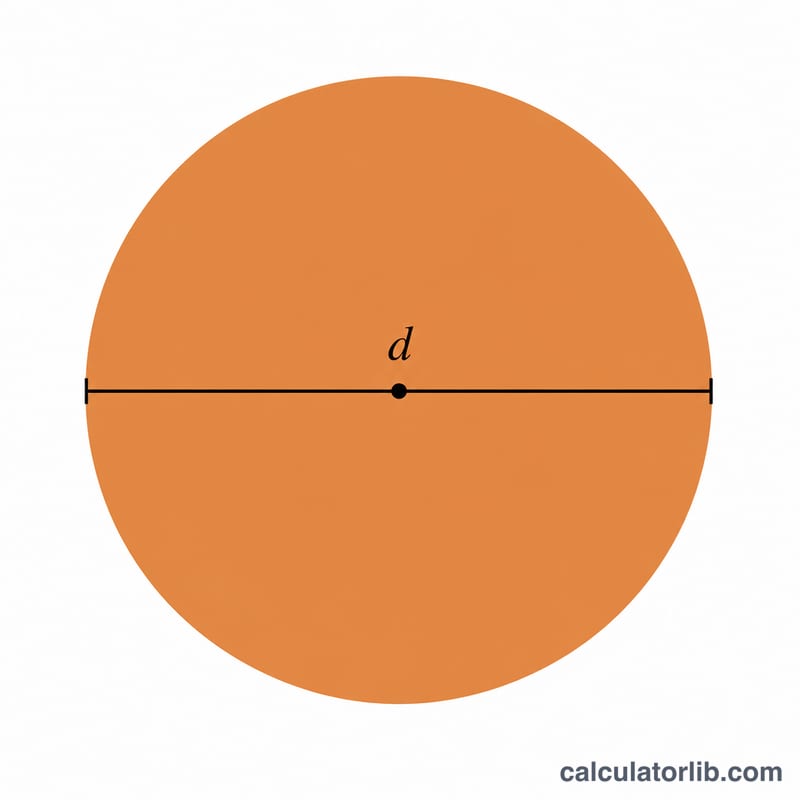
A round wire is a cylinder, so its volume is the circular cross-sectional area multiplied by the length: \(V = \frac{\pi}{4}\cdot d^{2}\cdot L\). Multiplying the volume by copper's density \(\rho\) gives the mass: $$W = \rho\cdot\frac{\pi}{4}\cdot d^{2}\cdot L$$ Because density is in kg/m³, the diameter and length are converted to metres internally (1 mm = 0.001 m).
Worked example
For a 2 mm diameter wire that is 100 m long: d = 0.002 m, so the area = \(\frac{\pi}{4}\cdot 0.002^{2} = 3.1416\times10^{-6}\ \text{m}^{2}\). Volume = \(3.1416\times10^{-6} \times 100 = 3.1416\times10^{-4}\ \text{m}^{3}\). Weight = \(8960 \times 3.1416\times10^{-4} \approx\) 2.815 kg (about 2815 g).
FAQ
Does this include insulation weight? No — it calculates the bare copper conductor only. Insulation adds extra mass not modelled here.
What about stranded wire? Use the equivalent total copper cross-section. If you only know the overall diameter of a stranded bundle there will be air gaps, so the true copper mass is slightly lower.
Can I use it for other metals? The density is fixed at 8960 kg/m³ for copper. For aluminium (≈2700 kg/m³) or other metals the result would need scaling by the density ratio.