
What Is a Permutation with Replacement?
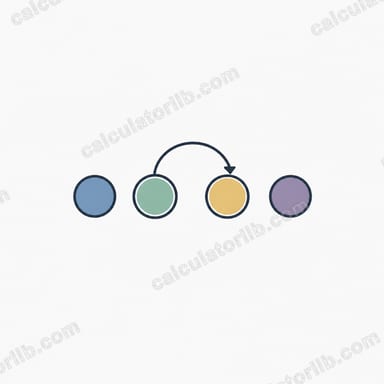
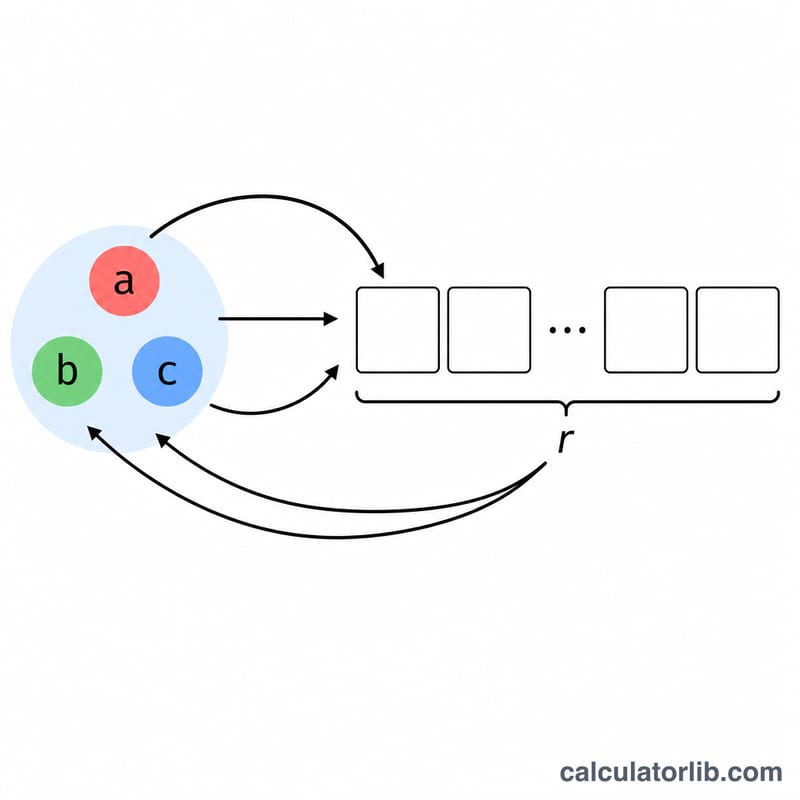
A permutation with replacement (also called permutation with repetition) counts the number of ordered arrangements you can make when each selection is returned to the pool before the next pick. Because items can repeat and order matters, every one of the r positions has the full n choices available. The total number of arrangements is therefore $$P = n^r$$
How to Use This Calculator
Enter two values: n, the number of distinct items available, and r, the number of positions or picks you want to fill. The calculator instantly raises n to the power r and shows the total count of possible ordered sequences.
The Formula Explained
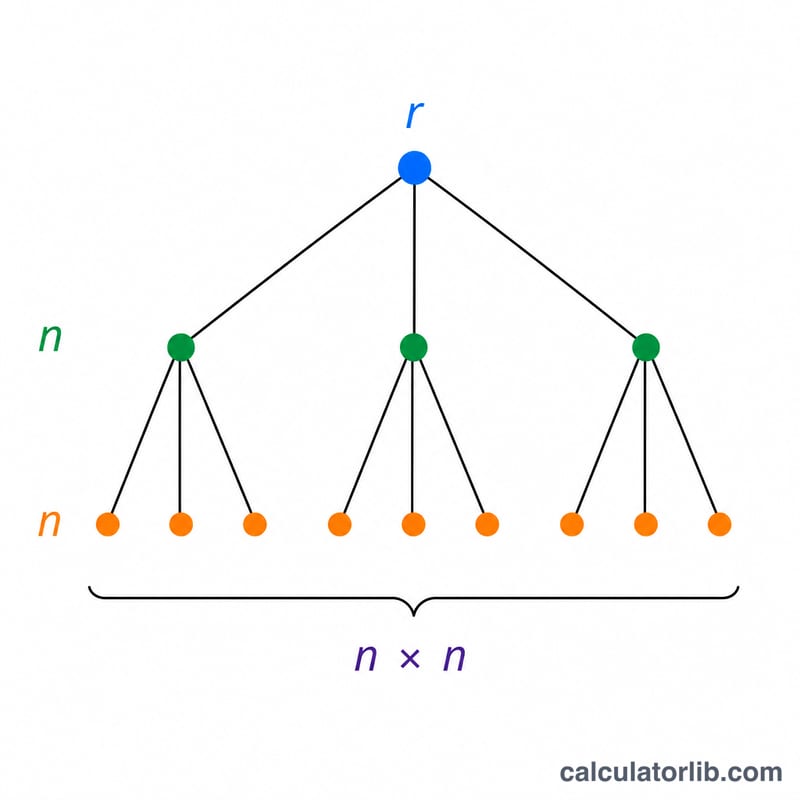
The rule comes from the multiplication principle. For the first position you have n options; since the item is replaced, the second position again has n options, and so on for all r positions. Multiplying gives \(n \times n \times \ldots \times n\) (r times) \(= n^r\). This differs from permutations without replacement, where each choice reduces the remaining pool.
Worked Example
A 4-digit PIN uses digits 0–9 and digits may repeat. Here \(n = 10\) and \(r = 4\), so $$P = 10^4 = 10{,}000$$ possible PINs. Similarly, a 3-character password drawn from 26 lowercase letters with repeats gives \(26^3 = 17{,}576\) combinations.
FAQ
How is this different from a combination? Combinations ignore order, while permutations count order. "AB" and "BA" are two different permutations but the same combination.
What if r is larger than n? That's fine with replacement — you can pick more times than there are distinct items because each item can be reused, e.g. \(2^5 = 32\).
What does \(n^0\) equal? Any non-zero n to the power 0 is 1: there is exactly one way to choose nothing (the empty arrangement).