
What Is a Permutation with Repetition?
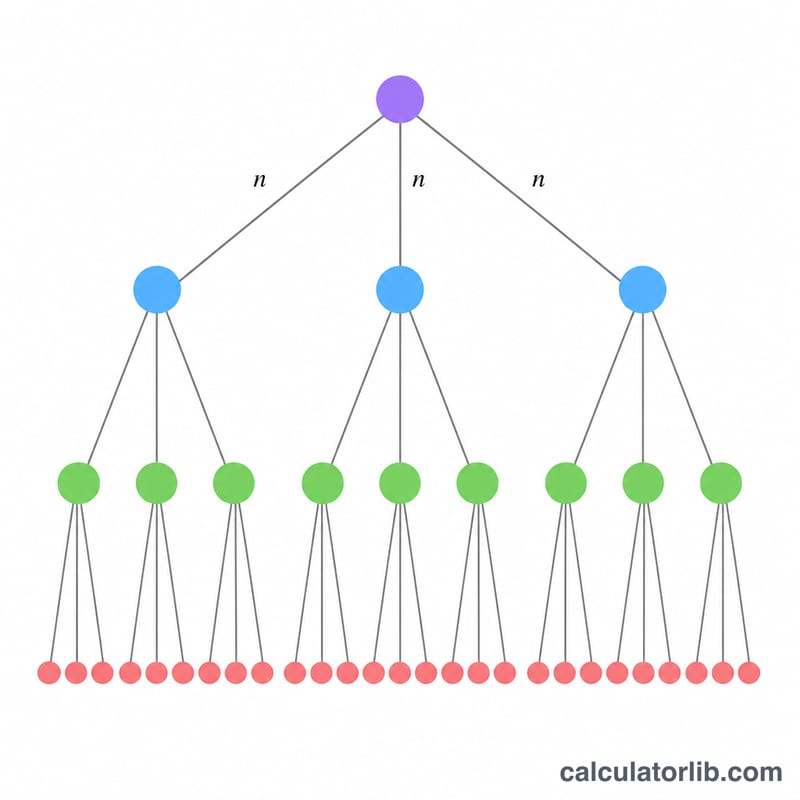
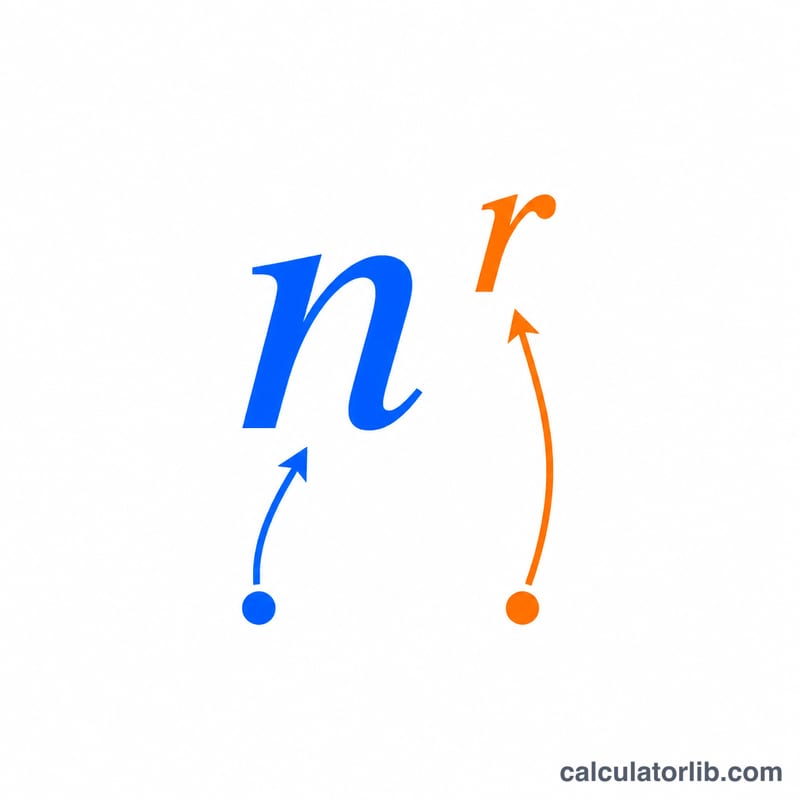
A permutation with repetition counts the number of ordered arrangements you can form when you choose r items from a set of n distinct items, and each item may be reused as many times as you like. Because order matters and repeats are allowed, the count grows very quickly — it follows the simple power rule \(P = n^{r}\).
How to Use This Calculator
Enter two values: n, the number of distinct items available (for example, the 10 digits 0–9), and r, the number of selections or positions to fill (for example, a 4-digit PIN). The calculator instantly returns \(n^{r}\), the total number of possible ordered arrangements.
The Formula Explained
Each of the r positions can independently be filled by any of the n items. By the multiplication principle, the choices multiply: $$n \times n \times \cdots \times n \ (r \text{ times}) = n^{r}.$$ This differs from permutations without repetition \(\left(\frac{n!}{(n-r)!}\right)\), where each item can be used only once.
Worked Example
How many 4-digit PIN codes are possible using digits 0–9? Here \(n = 10\) and \(r = 4\), so $$P = 10^{4} = 10{,}000$$ possible PINs. Likewise, a 3-character password using 26 letters gives $$26^{3} = 17{,}576$$ combinations.
FAQ
When should I use repetition? Use it whenever an item can appear more than once, such as digits in a PIN, characters in a password, or rolls of a die.
What if r = 0? By convention \(n^{0} = 1\) — there is exactly one arrangement (the empty selection).
How is this different from combinations? Combinations ignore order, while permutations count each ordering separately, producing larger totals.