
What Is the Possible Combinations Calculator?
This tool counts how many distinct groups of r items you can pick from a set of n items when the order does not matter. The number of combinations is written \(C(n, r)\), "n choose r," and appears everywhere from lottery odds and card hands to committee selection and probability problems.
How to Use It
Enter the total number of available items (n) and how many you want to choose (r). The calculator returns \(C(n, r)\), the number of unordered selections, and also shows \(P(n, r)\), the number of ordered arrangements, for comparison. If r is greater than n the result is 0, since you cannot choose more items than exist.
The Formula Explained
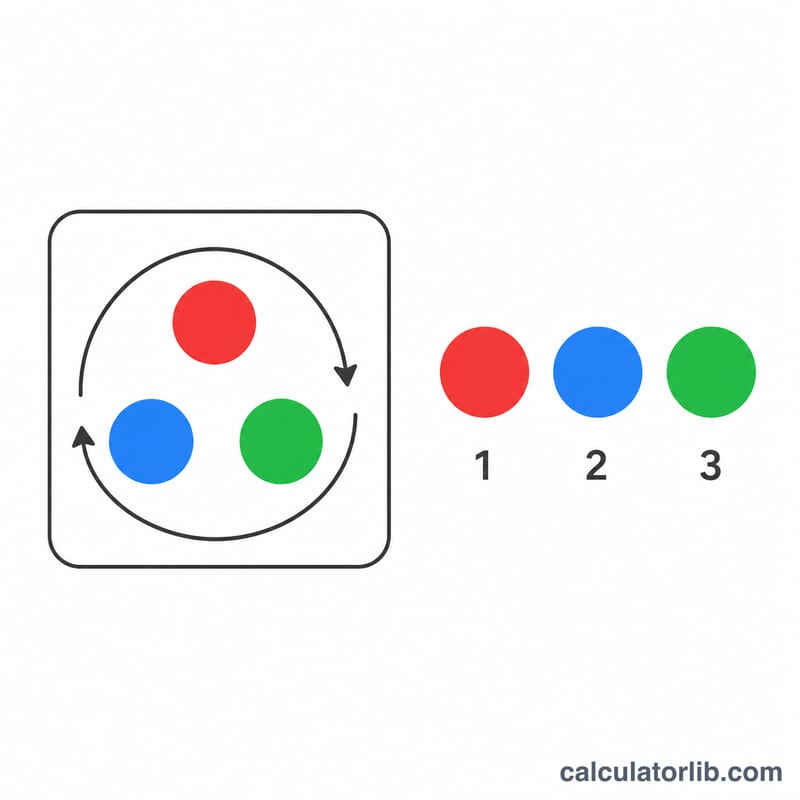
The combinations formula is $$C(n, r) = \frac{n!}{r!\,(n - r)!}.$$ Here \(n!\) ("n factorial") is the product of all whole numbers from 1 to n. Dividing by \(r!\) removes the duplicate orderings (combinations ignore order), and dividing by \((n - r)!\) accounts for the items left behind. Permutations use $$P(n, r) = \frac{n!}{(n - r)!},$$ which keeps order and therefore counts more arrangements: \(P(n, r) = C(n, r) \times r!\).
Worked Example
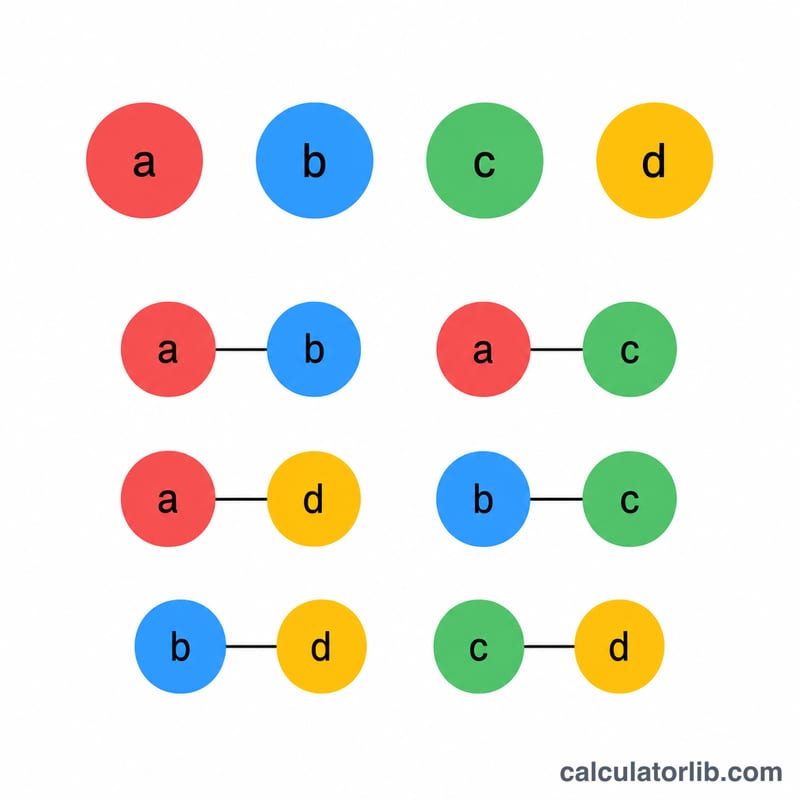
How many 2-person teams can you form from 5 people? $$C(5, 2) = \frac{5!}{2!\,\cdot\,3!} = \frac{120}{2 \cdot 6} = \frac{120}{12} = \mathbf{10}.$$ There are 10 possible pairs. By contrast, \(P(5, 2) = \frac{5!}{3!} = 20\), because order would matter (e.g. captain then deputy).
FAQ
What's the difference between combinations and permutations? Combinations ignore order ({A, B} = {B, A}); permutations count order ({A, B} ≠ {B, A}).
What is \(C(n, 0)\)? Always 1 — there is exactly one way to choose nothing.
Can r equal n? Yes. \(C(n, n) = 1\), the single way of taking the whole set.