
What Is Sensitivity?
Sensitivity, also called the true positive rate or recall, measures how well a test or classifier identifies actual positive cases. It answers the question: "Of all the people (or items) who truly have the condition, what fraction did the test correctly flag?" A high sensitivity means few positives are missed.
How to Use This Calculator
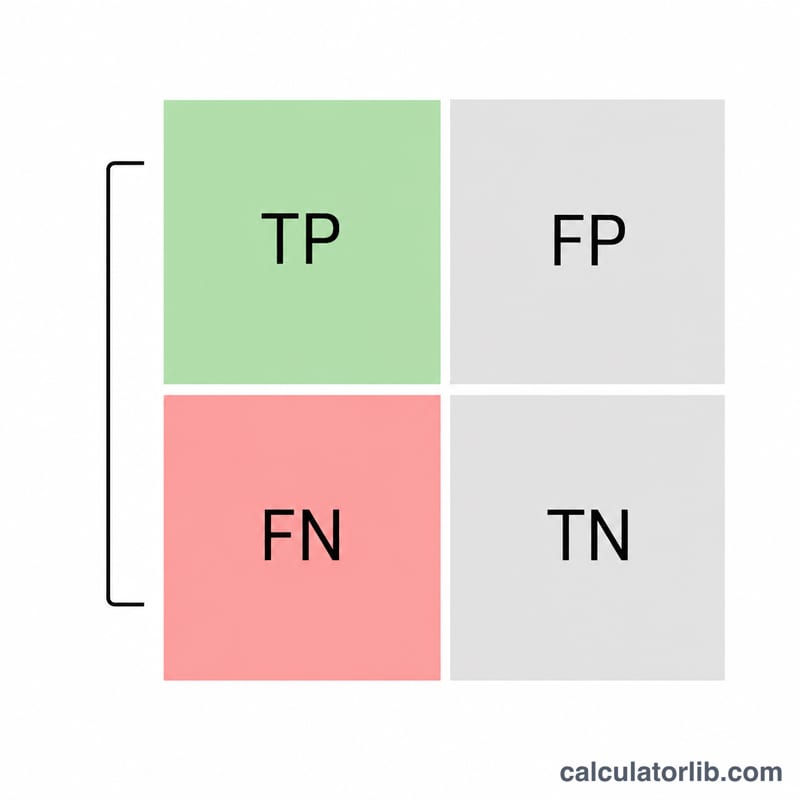
Enter the number of true positives (TP) — cases correctly identified as positive — and the number of false negatives (FN) — positive cases the test incorrectly labeled as negative. The calculator returns sensitivity as both a decimal (0–1) and a percentage.
The Formula Explained
$$\text{Sensitivity} = \frac{\text{TP}}{\text{TP} + \text{FN}} \times 100\%$$
The denominator \(\text{TP} + \text{FN}\) is the total number of actual positive cases. Dividing the correctly caught positives by all real positives gives the proportion the test successfully detects. The result ranges from 0 (catches none) to 1 (catches all).
Worked Example
Suppose a screening test correctly identifies 90 sick patients (TP = 90) but misses 10 sick patients (FN = 10). $$\text{Sensitivity} = \frac{90}{90 + 10} = \frac{90}{100} = 0.9 = 90\%$$ The test catches 90% of true cases.
FAQ
Is sensitivity the same as recall? Yes — in machine learning, recall and sensitivity are identical: \(\text{TP} / (\text{TP} + \text{FN})\).
What is the difference between sensitivity and specificity? Sensitivity measures the true positive rate, while specificity measures the true negative rate, \(\text{TN} / (\text{TN} + \text{FP})\). Together they describe a test's accuracy on positive and negative cases.
What is a good sensitivity value? It depends on context. Screening tests for serious diseases often aim for very high sensitivity (95%+) so few cases are missed, even at the cost of more false positives.