
What Is a Solenoid Inductance Calculator?
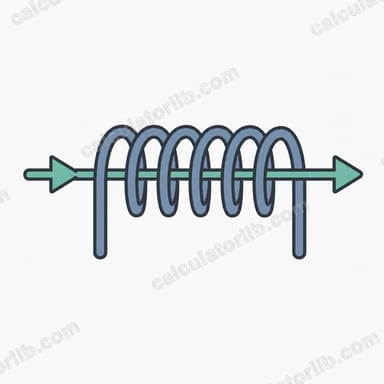
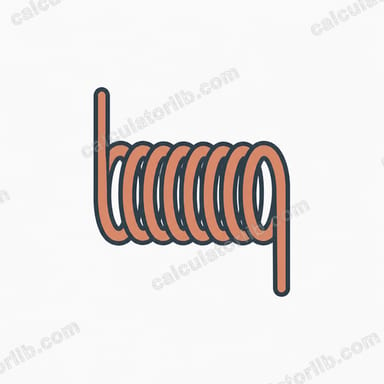
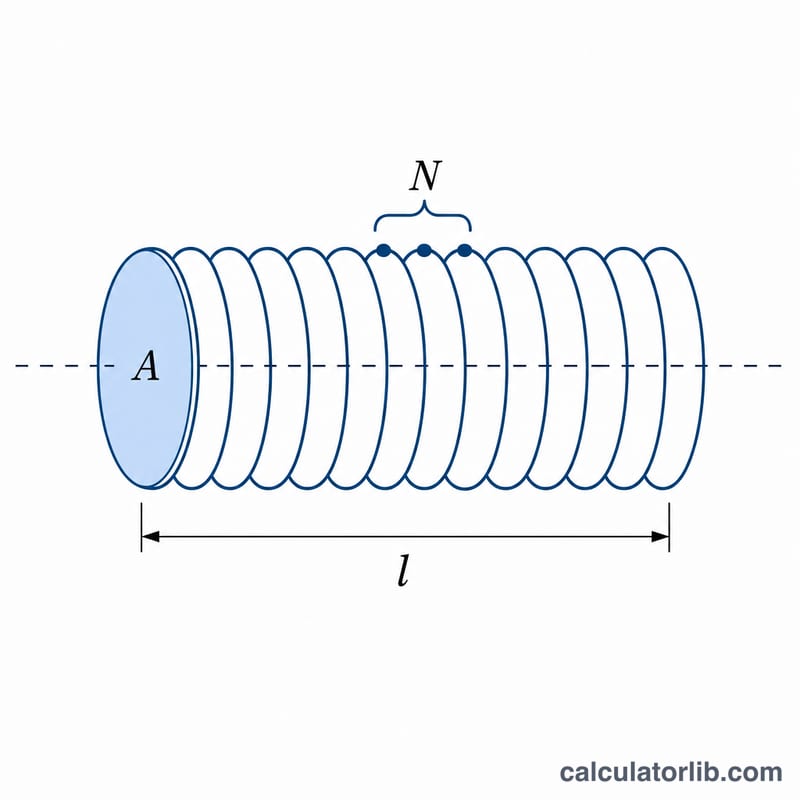
A solenoid is a coil of wire wound in a tight helix. When current flows through it, it stores energy in a magnetic field — a property quantified by its inductance (L), measured in henries (H). This calculator estimates the inductance of a long, air-core solenoid from three simple geometric quantities: the number of turns, the cross-sectional area, and the length of the coil.
How to Use It
Enter the number of turns of wire (N), the cross-sectional area of the coil in square metres (A), and the overall length of the winding in metres (l). The calculator returns the inductance in henries, and also converts it to millihenries (mH) and microhenries (µH) for convenience.
The Formula Explained
The inductance is given by:
$$L = \frac{\mu_0 \, \text{N}^{2} \cdot \text{A}}{\text{l}}$$
Here \(\mu_0 = 4\pi \times 10^{-7}\) H/m is the permeability of free space. Inductance grows with the square of the turns, increases with a larger cross-section, and decreases as the coil is stretched longer. This "ideal solenoid" formula assumes the length is much greater than the diameter and that the core is non-magnetic (air). For ferromagnetic cores, multiply by the relative permeability \(\mu_r\).
Worked Example
Suppose a coil has N = 100 turns, a cross-sectional area A = 0.001 m², and a length l = 0.1 m. Then:
$$L = \frac{(4\pi \times 10^{-7})(100^{2})(0.001)}{0.1} = \frac{(1.2566 \times 10^{-6})(10000)(0.001)}{0.1} \approx 1.2566 \times 10^{-4} \text{ H} \approx 0.1257 \text{ mH} \approx 125.7 \text{ µH}.$$
FAQ
Does this work for iron-core coils? Not directly. This formula is for air cores. Multiply the result by the core's relative permeability for magnetic cores.
What units should I use? Use SI units — square metres for area and metres for length — to get inductance in henries.
Why does it require a long coil? The formula assumes a uniform internal field, which holds best when the length is much larger than the diameter. Short coils have edge effects that reduce inductance.