
What is Coulomb's Law?
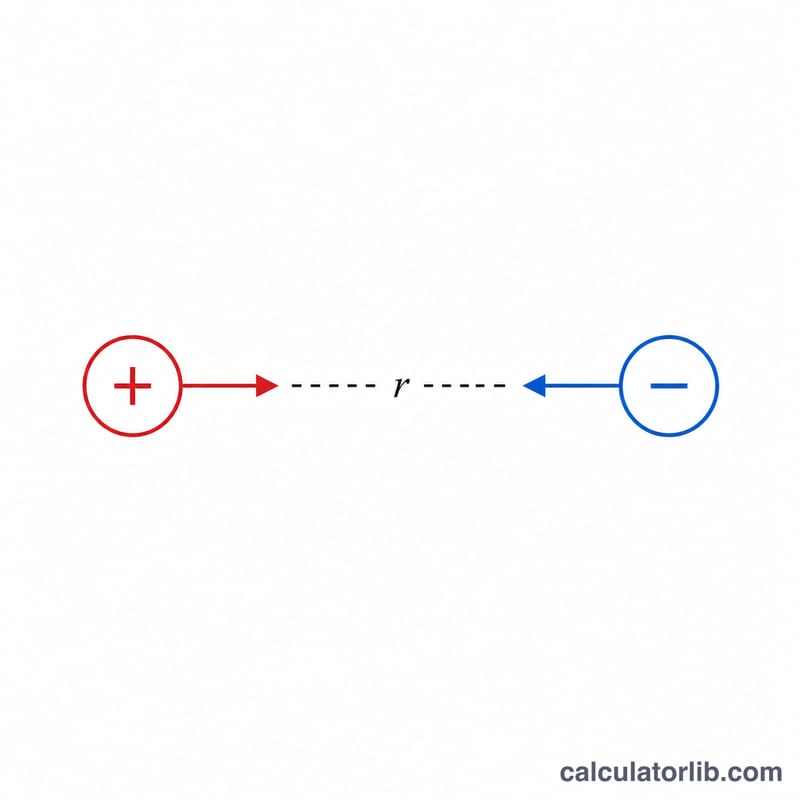
Coulomb's law describes the electrostatic force between two stationary, electrically charged point particles. The magnitude of the force is directly proportional to the product of the two charges and inversely proportional to the square of the distance between them. This calculator computes that force in Newtons given the two charge values (in Coulombs) and their separation (in meters). It is a universal physics tool that applies anywhere.
How to use this calculator
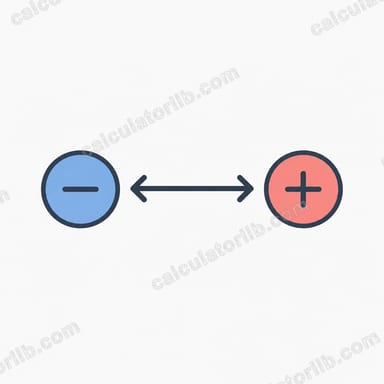
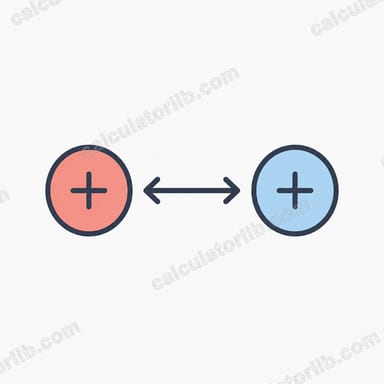
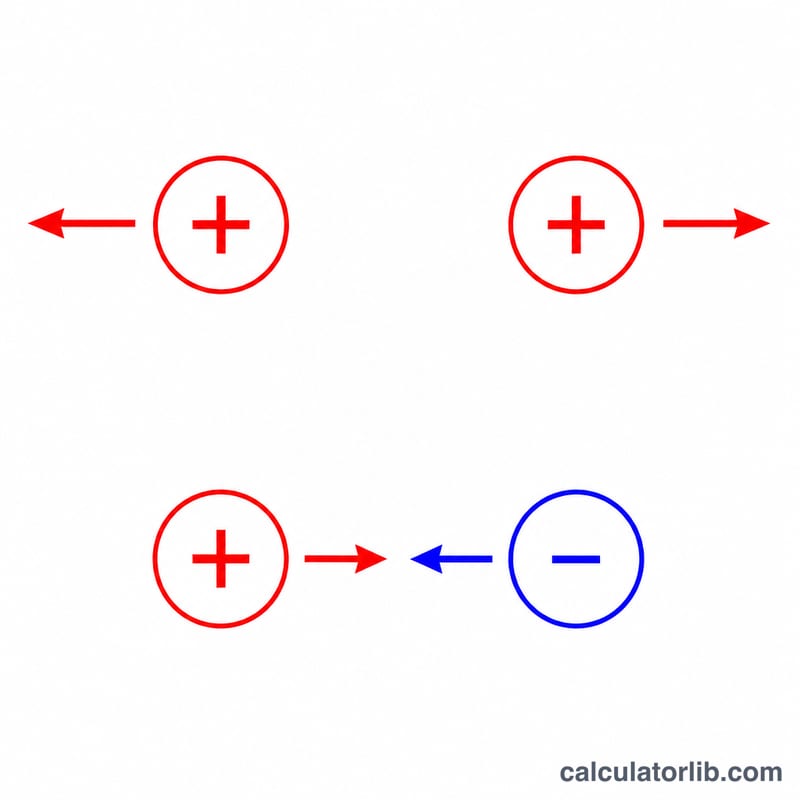
Enter the first charge (q₁) and second charge (q₂) in Coulombs — use scientific values such as 0.000001 for 1 microcoulomb (µC) — and the distance r between them in meters. The calculator returns the force magnitude and tells you whether the interaction is repulsive (like charges) or attractive (opposite charges). A positive product of charges yields a repulsive force; a negative product yields attraction.
The formula explained
The equation is $$F = k \cdot \frac{q_1 \cdot q_2}{r^{2}}$$ where \(k = 8.9875517873681764 \times 10^{9}\ \text{N}\cdot\text{m}^2/\text{C}^2\) is Coulomb's constant in a vacuum. Because the distance appears squared in the denominator, doubling the separation reduces the force to one quarter of its original value — an inverse-square relationship similar to gravity.
Worked example
Suppose two charges of \(q_1 = 1\ \mu\text{C}\) (\(1 \times 10^{-6}\ \text{C}\)) and \(q_2 = 1\ \mu\text{C}\) are placed 0.1 m apart. Then $$F = (8.9875517873681764 \times 10^{9}) \times \frac{1 \times 10^{-6} \times 1 \times 10^{-6}}{0.1^{2}} = 8.9875517873681764 \times 10^{9} \times \frac{1 \times 10^{-12}}{0.01} = 0.898755\ldots\ \text{N}$$ The force is repulsive because both charges are positive.
FAQ
What units should I use? Charges in Coulombs (C) and distance in meters (m) give a force in Newtons (N). Convert microcoulombs to Coulombs by multiplying by \(10^{-6}\).
What does a negative result mean? A negative sign indicates an attractive force, which occurs when the two charges have opposite signs. The magnitude row shows the absolute strength.
Does this account for a medium? No — this uses the vacuum (free-space) value of \(k\). In a dielectric medium you would divide by the relative permittivity.