
What Is the Conductivity to Resistivity Calculator?
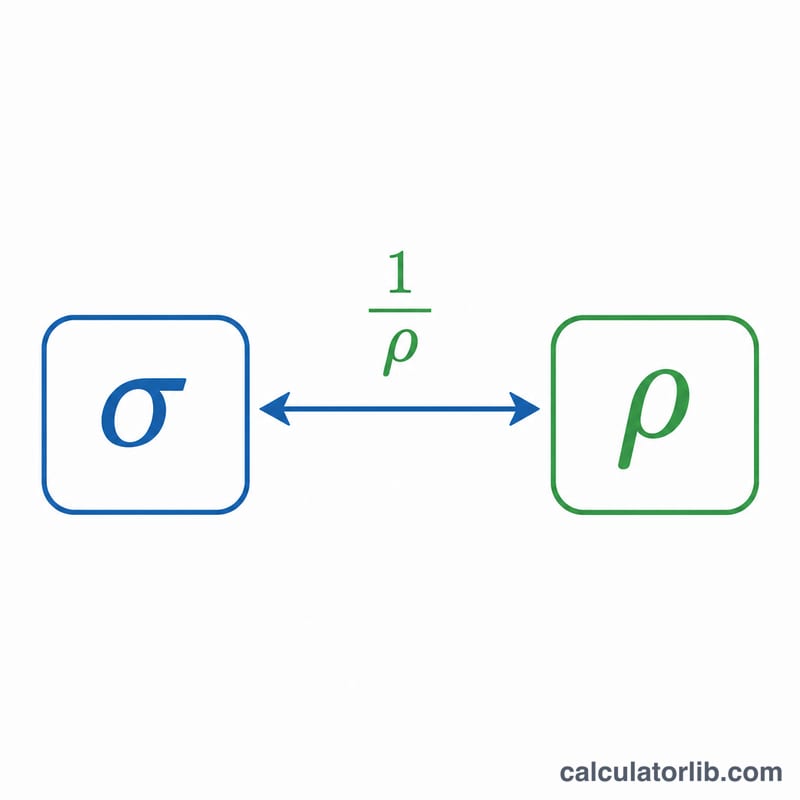
This calculator converts a material's electrical conductivity (σ, measured in siemens per metre, S/m) into its electrical resistivity (ρ, measured in ohm-metres, Ω·m). Conductivity describes how readily a material allows electric current to flow, while resistivity describes how strongly it opposes that flow. The two are exact reciprocals of one another, so the conversion is a simple division.
How to Use It
Enter the conductivity value in S/m and the calculator returns the resistivity in Ω·m. Scientific notation is accepted, so a value like 5.96e7 (copper) works directly. The result updates the moment you submit.
The Formula Explained
The relationship is:
$$\rho = \frac{1}{\sigma}$$
where \(\rho\) is resistivity in Ω·m and \(\sigma\) is conductivity in S/m. Because they are reciprocals, a highly conductive material (large \(\sigma\)) has a very small resistivity, and an insulator (tiny \(\sigma\)) has an enormous resistivity. The calculator guards against division by zero — a conductivity of exactly zero would correspond to a perfect insulator with infinite resistivity.
Worked Example
Copper has a conductivity of about \(\sigma = 5.96 \times 10^{7}\) S/m. Its resistivity is:
$$\rho = \frac{1}{5.96 \times 10^{7}} \approx 1.678 \times 10^{-8} \ \Omega\cdot\text{m}$$
This matches the textbook value for copper at room temperature (~\(1.68 \times 10^{-8}\) Ω·m), confirming why copper is such an excellent conductor for wiring.
FAQ
What units does this use? Conductivity in siemens per metre (S/m) and resistivity in ohm-metres (Ω·m), the SI standard units.
Can I go the other way? Yes — resistivity to conductivity uses the same reciprocal relationship, \(\sigma = 1/\rho\).
Does temperature matter? Both conductivity and resistivity change with temperature. This calculator converts whatever value you provide; supply the value measured at your temperature of interest.