
What Is Inductive Reactance?
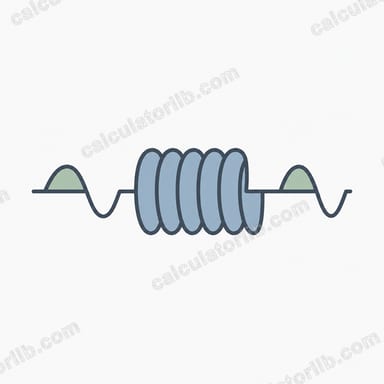
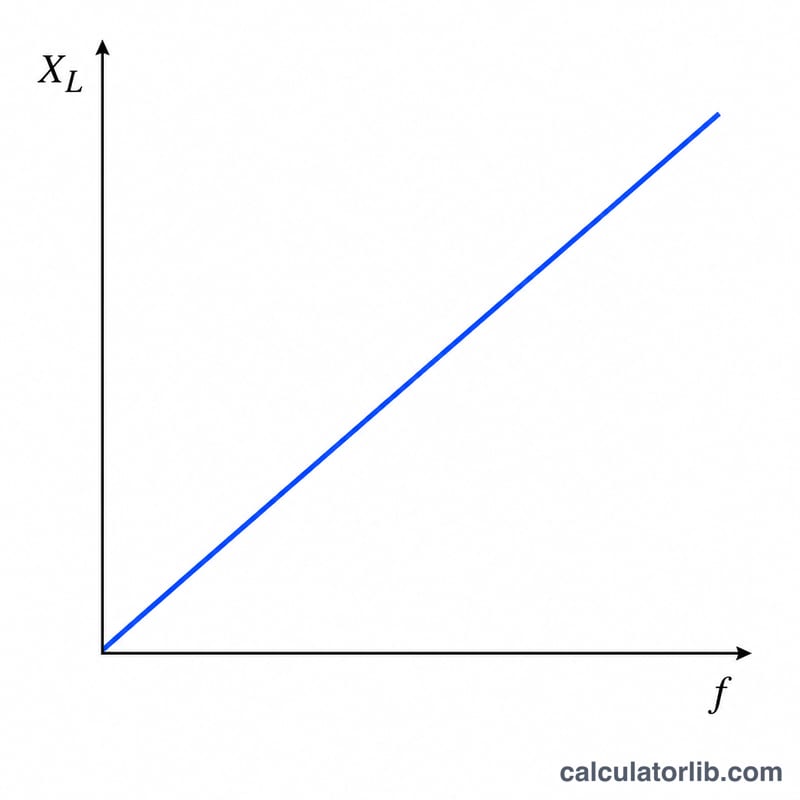
Inductive reactance (\(X_L\)) is the opposition that an inductor presents to alternating current (AC). Unlike resistance, reactance depends on frequency: the higher the frequency of the signal, the more an inductor "resists" the changing current. It is measured in ohms (Ω), just like resistance, but it arises from the inductor's tendency to oppose changes in current rather than from dissipation of energy.
How to Use This Calculator
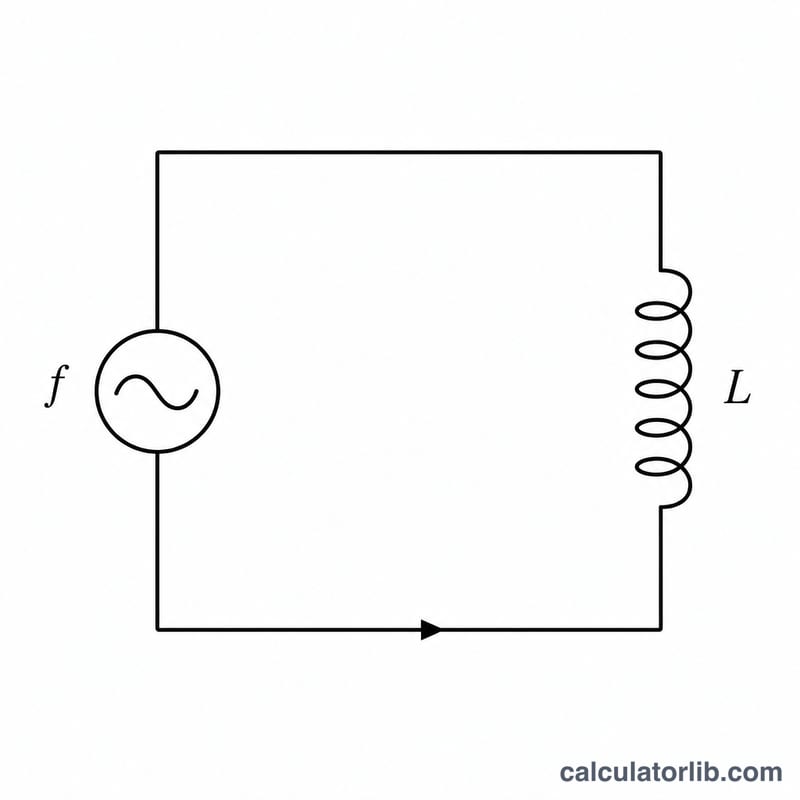
Enter the AC frequency in hertz (Hz) and the inductance in henries (H). The calculator returns the inductive reactance in ohms. For a 100 mH coil, enter 0.1 H. For a 47 µH coil, enter 0.000047 H. Common mains frequencies are 50 Hz or 60 Hz, while RF circuits may use thousands or millions of hertz.
The Formula Explained
The reactance is given by $$X_L = 2\pi f L$$ where f is frequency in hertz and L is inductance in henries. The term \(2\pi f\) converts ordinary frequency into angular frequency (\(\omega\), in radians per second), so the formula is equivalently \(X_L = \omega L\). Because reactance scales directly with both frequency and inductance, doubling either value doubles the reactance.
Worked Example
Suppose a 0.1 H inductor operates at 60 Hz. Then $$X_L = 2 \times \pi \times 60 \times 0.1 = 37.699 \ \Omega$$ At 50 Hz the same coil would have $$X_L = 2 \times \pi \times 50 \times 0.1 = 31.416 \ \Omega$$ showing how reactance rises with frequency.
FAQ
Does inductive reactance consume power? No. An ideal inductor stores and returns energy each cycle, so it dissipates no real power — only reactive power flows.
What happens at DC (0 Hz)? With \(f = 0\), \(X_L = 0\), meaning an ideal inductor behaves like a short circuit to direct current.
How does this differ from capacitive reactance? Inductive reactance increases with frequency, while capacitive reactance (\(X_C = \frac{1}{2\pi f C}\)) decreases with frequency.