
What is the Age-Adjusted D-dimer Calculator?
D-dimer is a blood test used to help rule out venous thromboembolism (VTE), including deep vein thrombosis (DVT) and pulmonary embolism (PE). Because D-dimer levels naturally rise with age, the traditional fixed cutoff (500 ng/mL FEU) produces many false positives in older patients. The age-adjusted cutoff raises the threshold for patients older than 50, increasing specificity without meaningfully sacrificing sensitivity. This tool is a clinical decision aid and does not replace physician judgment.
How to use it
Enter the patient's age in years and choose your laboratory's assay units (FEU or DDU). The calculator returns the age-adjusted cutoff, the standard cutoff for comparison, and the increase. A D-dimer result below the calculated cutoff — combined with a low or moderate clinical pretest probability (e.g., a non-high Wells score) — supports excluding VTE without imaging.
The formula explained
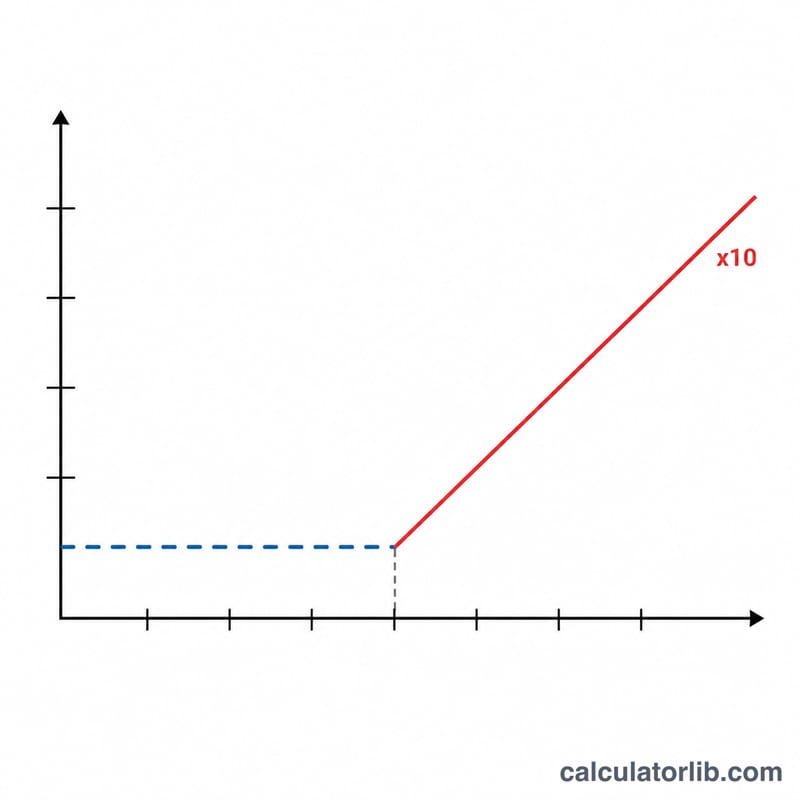
For patients over 50 the cutoff in FEU is simply age × 10 ng/mL:
$$\text{Cutoff (ng/mL FEU)} = \text{Age} \times 10 \quad (\text{age} > 50)$$So a 75-year-old has a cutoff of 750 ng/mL instead of 500 ng/mL. For assays reported in DDU (where the conventional cutoff is 250 ng/mL), the equivalent scaling is \(\text{Cutoff}_{DDU} = \text{Age} \times 5\). Patients aged 50 or younger keep the standard cutoff.
Worked example
A 70-year-old patient using an FEU assay:
$$\text{Cutoff} = 70 \times 10 = 700 \text{ ng/mL}$$The standard cutoff is 500 ng/mL, so the age-adjusted threshold is 200 ng/mL higher. A measured D-dimer of 650 ng/mL — abnormal by the old standard — falls below the age-adjusted cutoff, helping avoid unnecessary CT angiography.
Interpreting Your Result
The age-adjusted D-dimer cutoff is designed to be used after a clinician has established that a patient has a low or moderate (non-high) clinical pretest probability of venous thromboembolism (VTE) using a validated tool such as the Wells score or the revised Geneva score. The D-dimer value should never be interpreted in isolation.
D-dimer below the cutoff
For a patient older than 50, the cutoff is calculated as age \(\times\) 10 ng/mL FEU. For example, a 75-year-old patient has an age-adjusted cutoff of 750 ng/mL FEU, compared with the fixed conventional cutoff of 500 ng/mL FEU. A D-dimer result at or below this cutoff, combined with a non-high pretest probability, makes acute VTE highly unlikely and generally allows VTE to be ruled out without imaging. This is the central benefit: more older patients can safely avoid CT pulmonary angiography or compression ultrasound.
D-dimer above the cutoff
A result above the age-adjusted cutoff is not a diagnosis of VTE. D-dimer is highly sensitive but poorly specific — it rises with age, infection, inflammation, malignancy, trauma, surgery, pregnancy and many other conditions. An elevated value simply means VTE cannot be excluded on clinical grounds alone, so it warrants definitive imaging (CT pulmonary angiography for suspected PE, or venous ultrasound for suspected DVT) to confirm or refute the diagnosis.
Where this applies
The age-adjusted threshold is validated only for patients older than 50 years who have a low or moderate (non-high) pretest probability. In patients with a high pretest probability, D-dimer should not be used to rule out VTE at any threshold — proceed directly to imaging. For patients aged 50 or younger, the conventional 500 ng/mL FEU cutoff applies.
Evidence base
This approach is supported by the prospective multicenter ADJUST-PE study (Righini et al., JAMA, 2014), which demonstrated that combining an age-adjusted D-dimer cutoff with non-high clinical probability increased the proportion of older patients in whom PE could be excluded while maintaining a low (acceptable) rate of subsequent VTE on follow-up. Subsequent guidelines and meta-analyses have echoed these findings.
Important: This calculator is a clinical decision aid intended to support, not replace, the judgment of a qualified clinician. It is general information and not medical advice. Always interpret results in the full clinical context and follow local protocols and the assessment of the treating physician.
Key Terms Explained
- D-dimer
- A protein fragment produced when a blood clot (fibrin) is broken down in the body. Elevated levels suggest active clot formation and breakdown but are non-specific, rising in many conditions besides thrombosis.
- VTE (Venous Thromboembolism)
- An umbrella term for blood clots that form in the venous system, encompassing both deep vein thrombosis and pulmonary embolism.
- DVT (Deep Vein Thrombosis)
- A blood clot that forms in a deep vein, most commonly in the legs. It can cause pain and swelling and may dislodge to cause a pulmonary embolism.
- PE (Pulmonary Embolism)
- A blockage of an artery in the lungs, usually caused by a clot that has traveled from a deep vein. It is a potentially life-threatening form of VTE.
- FEU (Fibrinogen Equivalent Units)
- One of two common units for reporting D-dimer. The age-adjusted formula (age \(\times\) 10 ng/mL) is expressed in FEU, where the conventional cutoff is 500 ng/mL.
- DDU (D-Dimer Units)
- The alternative reporting unit. DDU values are roughly half the corresponding FEU values (the conventional cutoff is approximately 250 ng/mL DDU), so it is essential to know which unit your laboratory reports.
- Sensitivity
- The ability of a test to correctly identify patients who have the disease (true positives). A highly sensitive test like D-dimer rarely misses VTE, making a negative result reliable for ruling it out.
- Specificity
- The ability of a test to correctly identify patients who do not have the disease (true negatives). D-dimer has low specificity, meaning many positive results occur in patients without VTE. Age-adjustment improves specificity in older patients.
- Pretest Probability
- The estimated likelihood that a patient has the condition before a diagnostic test is performed, based on clinical findings. It is usually categorized as low, moderate, or high using a scoring system.
- Wells Score
- A validated clinical prediction rule that combines signs, symptoms, and risk factors to estimate the pretest probability of DVT or PE, helping decide whether D-dimer testing or imaging is appropriate.
FAQ
Does it apply to everyone? The adjustment is validated for patients older than 50 with a non-high clinical pretest probability. Patients 50 and under use the standard cutoff.
FEU vs DDU? Fibrinogen equivalent units (FEU) use a 500 ng/mL baseline; D-dimer units (DDU) use 250 ng/mL. Check your lab report and choose the matching option.
Is a low D-dimer enough to exclude PE? Only when combined with a low/moderate pretest probability. High-probability patients need imaging regardless of D-dimer.