
What this calculator does
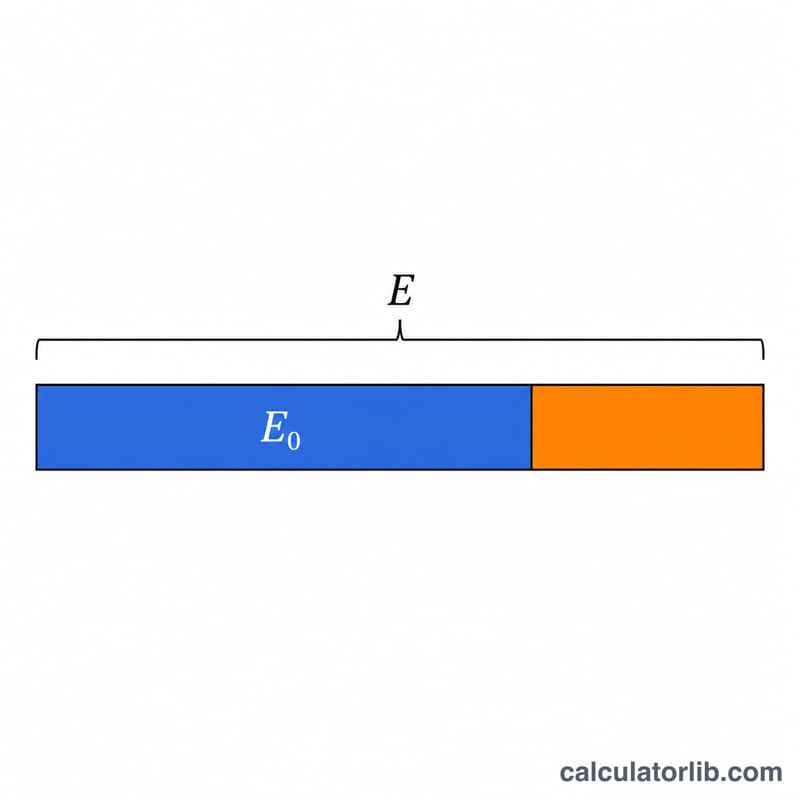
This tool applies Albert Einstein's special theory of relativity to find the energy of an object given its rest mass and speed. From a rest mass \(m_0\) (in kilograms) and a relative velocity \(v\) (in km/s), it returns four results: the rest energy \(E_0\), the total relativistic energy \(E\), the energy ratio \(E/E_0\) (which equals the Lorentz factor gamma), and the velocity expressed as a fraction of the speed of light, \(v/c\). The speed of light is fixed at \(c = 299{,}792.458\) km/s (299,792,458 m/s). This is universal physics and applies everywhere, no country scope.
How to use it
Enter the rest mass in kilograms and the relative velocity in km/s. The velocity must not exceed the speed of light. Energies are reported in megajoules (MJ), where 1 MJ = 1,000,000 joules. Internally the velocity is converted to m/s by multiplying by 1000, and all energies are computed in joules before being divided by 1e6 for display.
The formula explained
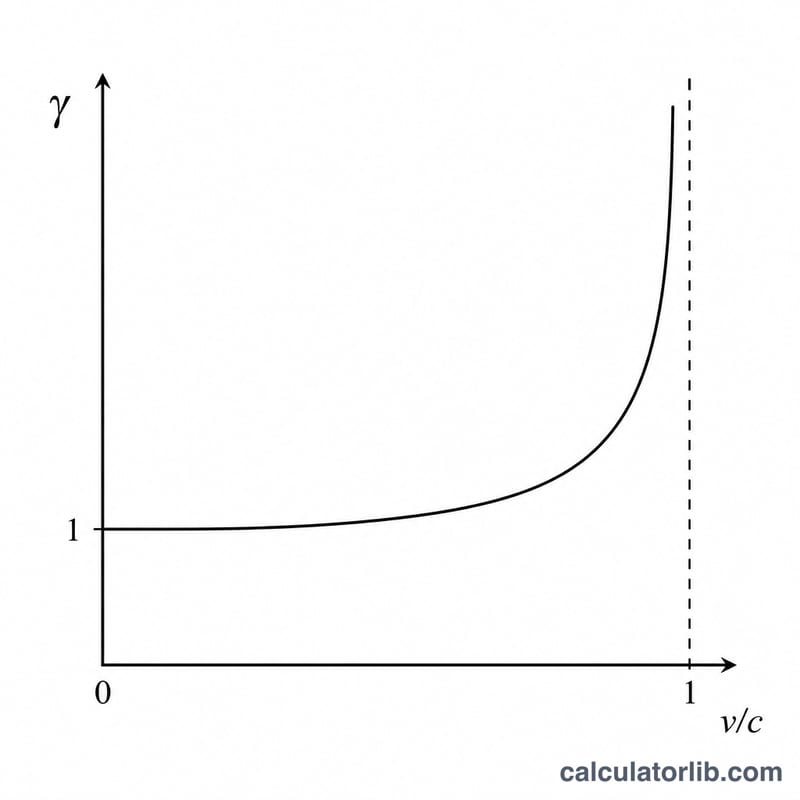
The rest energy is the famous $$E_0 = m_0 c^2.$$ When a body moves, its total energy grows by the Lorentz factor $$\gamma = \frac{1}{\sqrt{1 - v^2/c^2}},$$ so the total relativistic energy is $$E = \gamma\, m_0 c^2.$$ Because the ratio \(E/E_0\) cancels \(m_0\) and \(c^2\), it is exactly \(\gamma\). As \(v\) approaches \(c\), the term under the square root approaches zero and \(\gamma\) diverges toward infinity, reflecting the fact that no massive object can reach the speed of light.
Worked example
Take \(m_0 = 1\) kg and \(v = 200{,}000\) km/s. Then \(\beta = v/c = 200000 / 299792.458 = 0.667128\), so \(\beta^2 = 0.445060\) and \(1 - \beta^2 = 0.554940\). The Lorentz factor is $$\gamma = \frac{1}{\sqrt{0.554940}} = 1.342385.$$ Rest energy $$E_0 = 1 \times (299792458)^2 = 8.9876 \times 10^{16}\ \text{J} = 89{,}875{,}517{,}874\ \text{MJ}.$$ Total energy $$E = 1.342385 \times E_0 = 120{,}649{,}140{,}000\ \text{MJ}.$$ The ratio \(E/E_0\) is \(1.342385\) and \(v/c = 66.71\,\%\).
FAQ
Why is the energy ratio the same as the Lorentz factor? Because \(E = \gamma\, E_0\), dividing gives \(E/E_0 = \gamma\) exactly.
What happens at \(v = c\)? The denominator becomes zero and \(\gamma\) is infinite, so the calculator caps the ratio at infinity; physically a massive body cannot reach light speed.
What if rest mass is zero? Then \(E_0\) and \(E\) are both zero; the ratio is mathematically undefined (0/0), but the displayed ratio still shows the Lorentz factor \(\gamma\).