
What Is the Absolute Lymphocyte Count?
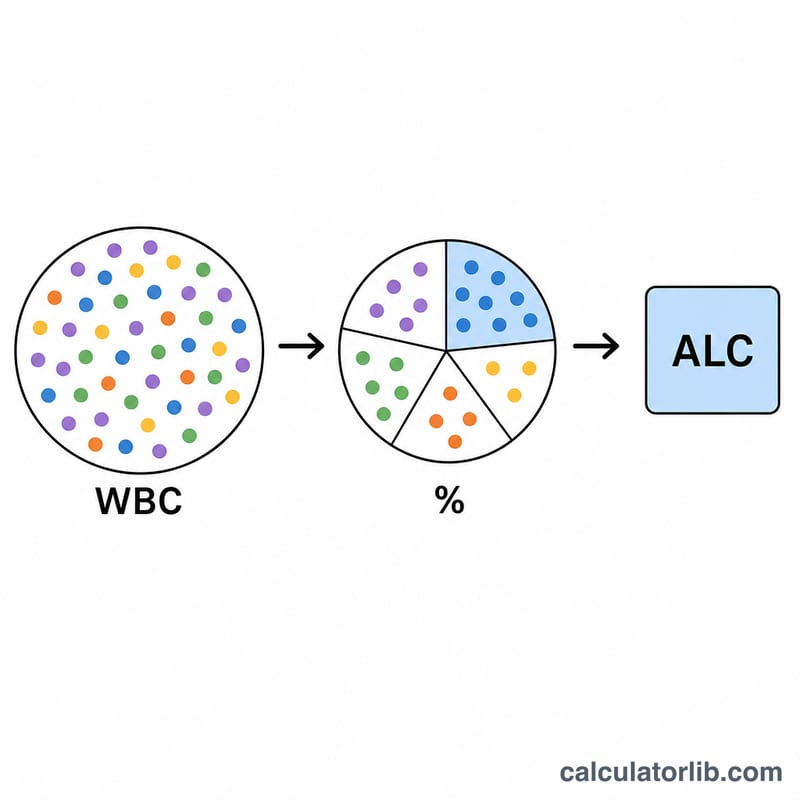
The Absolute Lymphocyte Count (ALC) is the actual number of lymphocytes — a type of white blood cell crucial to immune defense — circulating in a given volume of blood, usually expressed as cells per microliter (cells/µL). While a complete blood count (CBC) reports lymphocytes as a percentage of total white blood cells, the absolute number is far more clinically meaningful. This calculator converts that percentage into a true count using your WBC and lymphocyte percentage.
How to Use This Calculator
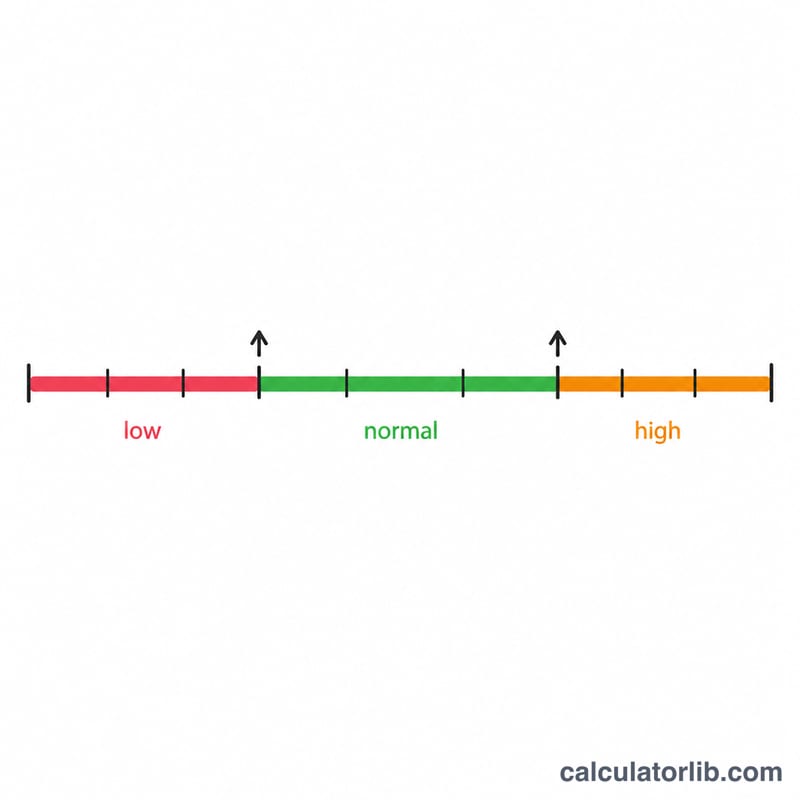
Enter your total white blood cell (WBC) count in cells/µL and the lymphocyte percentage reported on your CBC differential. The calculator multiplies the two values and divides by 100 to return your ALC, then compares it against typical reference ranges.
The Formula Explained
$$\text{ALC} = \text{WBC} \times \dfrac{\text{Lymphocyte \%}}{100}$$ For example, if the lab reports lymphocytes as a fraction of the total white cells, multiplying that fraction by the total restores the actual count. The general adult reference range is roughly 1,000–4,800 cells/µL; values below 1,000 suggest lymphocytopenia and values above 4,800 suggest lymphocytosis.
Worked Example
Suppose a patient has a WBC count of 7,000 cells/µL and lymphocytes make up 30% of the differential. $$\text{ALC} = 7{,}000 \times \dfrac{30}{100} = 2{,}100 \text{ cells/µL}$$ — within the normal range.
ALC Reference Ranges by Category
The Absolute Lymphocyte Count (ALC) is derived from the white blood cell (WBC) count and the lymphocyte percentage reported on a complete blood count (CBC) differential. The formula is:
$$\text{ALC} = \text{WBC (cells/µL)} \times \frac{\text{Lymphocyte \%}}{100}$$
The table below summarizes commonly cited adult interpretive categories along with typical age-adjusted reference ranges. Lymphocyte counts are notably higher in infants and young children than in adults, so age-specific ranges should always be used for pediatric patients.
| Category / Age group | ALC range (cells/µL) | Notes |
|---|---|---|
| Lymphocytopenia (adult) | < 1,000 | Low lymphocyte count |
| Normal (adult) | 1,000 – 4,800 | Reference interval varies slightly by lab |
| Lymphocytosis (adult) | > 4,800 | Elevated lymphocyte count |
| Newborn (0–1 month) | 2,000 – 11,000 | Lymphocyte-predominant differential |
| Infant (1–12 months) | 4,000 – 10,500 | Peaks in first year of life |
| Child (1–6 years) | 2,000 – 8,000 | Gradually declines with age |
| Child (6–12 years) | 1,500 – 5,000 | Approaching adult values |
| Adolescent / adult | 1,000 – 4,800 | Adult reference interval |
Worked example: for a WBC of 7,000 cells/µL with 35% lymphocytes, the ALC is \(7{,}000 \times \tfrac{35}{100} = \) 2,450 cells/µL, which falls within the adult normal range.
Reference ranges are approximate and differ between laboratories, analyzers, and patient populations. Always interpret ALC against the reference interval printed on your own laboratory report.
Interpreting Your ALC Result
The ALC reflects the number of circulating lymphocytes — the white blood cells primarily responsible for adaptive immunity. Results are generally grouped into three categories in adults.
Lymphocytopenia (ALC < 1,000 cells/µL)
A low ALC indicates a reduced number of circulating lymphocytes. It is commonly associated with acute infections (including viral illnesses such as influenza and COVID-19), corticosteroid or immunosuppressive therapy, chemotherapy and radiation, malnutrition, autoimmune disorders, and advanced HIV infection. A persistently low ALC may signal impaired immune defense and increased infection risk. Severe lymphocytopenia is sometimes defined as < 500 cells/µL.
Normal (ALC 1,000 – 4,800 cells/µL)
An ALC within the reference interval generally reflects a normal circulating lymphocyte population. A normal count does not, by itself, rule out disease, since functional or subset-specific immune abnormalities (for example, low CD4+ T cells) may not change the total count.
Lymphocytosis (ALC > 4,800 cells/µL)
An elevated ALC is most often a reactive response to viral infections (such as Epstein–Barr virus, cytomegalovirus, or pertussis) and is common and transient in children. Persistent or marked lymphocytosis, particularly in older adults, may warrant evaluation for lymphoproliferative disorders such as chronic lymphocytic leukemia (CLL). The clinical significance depends on the degree of elevation, its duration, the appearance of the cells on the blood smear, and the overall clinical picture.
The ALC is sometimes combined with the neutrophil count to form the neutrophil-to-lymphocyte ratio (NLR), an inflammatory marker. For example, with 4,200 neutrophils and 2,450 lymphocytes per µL, the NLR is approximately 1.71.
Disclaimer: This information is general and educational only and is not a diagnosis or medical advice. ALC must be interpreted by a qualified clinician alongside your symptoms, history, full CBC, and other tests. Consult your healthcare provider about any abnormal result.
Key Terms Defined
- Lymphocyte
- A type of white blood cell central to the adaptive immune response, including T cells, B cells, and natural killer (NK) cells. Lymphocytes fight infection and produce antibodies.
- White Blood Cell (WBC)
- The total count of all leukocytes (neutrophils, lymphocytes, monocytes, eosinophils, and basophils) per microliter of blood. WBC is the starting value for calculating any absolute differential count.
- CBC Differential
- The portion of a complete blood count that reports the proportion (percentage) of each white blood cell type. Multiplying a cell type's percentage by the total WBC yields its absolute count.
- Absolute Lymphocyte Count (ALC)
- The actual number of lymphocytes per microliter of blood, calculated as WBC multiplied by the lymphocyte percentage divided by 100. It is more clinically useful than the percentage alone.
- Lymphocytopenia (Lymphopenia)
- An abnormally low ALC, generally below 1,000 cells/µL in adults, indicating fewer circulating lymphocytes than expected.
- Lymphocytosis
- An abnormally high ALC, generally above 4,800 cells/µL in adults, indicating more circulating lymphocytes than expected.
- cells/µL
- Cells per microliter — the standard unit for blood cell concentration. One microliter (µL) equals one cubic millimeter (mm³), so cells/µL and cells/mm³ are equivalent. 1,000 cells/µL also equals \(1.0 \times 10^9\) cells/L.
FAQ
Why use the absolute count instead of the percentage? A normal percentage can mask an abnormal count if the total WBC is high or low, so the absolute value gives a clearer picture of immune status.
What is a low ALC? An ALC under about 1,000 cells/µL is generally considered lymphocytopenia and may warrant clinical follow-up.
Is this a medical diagnosis? No. This tool is for educational and informational purposes. Always interpret lab values with a qualified healthcare professional.