
What This Calculator Does
This tool computes the magnetic force exerted on a straight, current-carrying wire placed in a uniform magnetic field. When charges move through a conductor that sits in a magnetic field, the field pushes on those moving charges, producing a net force on the wire. The relationship is one of the foundational equations of electromagnetism and powers everything from electric motors to loudspeakers.
The Formula Explained
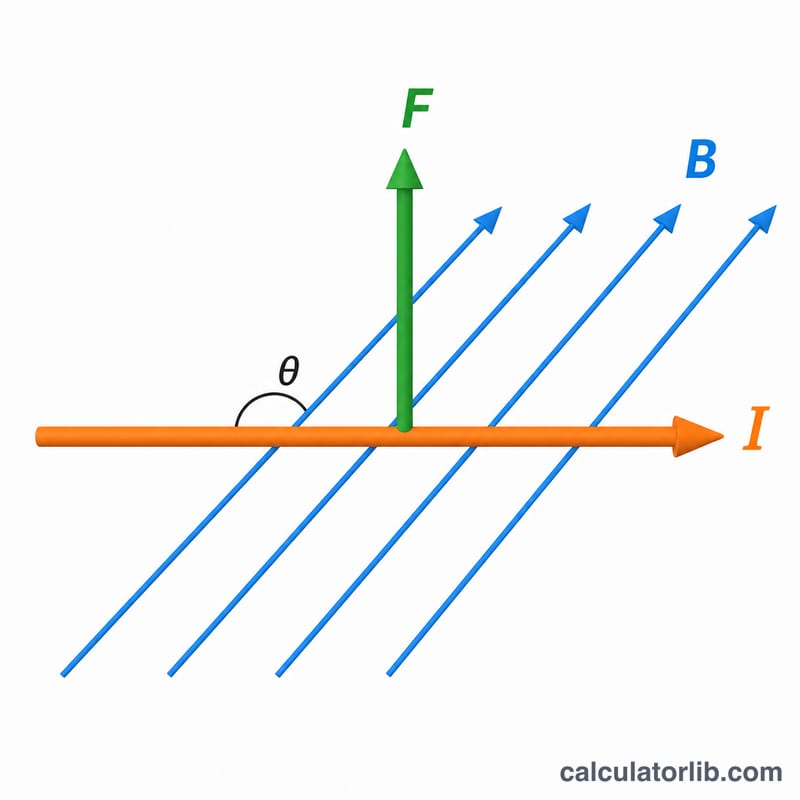
The force is given by $$F = \text{B} \cdot \text{I} \cdot \text{L} \cdot \sin\!\left(\theta\right)$$ where:
• B is the magnetic flux density in teslas (T).
• I is the current flowing through the wire in amperes (A).
• L is the length of wire inside the field in meters (m).
• θ is the angle between the direction of the current and the magnetic field.
The force is maximum when the wire is perpendicular to the field (\(\theta = 90°\), \(\sin\theta = 1\)) and zero when the wire runs parallel to the field (\(\theta = 0°\)). The resulting force is measured in newtons (N).
How to Use It
Enter the magnetic flux density, the current, the length of wire in the field, and the angle between the wire and the field lines. The calculator returns the force in newtons and shows the value of \(\sin(\theta)\) used in the computation.
Worked Example
Suppose \(B = 0.5\ \text{T}\), \(I = 10\ \text{A}\), \(L = 2\ \text{m}\), and \(\theta = 90°\). Then \(\sin(90°) = 1\), so $$F = 0.5 \times 10 \times 2 \times 1 = \textbf{10 N}$$ If the wire were tilted to 30°, \(\sin(30°) = 0.5\), giving $$F = 0.5 \times 10 \times 2 \times 0.5 = 5\ \text{N}$$
FAQ
What direction does the force point? The force is perpendicular to both the current and the magnetic field, determined by the right-hand rule (or left-hand rule for conventional current and field).
Why is the force zero when the wire is parallel to the field? Because \(\sin(0°) = 0\) — there is no component of motion across the field lines to be deflected.
Can I use it for a coil or loop? This calculator handles a single straight segment. For a coil, multiply by the number of turns and account for the geometry of each segment.