
What is 3×3 Matrix Multiplication?
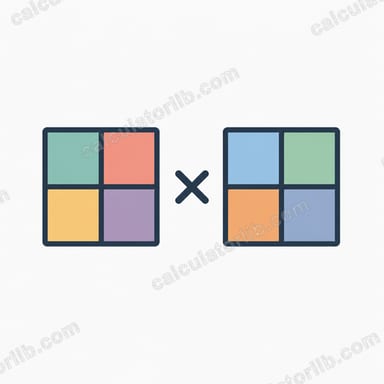
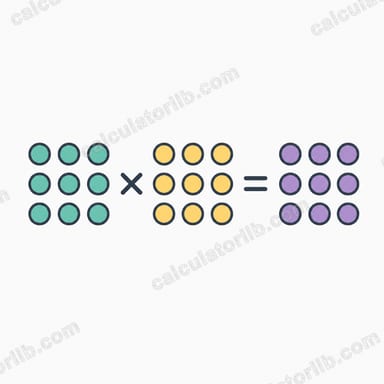
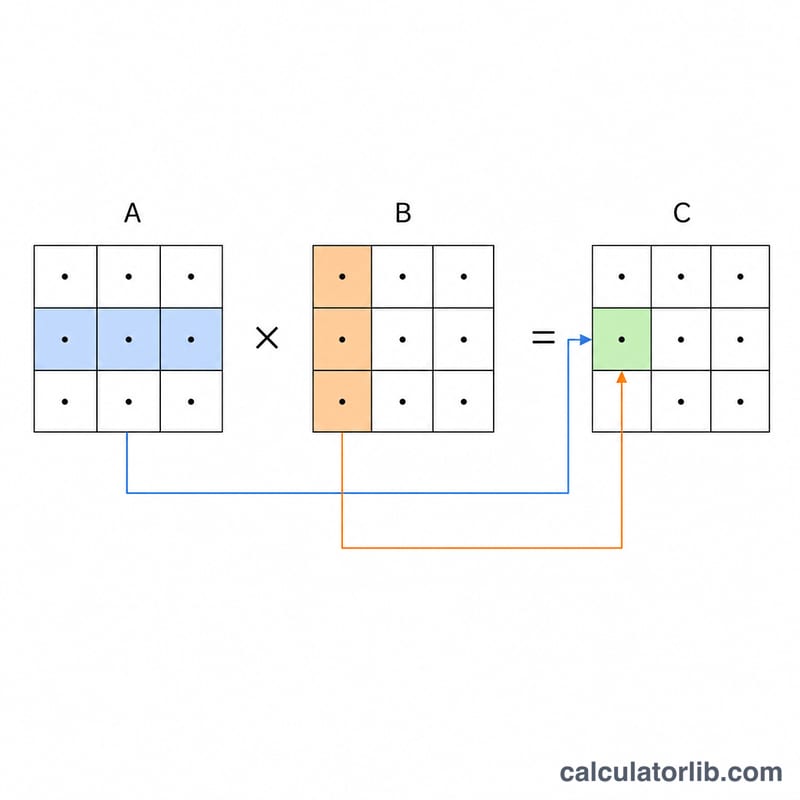
Matrix multiplication combines two matrices into a single product matrix. For two 3×3 matrices A and B, the product C = A × B is also a 3×3 matrix. Each entry of C is computed as the dot product of a row of A with a column of B. Matrix multiplication is fundamental in linear algebra, computer graphics, physics, and engineering — used for transformations, rotations, solving systems, and more.
How to Use This Calculator
Enter all nine numbers of Matrix A in the first 3×3 grid and all nine numbers of Matrix B in the second grid. Click calculate and the tool returns the full 3×3 product matrix C. Decimals and negative numbers are supported. Remember that matrix multiplication is not commutative: A × B is generally not equal to B × A.
The Formula Explained
The entry in row i, column j of the product is:
$$C_{ij} = A_{i1} \cdot B_{1j} + A_{i2} \cdot B_{2j} + A_{i3} \cdot B_{3j}$$
In words: walk across row i of A and down column j of B, multiply matching elements, and add the three products. Repeat for all nine positions to fill the product matrix.
Worked Example
Let A = [[1,2,3],[4,5,6],[7,8,9]] and B = the identity matrix [[1,0,0],[0,1,0],[0,0,1]]. Multiplying any matrix by the identity returns the original matrix, so C = A. For example $$C_{11} = 1 \cdot 1 + 2 \cdot 0 + 3 \cdot 0 = 1$$ and $$C_{23} = 4 \cdot 0 + 5 \cdot 0 + 6 \cdot 1 = 6.$$
How to Multiply 3×3 Matrices by Hand
- Check the dimensions. The product \(A\times B\) is defined only when the number of columns of \(A\) equals the number of rows of \(B\). For two 3×3 matrices this is automatically satisfied, and the result \(C\) is also 3×3.
- Pick a target entry \(C_{ij}\). Choose row \(i\) (1, 2, or 3) and column \(j\) (1, 2, or 3) of the result you want to fill in.
- Select row \(i\) of \(A\) and column \(j\) of \(B\). You will combine the three numbers in that row of \(A\) with the three numbers in that column of \(B\).
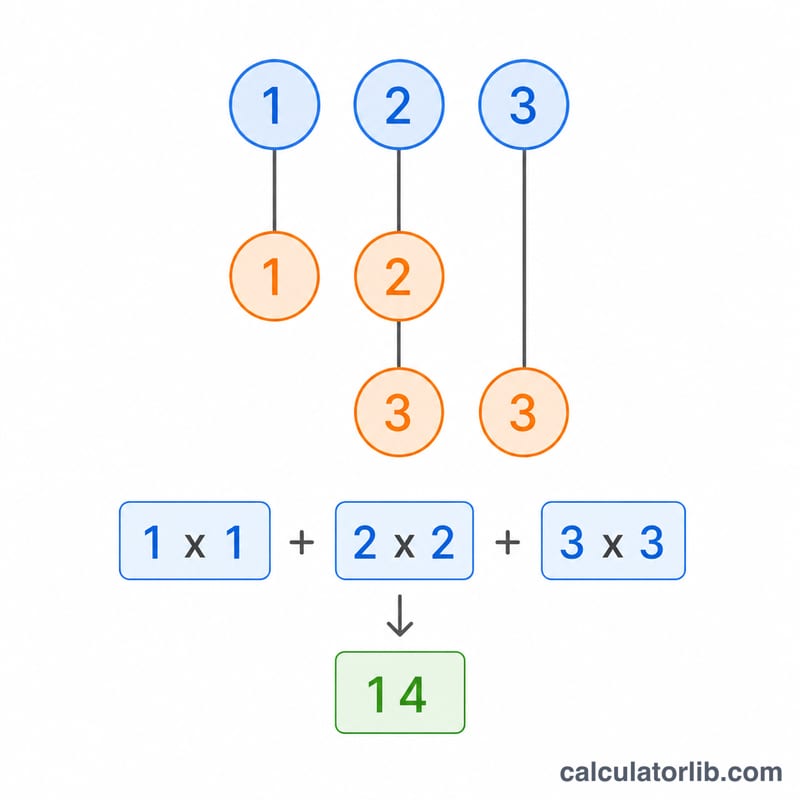
- Multiply paired elements. Match first-with-first, second-with-second, third-with-third: \(a_{i1}b_{1j}\), \(a_{i2}b_{2j}\), and \(a_{i3}b_{3j}\).
- Sum the three products. Add them to get the single entry: \(C_{ij}=a_{i1}b_{1j}+a_{i2}b_{2j}+a_{i3}b_{3j}\). This is exactly the dot product of the row and the column.
- Repeat for all nine positions. Work through every combination of \(i=1,2,3\) and \(j=1,2,3\) — nine dot products in total, each using three multiplications and two additions.
- Assemble the product matrix. Place each \(C_{ij}\) in its row \(i\), column \(j\) slot to form the final 3×3 matrix \(C\). Keep careful track of signs when negative entries are involved.
Key Terms & Definitions
- Matrix
- A rectangular array of numbers arranged in rows and columns; a 3×3 matrix has three rows and three columns (nine entries).
- Entry / element
- A single number in the matrix, written \(a_{ij}\), where \(i\) is its row and \(j\) is its column.
- Row
- A horizontal line of entries. Row \(i\) of a 3×3 matrix is \((a_{i1}, a_{i2}, a_{i3})\).
- Column
- A vertical line of entries. Column \(j\) is \((a_{1j}, a_{2j}, a_{3j})\).
- Dot product
- The sum of products of paired components of two equal-length lists: \(\sum_k a_k b_k\). Each product entry \(C_{ij}\) is the dot product of row \(i\) of \(A\) and column \(j\) of \(B\).
- Product matrix
- The result \(C = A\times B\), whose entry \(C_{ij}\) is the dot product of row \(i\) of \(A\) with column \(j\) of \(B\).
- Identity matrix
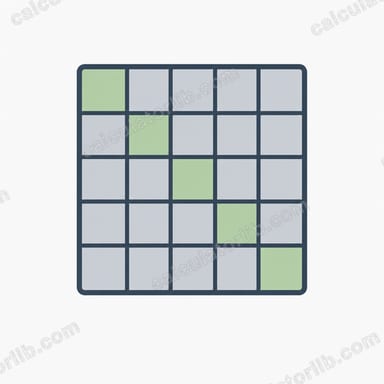
- The square matrix \(I\) with 1s on the main diagonal and 0s elsewhere. It satisfies \(A\times I = I\times A = A\) for any conformable \(A\).
- Commutative
- An operation is commutative if order does not matter. Matrix multiplication is generally not commutative: usually \(A\times B \neq B\times A\).
- Conformable / dimension rule
- Two matrices can be multiplied only if the number of columns of the first equals the number of rows of the second. An \(m\times n\) times an \(n\times p\) matrix yields an \(m\times p\) result.
FAQ
Is A × B the same as B × A? No. Matrix multiplication is not commutative; swapping the order usually gives a different result.
Can I multiply matrices of different sizes? Two matrices can be multiplied only when the number of columns of the first equals the number of rows of the second. Two 3×3 matrices always satisfy this.
What does multiplying by the identity matrix do? The identity matrix acts like the number 1 — A × I = A, leaving the matrix unchanged.