
What Is Magnetic Flux?
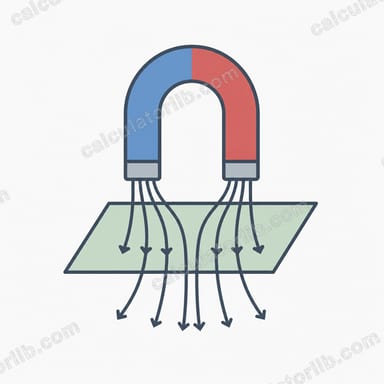
Magnetic flux (\(\Phi\)) measures the total magnetic field passing through a given surface area. It is a fundamental quantity in electromagnetism, central to Faraday's law of induction, transformers, generators, and inductors. The SI unit of magnetic flux is the weber (Wb), where \(1\ \text{Wb} = 1\ \text{T}\cdot\text{m}^2\).
How to Use This Calculator
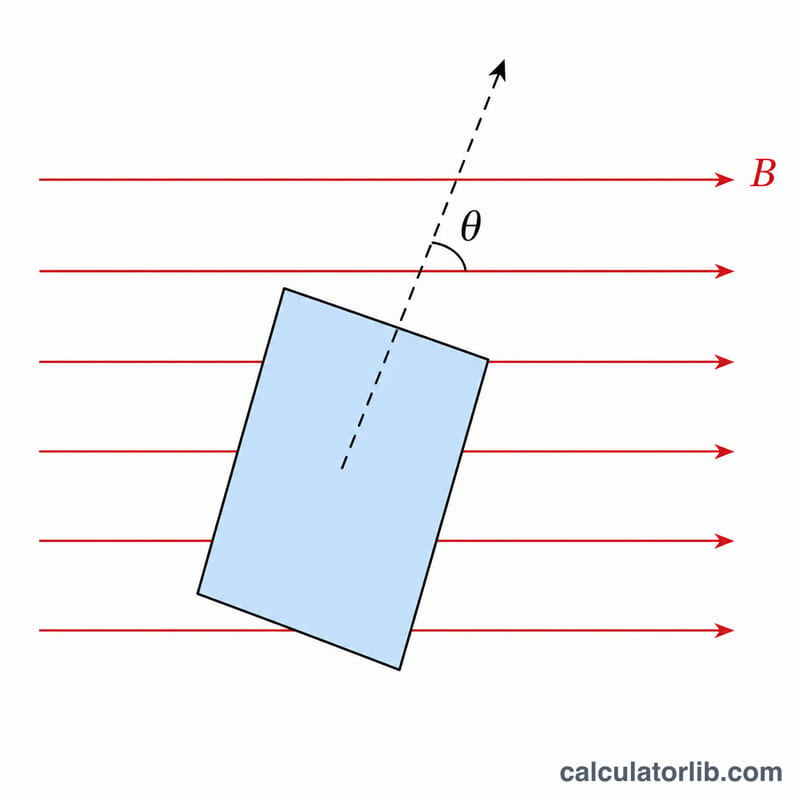
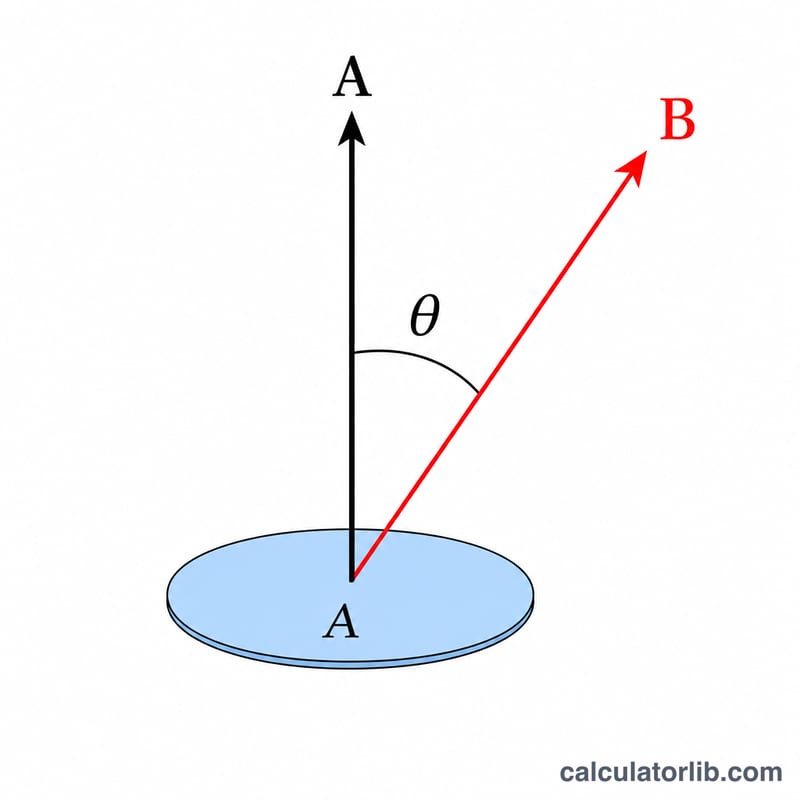
Enter three values: the magnetic field strength B in tesla (T), the surface area A in square meters (m²), and the angle θ in degrees between the magnetic field direction and the surface's normal vector. The calculator returns the flux in webers along with the cosine factor used.
The Formula Explained
The governing equation is:
$$\Phi = \text{B (T)} \cdot \text{A (m}^2\text{)} \cdot \cos\!\left(\text{θ (°)}\right)$$
The cosine term accounts for orientation. When the field is perpendicular to the surface (\(\theta = 0°\)), \(\cos\theta = 1\) and flux is maximum. When the field lies in the plane of the surface (\(\theta = 90°\)), \(\cos\theta = 0\) and no flux passes through. At intermediate angles, only the component of B perpendicular to the surface contributes.
Worked Example
Suppose a magnetic field of \(B = 0.5\ \text{T}\) passes through a flat coil of area \(A = 2\ \text{m}^2\) at an angle of \(\theta = 60°\) to the normal. Then \(\cos 60° = 0.5\), so $$\Phi = 0.5 \times 2 \times 0.5 = 0.5\ \text{Wb}.$$
FAQ
What is a weber? One weber is the flux that, when reduced uniformly to zero in one second, induces an EMF of one volt in a single-turn loop.
What angle should I use? Use the angle between the magnetic field vector and the surface's normal (perpendicular) — not the surface itself. If you know the angle to the surface plane, subtract it from 90°.
Can flux be negative? Yes. For \(\theta\) between 90° and 180°, \(\cos\theta\) is negative, indicating the field passes through the surface in the opposite direction relative to the chosen normal.