What is the Spiral Length Calculator?
The Spiral Length Calculator estimates the total developed length of a flat spiral or coil — such as a rolled strip of metal, a coiled hose, tape on a reel, or an Archimedean spiral track. Given the outer diameter, the inner (core) diameter, and the number of complete turns, it returns the unrolled length. The tool is unit-agnostic: enter all diameters in the same unit (mm, cm, inches, etc.) and the result comes out in that same unit.
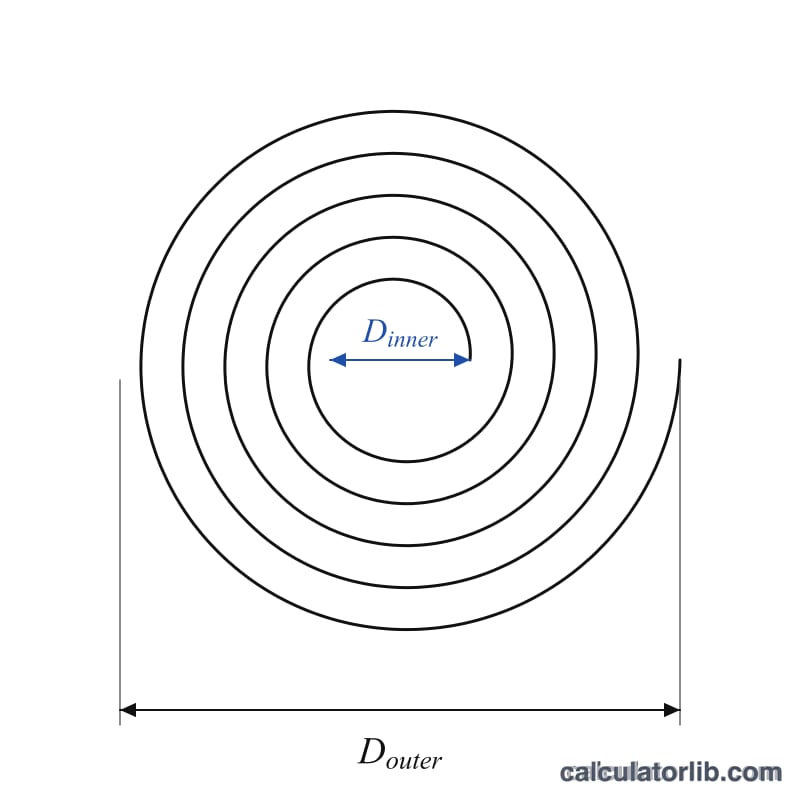
How to use it
Enter the outer diameter of the fully wound spiral, the inner diameter of the empty core or starting point, and the number of turns the material makes between them. Click calculate to see the total length, plus the average diameter and the radial spacing added per turn (the pitch).
The formula explained
An Archimedean spiral grows by a constant amount each turn. Its length is well approximated by treating it as a stack of concentric circles whose diameters increase linearly from the inner to the outer value. The average circle has diameter \((D_{\text{outer}} + D_{\text{inner}})/2\), and there are \(n\) of them, giving:
$$L \approx \frac{\pi \cdot n}{2} \times \left(D_{\text{outer}} + D_{\text{inner}}\right)$$
This is equivalent to \(n\) times the average circumference, which is accurate as long as the turns are evenly spaced and the spacing is small compared with the diameter.

Worked example
Suppose a coil has an outer diameter of 100 mm, an inner core diameter of 20 mm, and 10 turns. Then $$L \approx \frac{\pi \times 10}{2} \times (100 + 20) = 15.708 \times 120 \approx 1884.96 \text{ mm},$$ or about 1.88 metres of material.
Key Terms and Variables
| Term | Symbol | Typical units | Meaning |
|---|---|---|---|
| Archimedean spiral | \(r = a + b\theta\) | — | A curve whose radius grows in direct proportion to the angle turned, so every full revolution adds the same radial amount \(2\pi b\). This constant growth is what makes the average-diameter shortcut exact for evenly wound coils. Named for Archimedes, who described it in On Spirals (c. 225 BC). |
| Outer diameter | \(D_{\text{out}}\) | mm, cm, in, ft | Full diameter across the finished coil, measured through the centre. Also written OD. |
| Inner / core diameter | \(D_{\text{in}}\) | same unit as \(D_{\text{out}}\) | Diameter of the bore — the mandrel, arbor, spool or core the material is wound on. Also written ID. For a spiral wound from a point, \(D_{\text{in}} \to 0\). |
| Number of turns | \(n\) | dimensionless | Complete 360° revolutions from the inner end to the outer end. May be fractional (e.g. 12.5 turns). Sometimes called wraps or windings. |
| Pitch / radial spacing | \(b\) or \(p\) | mm/turn, in/turn | Radial distance gained per revolution: \(p = (D_{\text{out}} - D_{\text{in}})/(2n)\). In the polar form \(r = a + b\theta\) with \(\theta\) in radians, \(p = 2\pi b\). |
| Developed (unrolled) length | \(L\) | mm, m, in, ft | The straight-line length the material would have if fully unrolled — the quantity this calculator returns. |
| Average diameter | \(D_{\text{avg}}\) | same unit as inputs | \((D_{\text{out}} + D_{\text{in}})/2\). The diameter of the single equivalent circle representing the whole coil; \(L = n\pi D_{\text{avg}}\). |
| Material thickness | \(t\) | mm, in | Thickness of the strip, tape, foil or sheet. For a tightly wound coil with no air gaps, \(t \approx p\) (pitch), which lets you swap between \(n\) and \(t\): \(n = (D_{\text{out}} - D_{\text{in}})/(2t)\). |
Radial pitch vs. helix pitch
Two different quantities share the name "pitch", and confusing them gives badly wrong answers.
- Radial pitch (this tool): the spiral is flat — it lies in a plane, like a clock spring, a roll of tape or a spiral-wound gasket. Pitch is measured outward from the centre, and the length depends on the diameters and turn count only.
- Helix pitch (not this tool): the coil advances along an axis at constant diameter, like a helical compression spring, a screw thread or a solenoid winding. Its length per turn is \(\sqrt{(\pi D)^2 + p_{\text{axial}}^2}\), where \(p_{\text{axial}}\) is the axial rise per turn — a Pythagorean combination, not an average of two diameters.
A useful check: if the coil gets fatter as you wind it, use the Archimedean (flat spiral) formula here. If it gets longer at constant diameter, you need a helix length formula instead. A conical spring or a level-wound cable drum mixes both and needs the drum layers treated one at a time.
FAQ
Do the units matter? No — just keep them consistent. If diameters are in inches, the length is in inches.
Is the answer exact? It is a very close approximation for evenly wound spirals. The error grows only if the spacing per turn is large relative to the diameter.
What is the pitch value? It is the radial distance the spiral moves outward per turn: \(\frac{D_{\text{outer}} - D_{\text{inner}}}{2 \cdot n}\).