
What is the Star Shape Calculator?
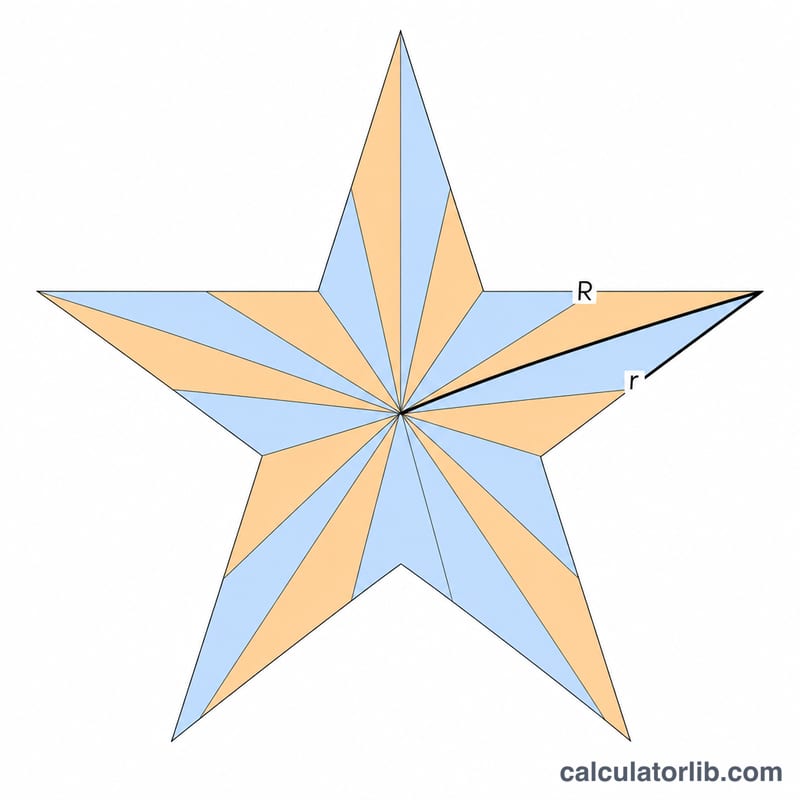
A star polygon (the familiar 5-pointed star, the 6-pointed Star of David, and so on) is built from n outer points lying on a large circle of radius R and n inner vertices lying on a small circle of radius r. This calculator finds the enclosed area, the length of each edge, and the total perimeter of such a star from just three inputs.
How to use it
Enter the number of points n (3 or more), the outer radius R (center to a point tip) and the inner radius r (center to a valley between two points). The calculator instantly returns the area in square units, the length of one slanted edge, and the perimeter (the star has 2n edges).
The formula explained
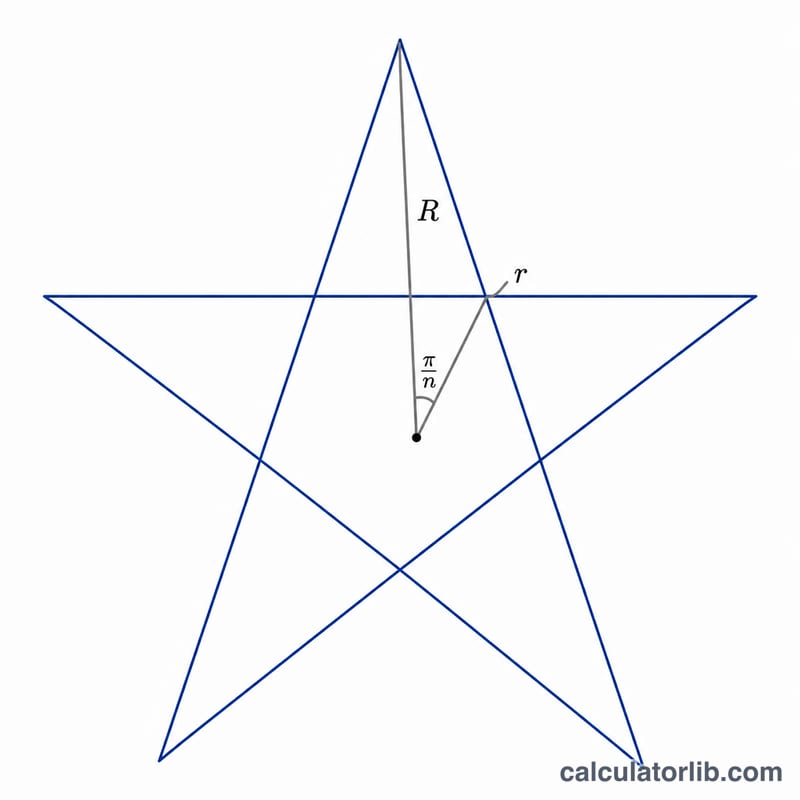
The star can be cut into 2n identical triangles, each spanning a half-angle of \(\frac{\pi}{n}\) with sides \(R\) and \(r\). The area of each such triangle is \(\frac{1}{2}\cdot R\cdot r\cdot\sin\!\left(\frac{\pi}{n}\right)\), and there are \(2n\) of them, giving the compact result:
$$A = n \cdot r \cdot R \cdot \sin\!\left(\frac{\pi}{n}\right)$$
The edge connecting an outer point at radius \(R\) to the neighbouring inner vertex at radius \(r\) (offset by angle \(\frac{\pi}{n}\)) has length \(e = \sqrt{\left(R - r\cos\frac{\pi}{n}\right)^{2} + \left(r\sin\frac{\pi}{n}\right)^{2}}\), and the perimeter is \(2n\cdot e\).
Worked example
For a classic 5-pointed star with \(R = 10\) and \(r = 5\):
$$A = 5 \cdot 5 \cdot 10 \cdot \sin(36°) = 250 \cdot 0.587785 \approx 146.95$$square units. The edge length is
$$\sqrt{(10 - 5\cdot\cos 36°)^{2} + (5\cdot\sin 36°)^{2}} = \sqrt{(10 - 4.0451)^{2} + (2.9389)^{2}} \approx \sqrt{35.46 + 8.64} \approx 6.6408$$so the perimeter is \(10 \cdot 6.6408 \approx 66.41\).
FAQ
Does this work for any number of points? Yes — enter any \(n \geq 3\). With \(n = 3\) you get a three-pointed star.
What if R and r are equal? The shape becomes a regular \(2n\)-gon (no concave valleys), and the area formula still holds.
What units does it use? Any consistent unit. If \(R\) and \(r\) are in centimetres, area is in square centimetres and perimeter in centimetres.