
What is the L-Shape Area Calculator?
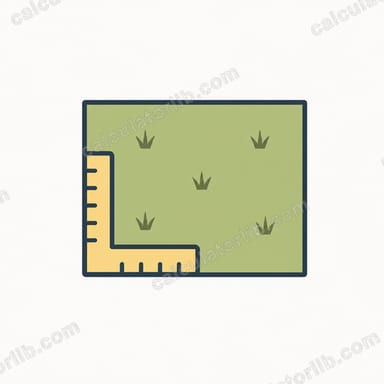
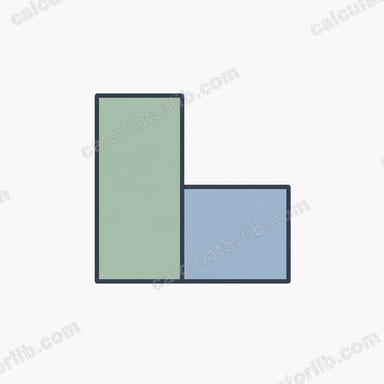
Many rooms, floors, gardens, decks and plots are not simple rectangles — they form an "L" shape. The easiest way to find the area of any L-shaped region is to divide it into two rectangles, calculate the area of each, and add them together. This calculator does exactly that: enter the width and length of each rectangle and it returns the combined total area.
How to Use It
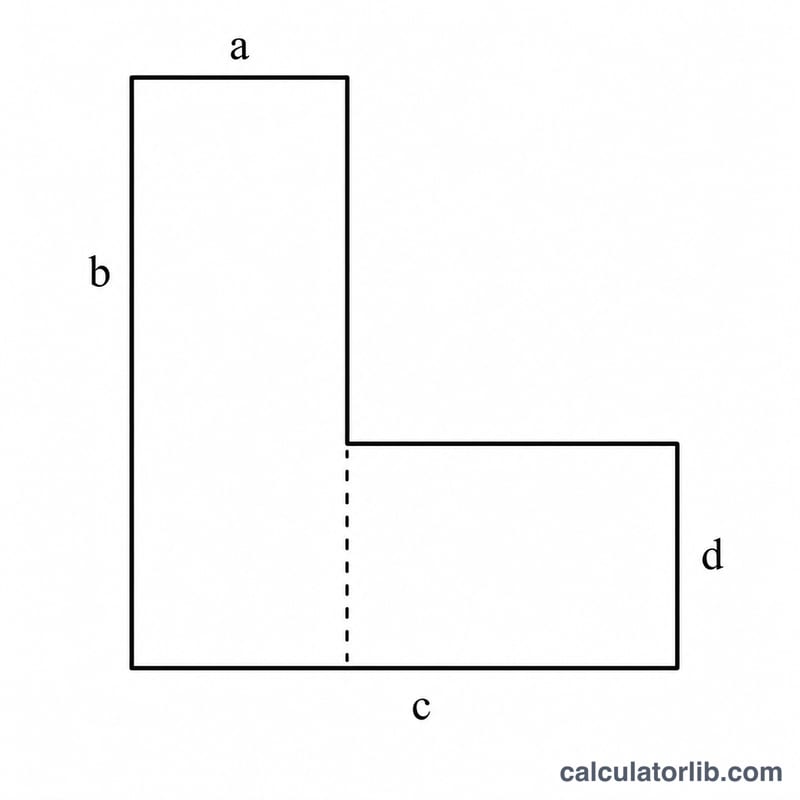
Mentally split your L-shaped space into two non-overlapping rectangles. Measure the two sides of the first rectangle and enter them as Rectangle 1 Width and Rectangle 1 Length. Do the same for the second rectangle. Use the same unit (feet, metres, inches) for every measurement and your answer will be in the matching square unit. The calculator shows each rectangle's area separately so you can double-check your split.
The Formula Explained
The area is simply the sum of two rectangle areas:
$$A = (a \times b) + (c \times d)$$
Here \(a\) and \(b\) are the sides of the first rectangle and \(c\) and \(d\) are the sides of the second. Because area of a rectangle is width times length, adding the two pieces gives the full L-shape. There must be no overlap between the two rectangles, and together they must cover the entire shape.
Worked Example
Suppose a room's main section is 10 ft by 12 ft, and an attached alcove is 6 ft by 8 ft. The first rectangle is \(10 \times 12 = 120\) sq ft and the second is \(6 \times 8 = 48\) sq ft. Total area = $$120 + 48 = \textbf{168 square feet}.$$
Area Unit Conversions
Once you have the area of your L-shaped room in square feet, you may need to convert it to other units — for example, square metres for international suppliers or square yards for carpet ordering. The table below lists the common conversions.
| From | To | Multiply by | Example |
|---|---|---|---|
| Square feet (sq ft) | Square metres (sq m) | 0.0929 | 100 sq ft = 9.29 sq m |
| Square feet (sq ft) | Square yards (sq yd) | 0.1111 (\(\tfrac{1}{9}\)) | 100 sq ft = 11.11 sq yd |
| Square feet (sq ft) | Square inches (sq in) | 144 | 1 sq ft = 144 sq in |
| Square metres (sq m) | Square feet (sq ft) | 10.764 | 1 sq m = 10.764 sq ft |
| Square metres (sq m) | Square yards (sq yd) | 1.196 | 1 sq m = 1.196 sq yd |
| Square yards (sq yd) | Square feet (sq ft) | 9 | 1 sq yd = 9 sq ft |
| Square inches (sq in) | Square feet (sq ft) | 0.006944 (\(\tfrac{1}{144}\)) | 1000 sq in = 6.944 sq ft |
Note that area conversion factors are the square of the linear factor. Because 1 ft = 0.3048 m, the area factor is \(0.3048^2 = 0.0929\). Likewise, since 1 yard = 3 feet, one square yard equals \(3^2 = 9\) square feet.
Estimating Materials From Your Result
The square footage from this calculator is the starting point for ordering flooring, tile, carpet, or underlayment. Follow these steps to turn your area into a reliable purchase quantity.
- Start with the bare area, then add waste. Add 5–10% extra for cutting and offcuts with most tile, carpet, laminate, and vinyl plank. Increase this to about 15% for diagonal or herringbone layouts and 15–20% for large-repeat patterned materials that must be matched across seams. For example, a 200 sq ft L-shaped room at 10% waste needs 220 sq ft of material.
- Round up to whole units. Flooring is sold by the full box, carpet by the full roll width, and tile by the case. Always round your waste-adjusted area up to the next whole package — never down.
- Divide by the coverage per unit. Take the waste-adjusted area and divide by the square footage each box or roll covers (printed on the label) to get the number of units to buy. For instance, 220 sq ft ÷ 22 sq ft per box = 10 boxes.
- Keep a spare box for repairs. Buy one extra box (or a few extra tiles) from the same production batch and store it. Dye lots and product lines change over time, so a matching spare is invaluable for fixing future damage.
- Account for the L-shape geometry. Because an L-shaped room has an inside corner, plan plank or seam direction across the longer leg to minimize awkward cuts, and double-check that both rectangles in your measurement do not overlap at the corner.
This is general estimating guidance; always confirm coverage figures and return policies with your specific product and supplier before ordering.
FAQ
How do I split an L-shape into rectangles? Draw a straight line that extends one of the inner edges until it reaches the opposite wall. This divides the L into two clean rectangles.
What units does it use? Any unit — just be consistent. If you enter feet, the area is in square feet; metres give square metres.
Can I use it for flooring estimates? Yes. Once you have the total area, add about 5–10% for cutting waste when ordering tile, carpet or laminate.