
What Is the Independent Events Probability Calculator?
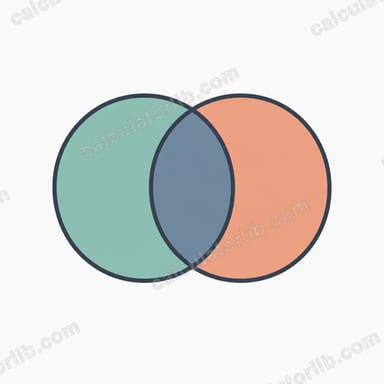
This calculator works out the combined probability of two independent events, A and B. Two events are independent when the occurrence of one has no effect on the probability of the other — for example, flipping a coin and rolling a die. Enter each individual probability and instantly get the chance that both happen, that at least one happens, and that neither happens.
How to Use It
Enter the probability of event A and event B as numbers between 0 and 1 (a probability of 50% is 0.5). Click calculate. The tool returns:
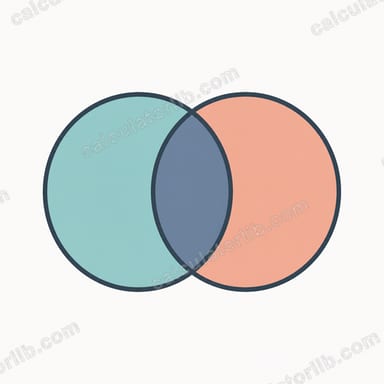
- P(A and B) — both events occur.
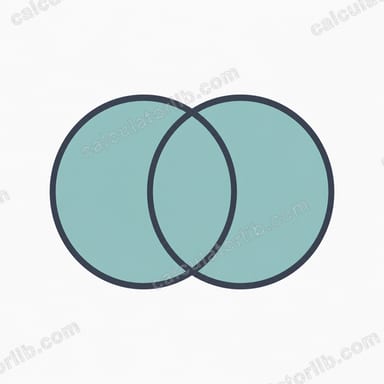
- P(A or B) — at least one event occurs.
- P(neither) — neither event occurs.
The Formula Explained
For independent events the joint probability is simply the product of the individual probabilities:
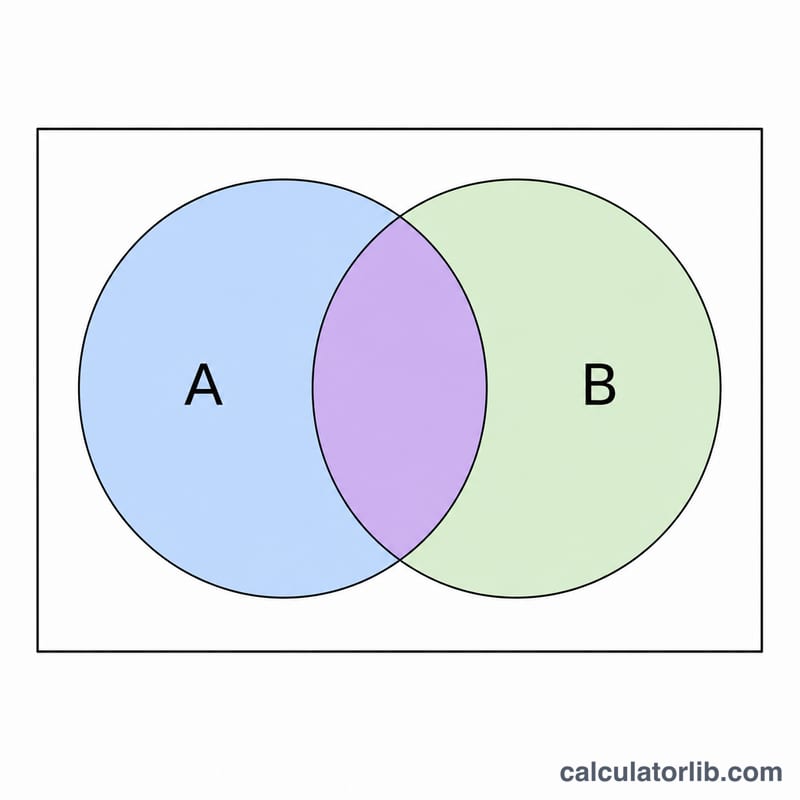
$$P(A \cap B) = \text{P(A)} \times \text{P(B)}$$
The probability that at least one event happens uses the inclusion–exclusion rule, where the overlap is the product because the events are independent:
$$P(A \cup B) = \text{P(A)} + \text{P(B)} - \text{P(A)} \times \text{P(B)}$$
The probability that neither happens is the product of the complements:
$$P(\text{neither}) = \left(1 - \text{P(A)}\right)\left(1 - \text{P(B)}\right)$$
Worked Example
Suppose \(P(A) = 0.5\) and \(P(B) = 0.4\). Then:
- $$P(A \cap B) = 0.5 \times 0.4 = 0.20$$
- $$P(A \cup B) = 0.5 + 0.4 - 0.20 = 0.70$$
- $$P(\text{neither}) = (1 - 0.5)(1 - 0.4) = 0.5 \times 0.6 = 0.30$$
Notice \(P(A \cup B) + P(\text{neither}) = 0.70 + 0.30 = 1.00\), a useful sanity check.
FAQ
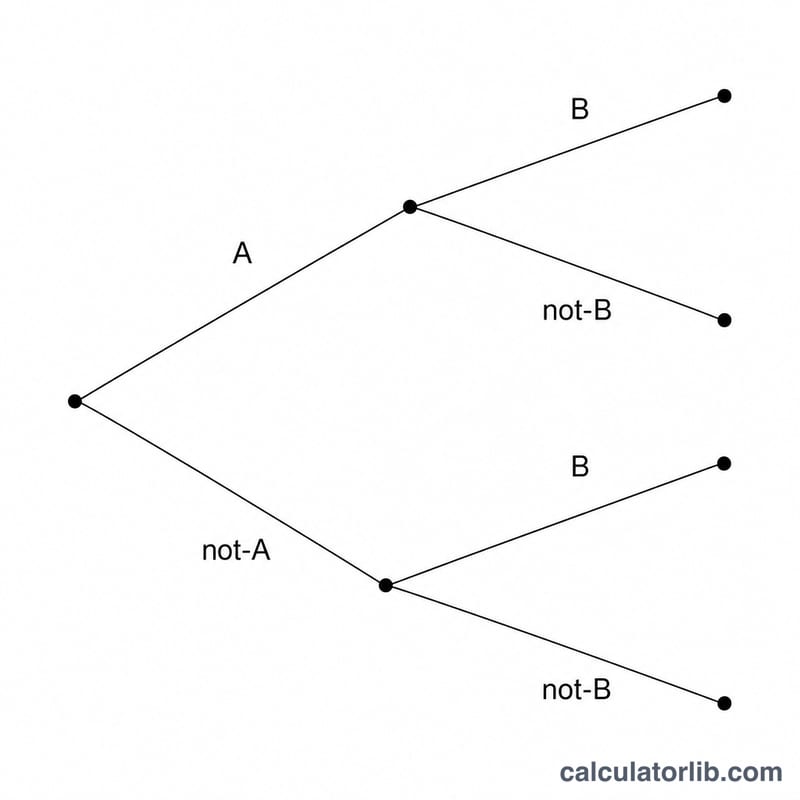
What does "independent" mean? Events are independent if knowing the outcome of one tells you nothing about the other. The multiplication rule \(P(A \cap B) = \text{P(A)} \cdot \text{P(B)}\) only holds for independent events.
Can I enter percentages? Convert to a decimal first: 25% becomes 0.25. All inputs must be between 0 and 1.
What if the events are not independent? Then you must use conditional probability, \(P(A \cap B) = \text{P(A)} \cdot P(B|A)\), and this calculator will overstate or understate the result.