
What this calculator does
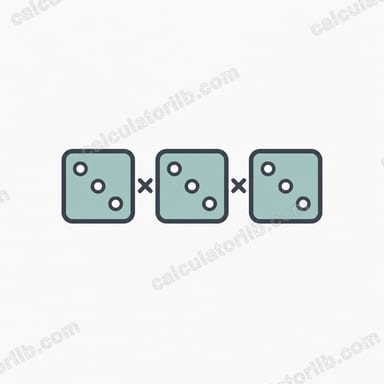
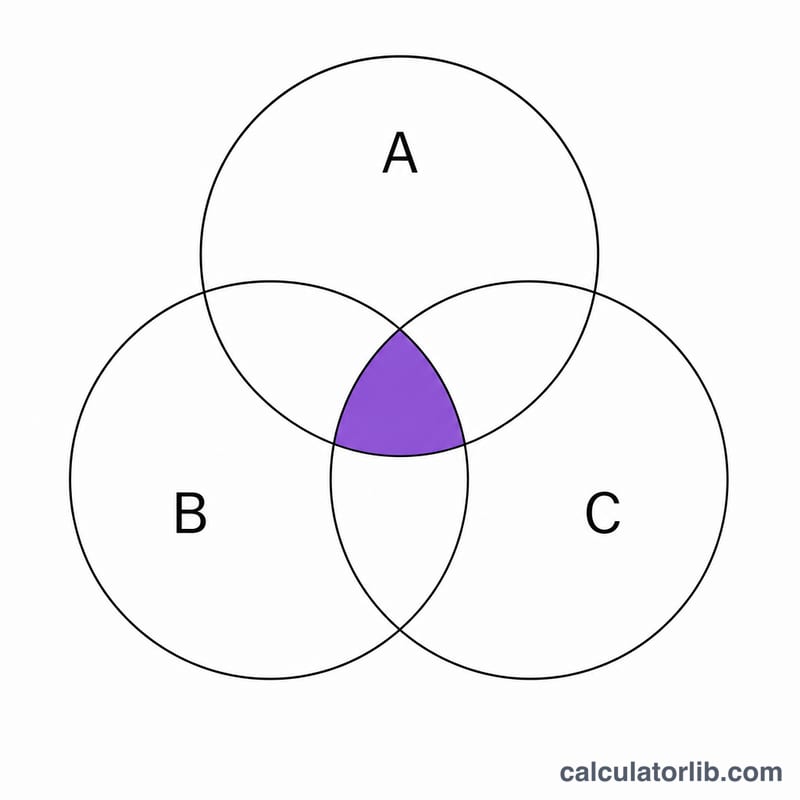
The Probability of 3 Events Calculator finds the chance that three independent events — A, B and C — all happen together. For independent events, the joint probability is simply the product of the individual probabilities: \(P(A \cap B \cap C) = \text{P(A)} \times \text{P(B)} \times \text{P(C)}\). The tool also reports the probability that at least one of the events occurs and the probability that none of them occur.
How to use it
Enter each probability as a decimal between 0 and 1. For example, a 50% chance is entered as 0.5, a 1-in-4 chance as 0.25, and a certainty as 1. Click calculate and the result shows the combined probability as both a decimal and a percentage.
The formula explained
Two events are independent when the outcome of one does not affect the others. Under independence, probabilities multiply. With three events this extends to \(P(A) \cdot P(B) \cdot P(C)\). To find the probability that none occur, multiply the complements \((1-P)\) of each event; the probability that at least one occurs is one minus that value.
Worked example
Suppose a basketball player makes a free throw 80% of the time (0.8). The probability of making three in a row is $$0.8 \times 0.8 \times 0.8 = 0.512,$$ or 51.2%. The probability of missing all three is $$0.2 \times 0.2 \times 0.2 = 0.008,$$ so the chance of making at least one is \(1 - 0.008 = 0.992\) (99.2%).
FAQ
Does this work for dependent events? No. The multiplication rule \(P(A) \cdot P(B) \cdot P(C)\) assumes the events are independent. For dependent events you must use conditional probabilities.
Can I enter percentages? Convert percentages to decimals first — divide by 100. For example 75% becomes 0.75.
What if one probability is 0? If any single event has probability 0, the combined probability of all three is also 0, since the product includes a zero factor.