
What Is the Condense Logarithms Calculator?
This tool combines several logarithms that share the same base into one single logarithm. It applies the laws of logarithms to rewrite an expression of the form \(a\cdot\log_{b}(x) + c\cdot\log_{b}(y) - d\cdot\log_{b}(z)\) as a single, compact logarithm. This is the reverse of expanding logarithms and is a common step in algebra, precalculus, and solving logarithmic equations.
How to Use It
Enter the common base b, then the three coefficients (a, c, d) and the three arguments (x, y, z). The calculator returns the single combined logarithm along with the numeric value of its argument and the evaluated log. If a term is missing, set its coefficient to 0 (or its argument to 1).
The Formula Explained
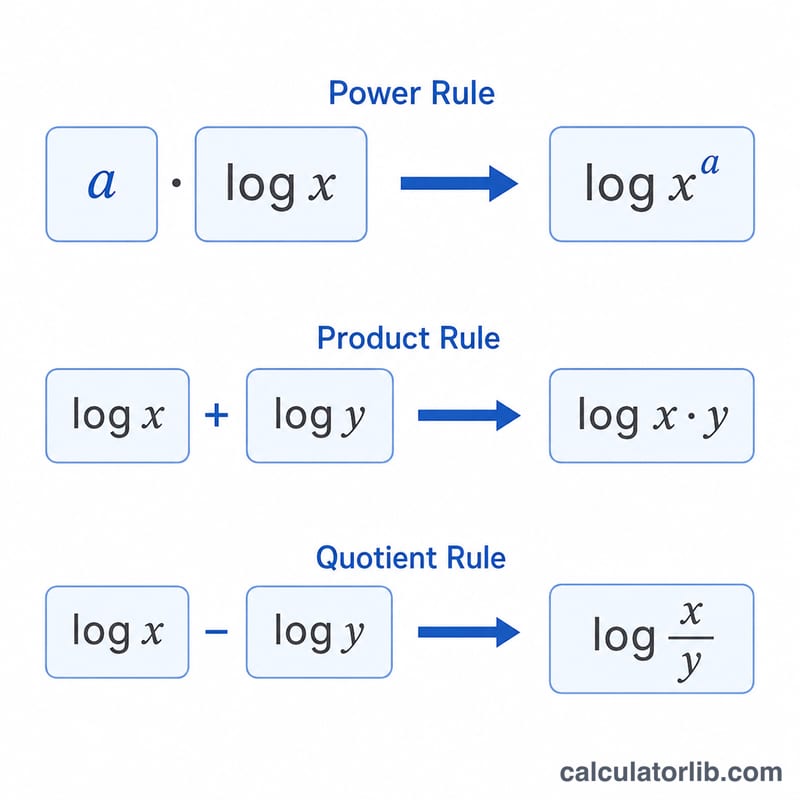
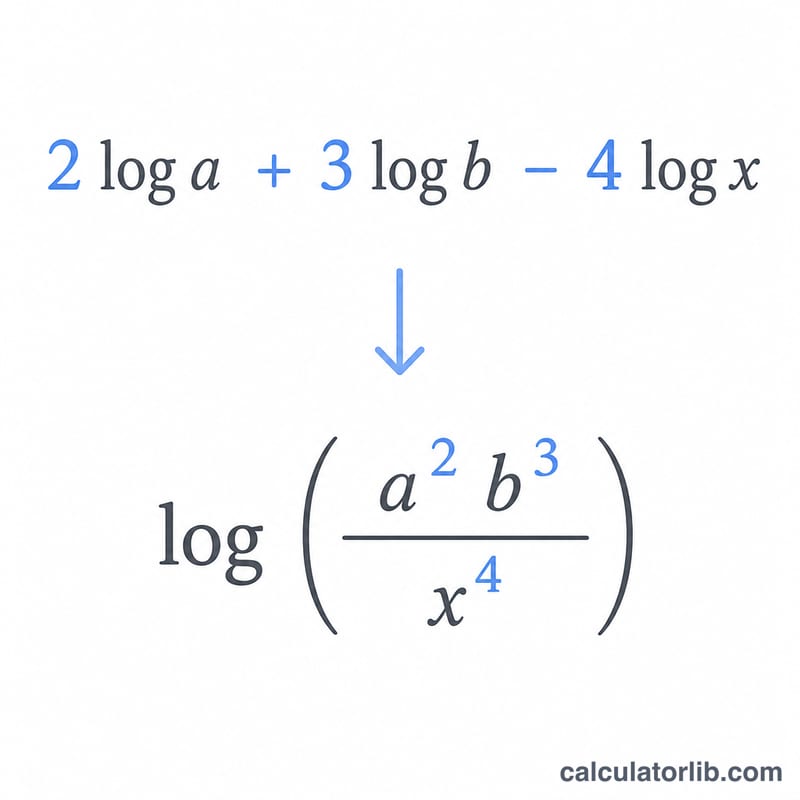
Three rules drive the result. The power rule moves each coefficient up as an exponent: \(a\cdot\log_{b}(x) = \log_{b}(x^{a})\). The product rule turns a sum of logs into the log of a product. The quotient rule turns a difference into the log of a quotient. Together they yield $$\log_{b}\!\left(\frac{x^{a}\,y^{c}}{z^{d}}\right)$$
Worked Example
Take base 10 with \(2\cdot\log(3) + 1\cdot\log(5) - 1\cdot\log(9)\). The argument becomes $$\frac{3^{2} \times 5^{1}}{9^{1}} = \frac{9 \times 5}{9} = 5.$$ So the expression condenses to \(\log_{10}(5) \approx 0.69897\).
FAQ
Do all the logs need the same base? Yes. The product, quotient, and power rules only apply when every term shares the same base.
Can I use natural log (ln)? Yes — set the base to \(e \approx 2.71828\).
What if my argument turns out negative or zero? The numeric log is undefined; only positive arguments give a real logarithm value.