
What is the Swim Pace Calculator?
This tool converts the time you swam over any distance into a standardized pace per 100 metres — the universal benchmark swimmers and coaches use to compare efforts across different workout distances. Whether you swam a 1500 m time trial or a quick 200 m set, the calculator tells you how fast you were moving per 100 m, per 50 m, and your average speed in km/h.
How to use it
Enter the total distance you swam in metres, then enter your finishing time split into minutes and seconds. Press calculate to see your pace. Use it to set target splits, track improvement over a season, or compare a pool session to a race.
The formula explained
The core formula is simply pace per 100 = total time ÷ (distance / 100). The distance is first converted into the number of 100 m segments it contains, then the total swim time is divided evenly across those segments. The result is the average time it would take you to cover each 100 m at the effort you just swam. The per-50 m split is half of that value, and average speed converts the same effort into kilometres per hour.
$$\text{pace}_{100} = \dfrac{T}{D / 100}$$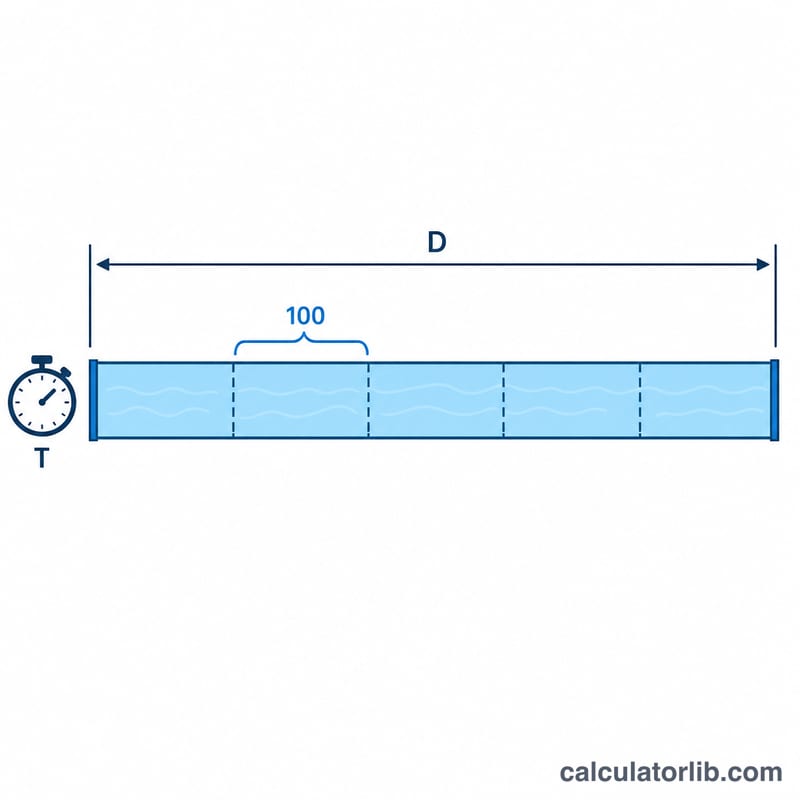
Worked example
Suppose you swim 1500 m in 30 minutes (1800 seconds). The distance contains \(1500 / 100 = 15\) segments of 100 m. Dividing 1800 seconds by 15 gives 120 seconds per 100 m, which is exactly 2:00 per 100 m. Your average speed is \((1.5\ \text{km}) / (0.5\ \text{h}) = 3\ \text{km/h}\).
$$\text{pace}_{100} = \dfrac{1800}{1500 / 100} = \dfrac{1800}{15} = 120\ \text{s}$$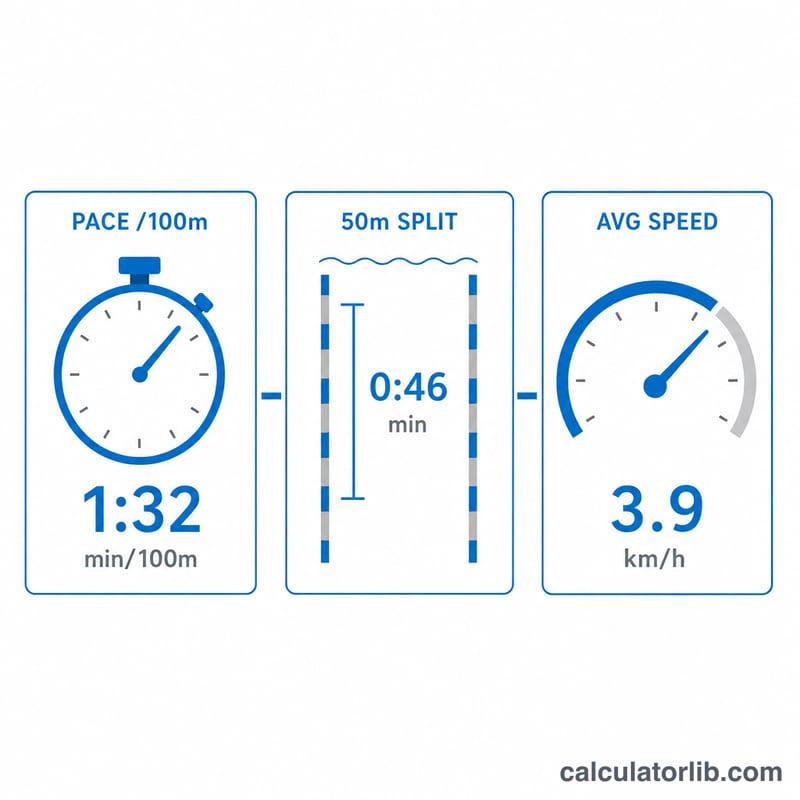
FAQ
Does this work for yards? The calculator uses metres. If you swam in a yard pool, enter your distance in yards to get pace per 100 yards — the math is identical, only the unit label changes.
Why per 100 m? Per-100 pace is the standard reference in swimming because most sets and intervals are built around 100 m repeats, making it easy to plan and compare workouts.
Can I use this for open water? Yes — enter your GPS distance and elapsed time to get an average pace, though currents and sighting will affect open-water consistency.