What is the Miles Per Hour Pace Calculator?
This calculator converts a distance and an elapsed time into your running or walking pace (minutes per mile and minutes per kilometer) as well as your speed in miles per hour and kilometers per hour. It is a universal tool that works for any distance and any pace.
How to use it
Enter the distance you covered, choose miles or kilometers, then enter the time it took in hours, minutes and seconds. The calculator instantly returns your pace per mile, pace per kilometer, and your average speed in both mph and km/h.
The formula explained
Pace is simply the time taken divided by the distance traveled, while speed is the distance divided by the time. We first convert your time to total seconds (\(\text{hours}\times 3600 + \text{minutes}\times 60 + \text{seconds}\)) and your distance to both miles and kilometers using \(1\text{ mile} = 1.609344\text{ km}\). Pace per unit = total seconds ÷ distance, then we split that into whole minutes and remaining seconds. Speed = distance ÷ (total seconds ÷ 3600).
$$\text{MPH} = \frac{\text{Distance (mi)}}{\dfrac{\text{Hours}\cdot 3600 + \text{Minutes}\cdot 60 + \text{Seconds}}{3600}}$$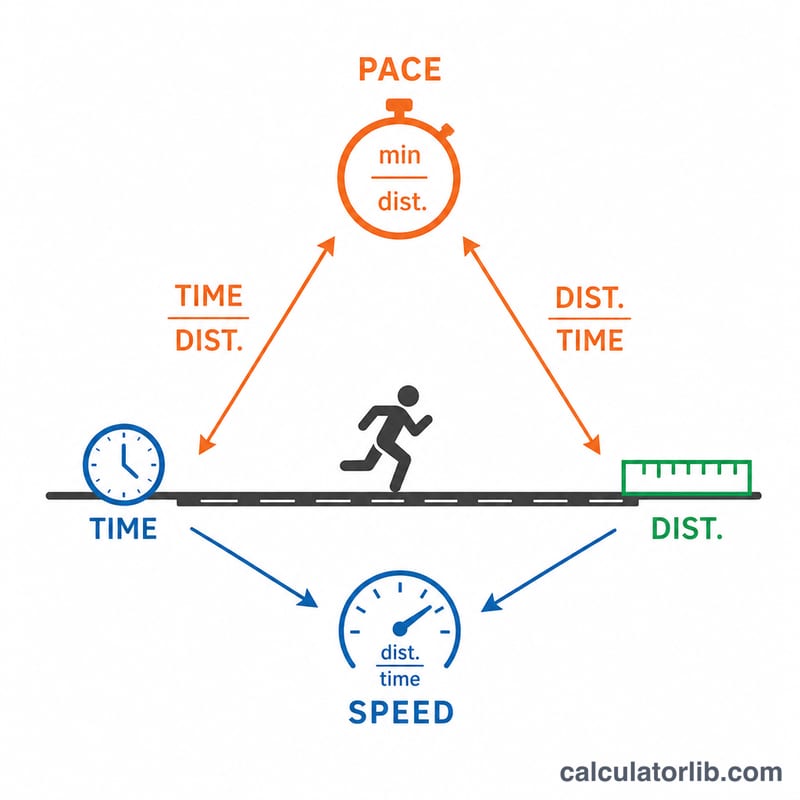
Worked example
Suppose you run 10 km in 50 minutes. Total time = 3000 seconds. Pace per km = \(3000 \div 10 = 300\) seconds = 5:00 min/km. In miles, 10 km = 6.2137 miles, so pace per mile = \(3000 \div 6.2137 = 482.8\) s = 8:02.8 min/mile. Speed = \(10\text{ km} \div (3000/3600)\text{ h} = 12\text{ km/h}\), or about 7.46 mph.
Pace to Speed Conversion Chart (min/mile, min/km, mph, km/h)
Speed and pace are two views of the same quantity. With pace in seconds per mile, \(\text{mph} = 3600 / \text{seconds per mile}\), \(\text{km/h} = \text{mph} \times 1.609344\), and pace per km = pace per mile ÷ 1.609344. Speeds are rounded to 2 decimals and pace per km to the nearest second.
| Pace (min/mile) | Pace (min/km) | Speed (mph) | Speed (km/h) |
|---|---|---|---|
| 5:00 | 3:06 | 12.00 | 19.31 |
| 5:30 | 3:25 | 10.91 | 17.56 |
| 6:00 | 3:44 | 10.00 | 16.09 |
| 6:30 | 4:02 | 9.23 | 14.86 |
| 7:00 | 4:21 | 8.57 | 13.79 |
| 7:30 | 4:40 | 8.00 | 12.87 |
| 8:00 | 4:58 | 7.50 | 12.07 |
| 8:30 | 5:17 | 7.06 | 11.36 |
| 9:00 | 5:36 | 6.67 | 10.73 |
| 9:30 | 5:54 | 6.32 | 10.16 |
| 10:00 | 6:13 | 6.00 | 9.66 |
| 10:30 | 6:31 | 5.71 | 9.20 |
| 11:00 | 6:50 | 5.45 | 8.78 |
| 11:30 | 7:09 | 5.22 | 8.40 |
| 12:00 | 7:27 | 5.00 | 8.05 |
| 12:30 | 7:46 | 4.80 | 7.72 |
| 13:00 | 8:05 | 4.62 | 7.43 |
| 13:30 | 8:23 | 4.44 | 7.15 |
| 14:00 | 8:42 | 4.29 | 6.90 |
| 14:30 | 9:01 | 4.14 | 6.66 |
| 15:00 | 9:19 | 4.00 | 6.44 |
Example: an 8:00 min/mile pace is 480 seconds per mile, so \(3600 / 480 = 7.5\) mph, and \(7.5 \times 1.609344 \approx 12.07\) km/h.
Common Race Distances and Finish Times by Pace
Finish time = pace × distance. The table uses the distances 5K = 3.107 mi, 10K = 6.214 mi, half marathon = 13.1094 mi (21.0975 km) and marathon = 26.2188 mi (42.195 km), and assumes a perfectly even pace. Times are rounded to the nearest second and shown as h:mm:ss (or mm:ss under one hour).
| Pace (min/mile) | 5K | 10K | Half marathon | Marathon |
|---|---|---|---|---|
| 6:00 | 18:39 | 37:17 | 1:18:39 | 2:37:19 |
| 7:00 | 21:45 | 43:30 | 1:31:46 | 3:03:32 |
| 8:00 | 24:51 | 49:43 | 1:44:53 | 3:29:45 |
| 9:00 | 27:58 | 55:56 | 1:57:59 | 3:55:58 |
| 10:00 | 31:04 | 1:02:08 | 2:11:06 | 4:22:11 |
| 12:00 | 37:17 | 1:14:34 | 2:37:19 | 5:14:38 |
Worked example: a 9:00 min/mile pace is 540 seconds per mile. For the marathon, \(540 \times 26.2188 = 14158.15\) seconds, which is 3 h 55 min 58 s (3:55:58).
Small differences from official results are normal: real races are rarely run at a perfectly even pace, and the 5K and 10K are exactly 3.10686 and 6.21371 miles, which this table rounds to 3.107 and 6.214.
Interpreting Your Pace and Speed
The ranges below are general, approximate figures for typical recreational activity. They are not standards or targets.
| Activity | Approx. speed | Approx. pace |
|---|---|---|
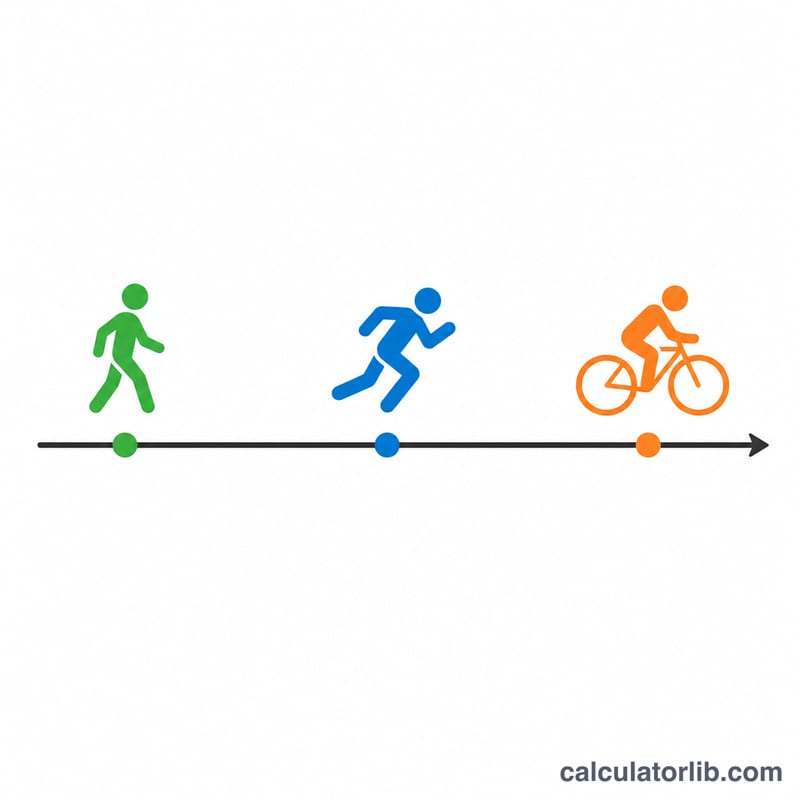
| Walking | about 3–4 mph (4.8–6.4 km/h) | about 15–20 min/mile (9:19–12:25 min/km) |
| Jogging | about 5–6 mph (8.0–9.7 km/h) | about 10–12 min/mile (6:13–7:27 min/km) |
| Running | above about 6 mph | faster than about 10 min/mile |
| Recreational cycling | about 10–15 mph (16–24 km/h) | about 4–6 min/mile (2:29–3:44 min/km) |
The boundaries between walking, jogging and running are fuzzy, and different sources draw them in slightly different places.
What affects pace
- Terrain: hills, trails, sand, wind and heat slow the same effort. Downhill and tailwind sections speed it up.
- Fitness and effort: the same person has a different pace on an easy day than in a race.
- Distance: pace generally slows as distance increases, so a 5K pace is usually faster than a marathon pace for the same person.
Average pace vs. split pace
Average pace is total time divided by total distance, including any stops if you use elapsed time. A split pace covers one segment, such as a single mile or kilometer. A run with an 8:00 first mile and a 9:00 second mile has an average of 8:30 min/mile, which is \(\tfrac{17}{2}\) minutes per mile. Because speed is the inverse of pace, the average of two speeds is not the same as the speed at the average pace. Always compute the average from total distance and total time.
FAQ
What is a good running pace? Recreational runners often target 9–11 min/mile (about 5:30–6:50 min/km), but a "good" pace is relative to your fitness and goals.
How do I convert min/mile to min/km? Divide your min/mile pace by \(1.609344\). The calculator does this automatically for you.
Does this work for cycling or swimming? Yes — any activity where you cover a distance over a time. Just enter the values and read off the pace and speed.