

What is the Business Days Calculator?
This tool counts the number of business days (working days) between two dates. It starts from the total number of calendar days, removes every Saturday and Sunday, and optionally subtracts public holidays that land on a weekday. The result is the figure you need for project deadlines, shipping estimates, payment terms, notice periods, and SLA windows.
How to use it
Pick a Start Date and an End Date. Enter how many public holidays fall on weekdays inside that range (leave it at 0 if none). Tick Include the end date if you want the final day counted as a full day — leave it unticked to count the gap between the dates only. The calculator returns business days plus a breakdown of total days, weekend days, and approximate weeks.
The formula explained
The core relationship is simple:
$$\text{business\_days} = \text{total\_days} - \text{weekends} - \text{holidays}$$Weekends are detected by walking each day in the range and checking whether it falls on Saturday or Sunday. Holidays are user-supplied because public holidays differ by country and region; only count those that occur on a weekday (a holiday on a Saturday is already excluded as a weekend).
$$\begin{gathered} \text{Business Days} = D_{\text{wk}} - \text{Holidays} \\[1.5em] \text{where}\quad \left\{ \begin{aligned} N &= \left\lfloor \frac{\text{End Date} - \text{Start Date}}{1\,\text{day}} \right\rfloor + \text{Include End} \\ D_{\text{wk}} &= N - (\text{Saturdays} + \text{Sundays}) \end{aligned} \right. \end{gathered}$$
Worked example
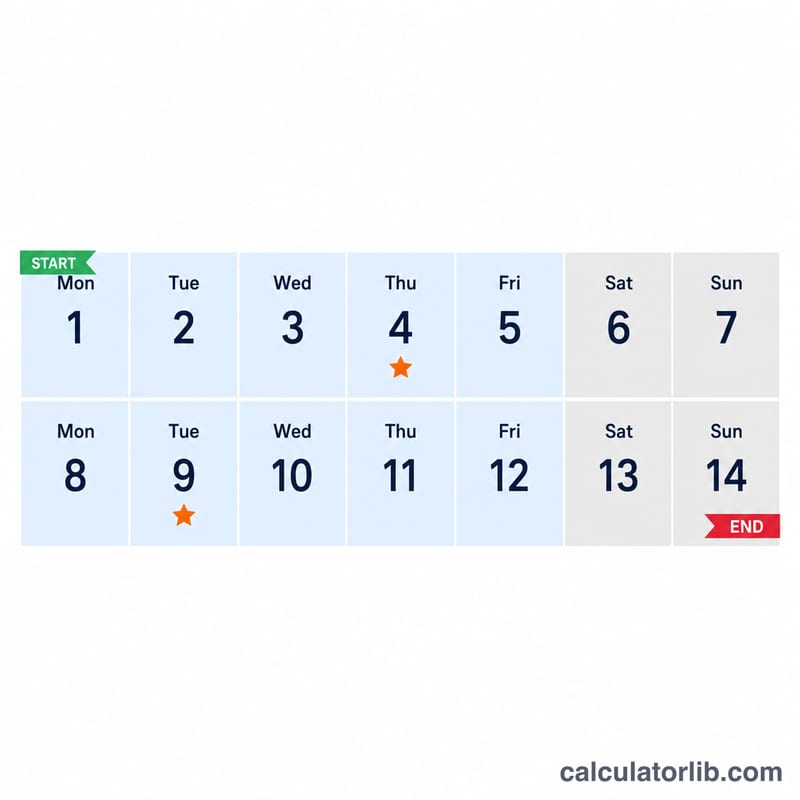
From Mon 1 Jan 2024 to Wed 31 Jan 2024 with the end date included: that span is 31 calendar days. January 2024 contains 8 weekend days (the 6th, 7th, 13th, 14th, 20th, 21st, 27th, 28th), leaving 23 weekdays. With 0 holidays, the answer is 23 business days.
$$31 - 8 - 0 = 23$$Key Terms Explained
Understanding the vocabulary behind a workday count helps you interpret the result and apply it correctly to contracts, shipping estimates and service commitments.
- Business day (workday) — Any day on which normal business operations occur. In most of the world this means Monday through Friday, excluding weekends and recognized public holidays. This is the unit the calculator returns.
- Calendar day — Every day on the calendar counted equally, including weekends and holidays. The total span between two dates is measured in calendar days first, then weekends and holidays are subtracted to reach business days.
- Weekend — The non-working days at the end of the week, conventionally Saturday and Sunday in Western calendars. The calculator removes every Saturday and Sunday in the span. (Some regions use a Friday–Saturday weekend, which would change the count.)
- Weekday holiday — A public or company holiday that falls on a Monday through Friday. Only these reduce the business-day total; a holiday landing on a weekend is already excluded as a weekend day. Enter the count of such weekday holidays in the holidays field.
- SLA window — A Service Level Agreement window is the contractually promised time to respond or resolve, often stated in business days (e.g., “resolved within 3 business days”). Counting workdays rather than calendar days reflects when staff are actually available.
- Notice period — A required advance-warning span, such as resignation or contract-termination notice. When written in business days, weekends and holidays do not count toward satisfying it.
- Include end date — A choice of whether the final date is counted as a full day in the span. Turning includeEnd on counts both the start and the end date (inclusive counting); leaving it off counts the gap between them (exclusive counting). The setting can shift the result by one day, so match it to how your deadline is worded.
FAQ
Are the start and end dates both counted? The start date is always counted. The end date is counted only if you tick "Include the end date."
Does it know my country's holidays? No — holidays vary worldwide, so you enter the number of weekday holidays manually for full control.
What counts as a weekend? This calculator treats Saturday and Sunday as the weekend, the most common convention.