

What is the Working Days in a Month Calculator?
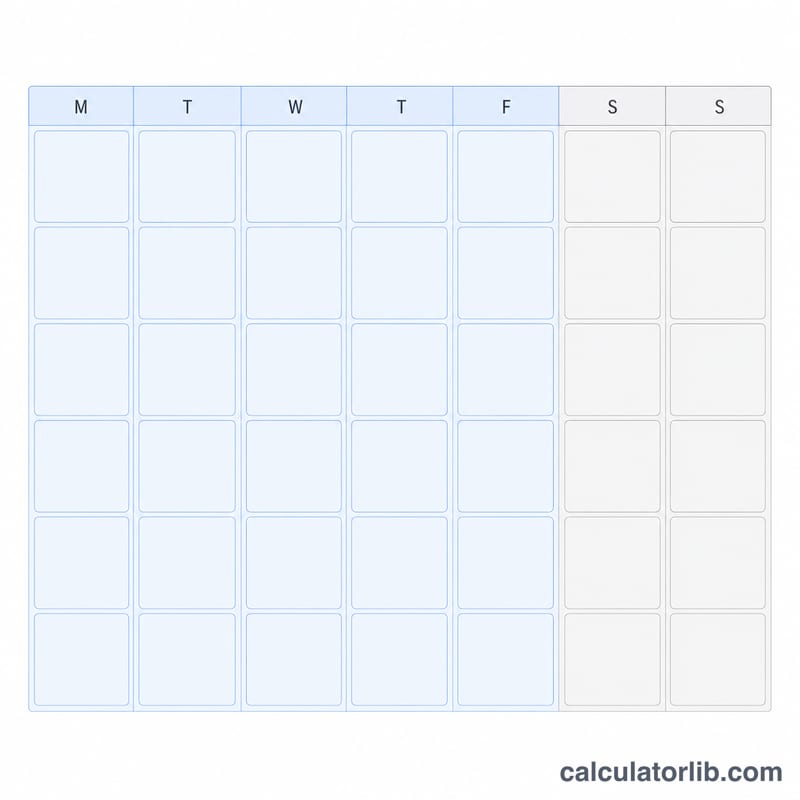
This tool counts the number of working (business) days — Monday through Friday — in any month of any year. It is handy for payroll, project planning, billing, leave accruals, and forecasting how much time a team actually has in a given month. Weekends (Saturday and Sunday) are excluded, but note that public holidays are not deducted, since holidays vary by country and region.
How to use it
Enter the year and pick the month from the dropdown, then read the result. The calculator shows the working days as the headline figure, plus a breakdown of total days, weekend days, and how many Saturdays and Sundays fall in that month.
The formula explained
The calculation is simple:
$$\text{Business Days} = \text{Total Days} - (\text{Saturdays} + \text{Sundays})$$
The tool walks through each calendar date in the month, checks which day of the week it falls on, and counts every Saturday and Sunday. Subtracting those weekend days from the month's total day count leaves the working days.

Worked example
Take February 2024 (a leap year). It has 29 days. February 2024 includes 4 Saturdays and 4 Sundays, for 8 weekend days. So working days = $$29 - 8 = 21 \text{ business days}$$.
FAQ
Does this include public holidays? No. Holidays differ by country, so only weekends are removed. Subtract any holidays manually if needed.
What counts as a weekend? Saturday and Sunday. If your region uses a different work week, the result will not match.
How many working days are in a typical year? Most years have about 260–262 working days when only weekends are excluded.