
What Is Thermal Diffusivity?
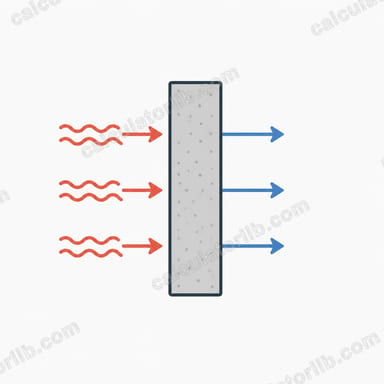
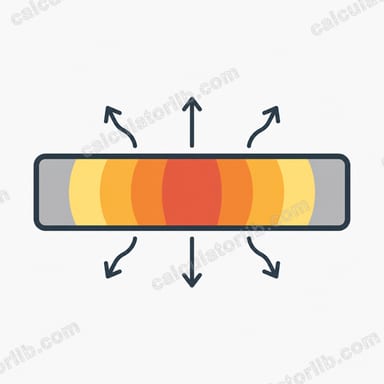
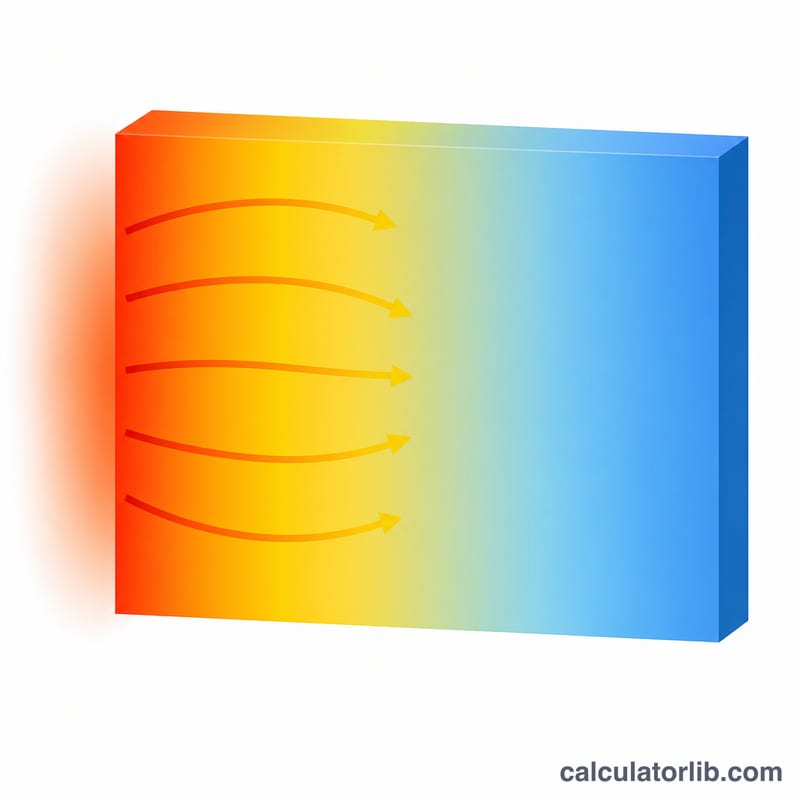
Thermal diffusivity (\(\alpha\)) measures how quickly heat spreads through a material relative to how much it stores. A high diffusivity means heat moves fast and the material reaches thermal equilibrium quickly; a low value means heat conducts slowly. It is a key property in transient heat-transfer analysis, casting, electronics cooling, and building physics. The SI unit is square metres per second (m²/s).
How to Use This Calculator
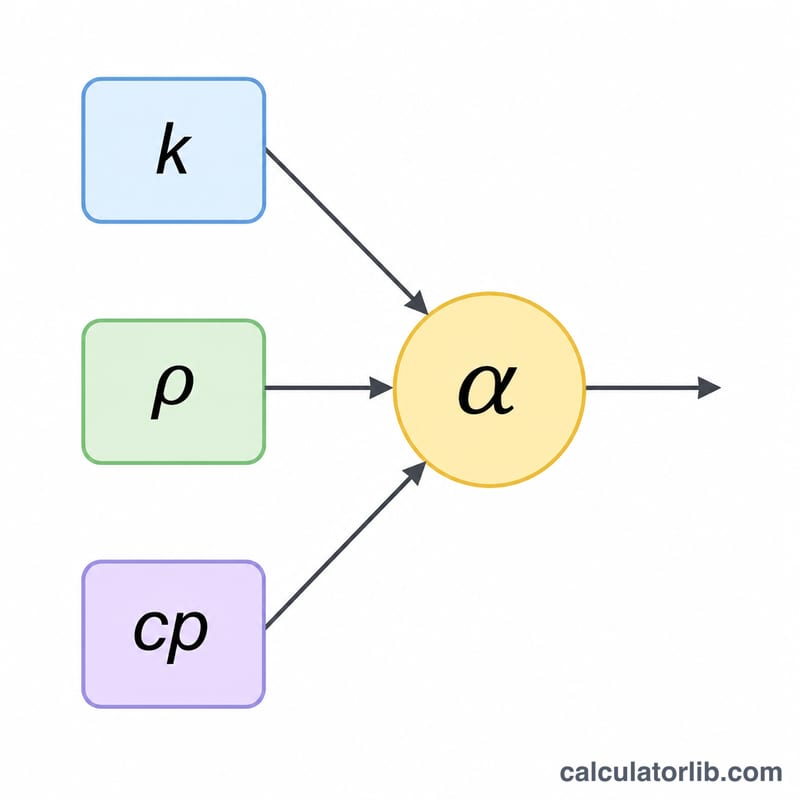
Enter three material properties: thermal conductivity k in W/m·K, density ρ in kg/m³, and specific heat capacity cp in J/kg·K. The calculator returns the thermal diffusivity in m²/s and, for convenience, in mm²/s (multiply m²/s by 1,000,000).
The Formula Explained
The defining equation is:
$$\alpha = \frac{\text{Thermal Conductivity } k}{\text{Density } \rho \cdot \text{Specific Heat } c_p}$$Here k tells you how readily a material conducts heat, while the product \(\rho \cdot c_p\) is the volumetric heat capacity — the amount of heat needed to raise a unit volume by one degree. Dividing conduction ability by heat-storage capacity gives the rate at which a temperature disturbance propagates.
Worked Example
For pure aluminium: k = 237 W/m·K, ρ = 2700 kg/m³, cp = 900 J/kg·K.
$$\alpha = \frac{237}{2700 \times 900} = \frac{237}{2{,}430{,}000} \approx 0.00009753 \ \text{m}^2/\text{s}$$or about 97.53 mm²/s. This high value explains why aluminium heats and cools so rapidly.
FAQ
What units must I use? Use consistent SI units (W/m·K, kg/m³, J/kg·K) to get \(\alpha\) in m²/s.
How does diffusivity differ from conductivity? Conductivity (\(k\)) describes steady-state heat flow; diffusivity (\(\alpha\)) describes how fast temperature changes propagate during transient conditions.
Why convert to mm²/s? Material tables often list \(\alpha\) in mm²/s because the m²/s values are very small; 1 m²/s = 1,000,000 mm²/s.