
What Is the Normal Force?
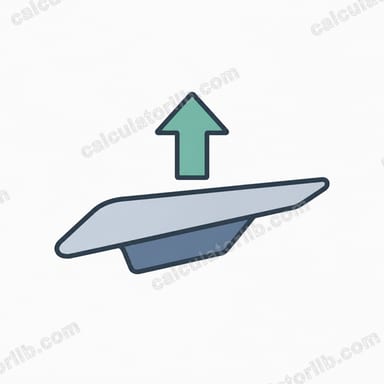
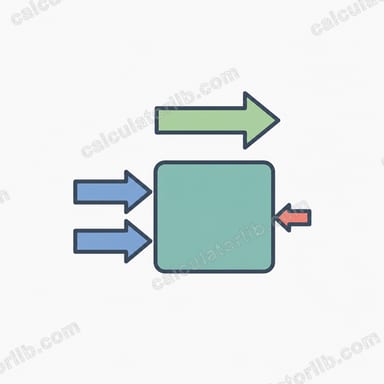
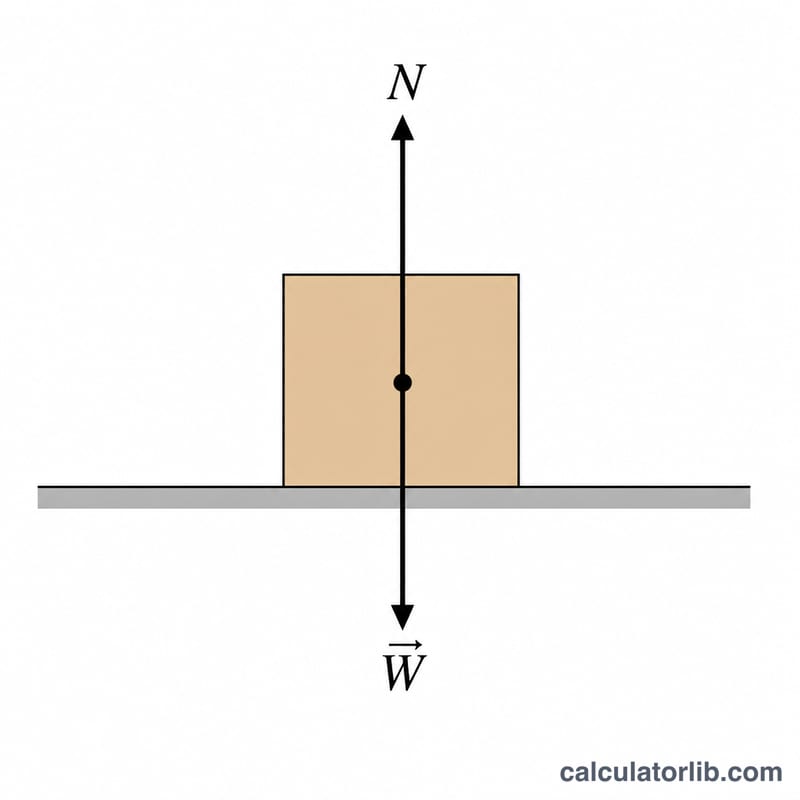
The normal force is the support force exerted by a surface perpendicular to the object resting on it. It is what prevents an object from falling through the floor or sliding ground. On a horizontal surface the normal force balances the full weight of the object, but on an inclined surface only the component of weight perpendicular to the surface must be supported, so the normal force is smaller.
How to Use This Calculator
Enter the object's mass in kilograms, the gravitational acceleration (9.81 m/s² on Earth), and the incline angle in degrees measured from the horizontal. For a flat surface, leave the angle at 0. The calculator returns the normal force in newtons along with the object's weight for comparison.
The Formula Explained
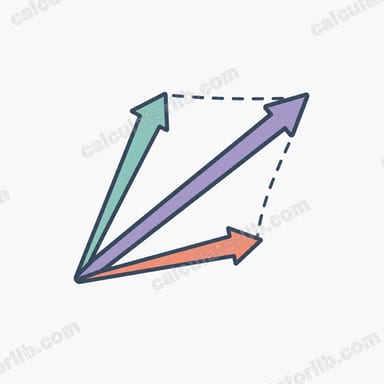
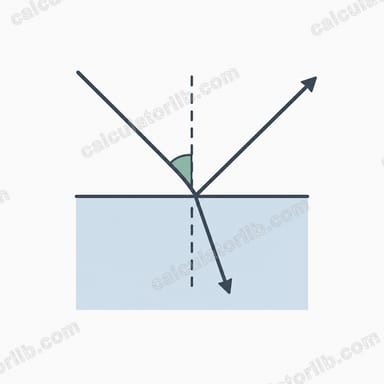
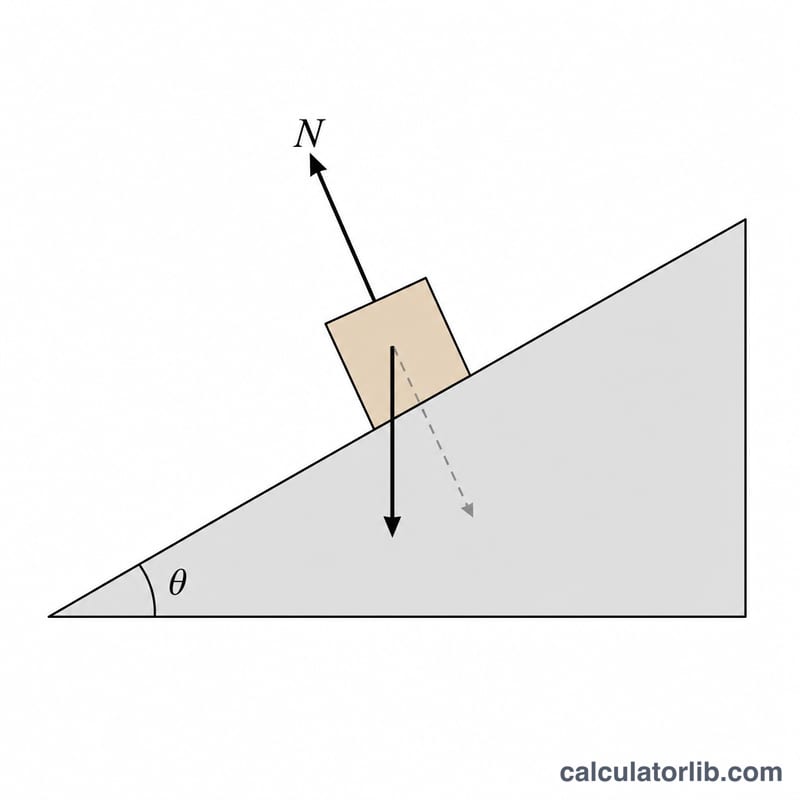
The normal force on an incline is $$N = m \cdot g \cdot \cos\!\left(\theta\right)$$, where \(m\) is mass, \(g\) is gravitational acceleration, and \(\theta\) is the incline angle. The weight of the object is \(m \cdot g\), acting straight down. Splitting that weight into components parallel and perpendicular to the slope, the perpendicular component is \(m \cdot g \cdot \cos(\theta)\) — this is what the surface must push back against. When \(\theta = 0\), \(\cos(0) = 1\) and the formula reduces to \(N = m \cdot g\).
Worked Example
A 10 kg box sits on a ramp inclined at 30° with g = 9.81 m/s². The weight is \(10 \times 9.81 = 98.1\) N. The normal force is $$98.1 \times \cos(30°) = 98.1 \times 0.8660 \approx 84.96 \text{ N}.$$ Because the surface is tilted, the normal force is less than the full 98.1 N weight.
FAQ
Does the normal force always equal weight? Only on a horizontal surface with no additional vertical forces. On an incline it is reduced by \(\cos(\theta)\).
What unit is the result in? Newtons (N), the SI unit of force.
What angle should I use for a flat floor? Use 0 degrees, which gives \(N = m \cdot g\).