
What Is a Diopter?
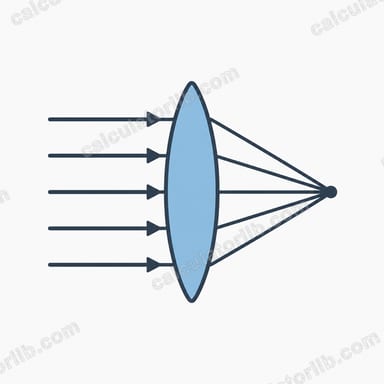
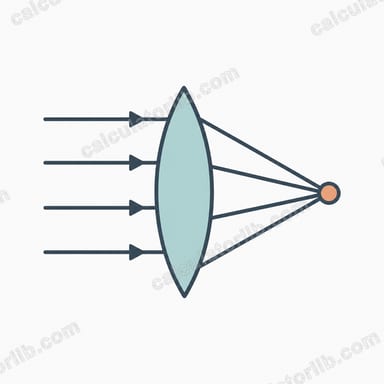
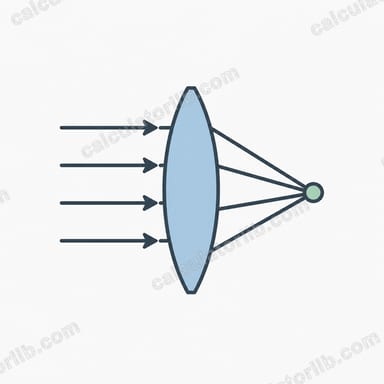
A diopter (D) is the unit used to measure the optical power of a lens or curved mirror. It is defined as the reciprocal of the focal length expressed in meters. A lens with a shorter focal length bends light more strongly and therefore has a higher diopter value. Diopters are the standard unit for prescribing eyeglasses, contact lenses, and for describing camera and microscope optics.
How to Use This Calculator
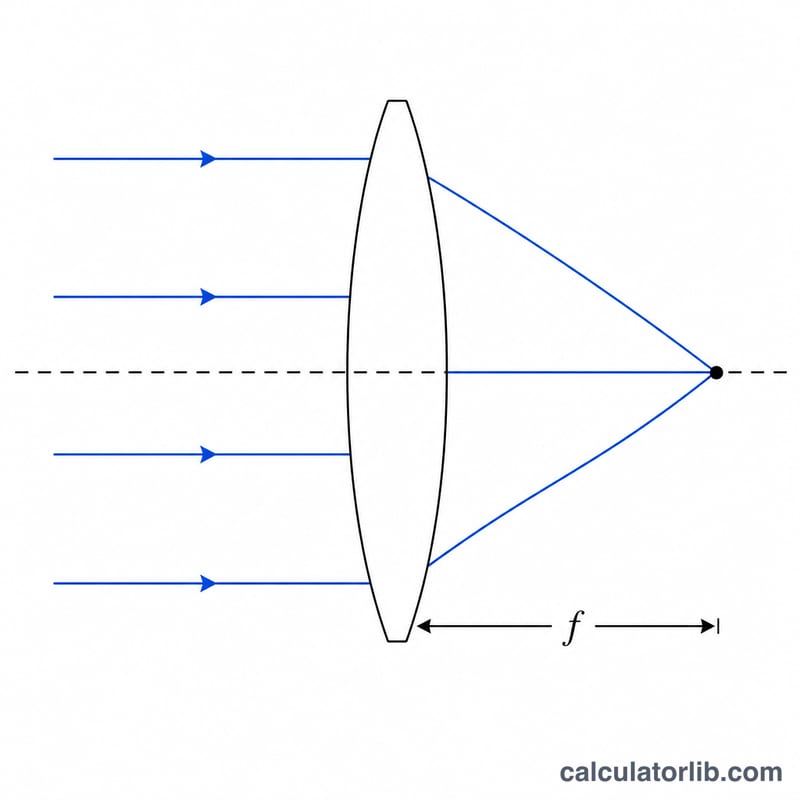
Enter the focal length of your lens in meters. If your value is in centimeters or millimeters, convert it first (1 cm = 0.01 m, 1 mm = 0.001 m). The calculator instantly returns the optical power in diopters. A positive focal length gives a positive (converging) power, while a negative focal length gives a negative (diverging) power, just like in eyewear prescriptions.
The Formula Explained
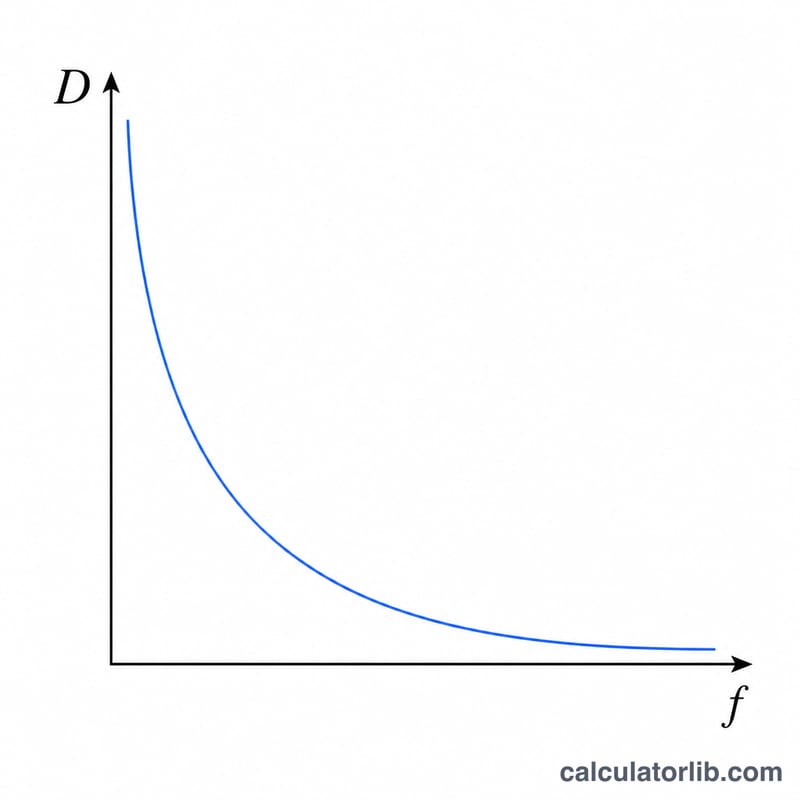
The relationship is simply $$D = \frac{1}{f}$$ where f is the focal length in meters and D is the power in diopters. Because the formula uses meters, a 1-meter focal length equals exactly 1 diopter, a 0.5-meter focal length equals 2 diopters, and a 0.25-meter focal length equals 4 diopters. The unit is intentionally additive: placing two thin lenses close together gives a combined power roughly equal to the sum of their individual diopters.
Worked Example
Suppose a magnifying lens has a focal length of 0.25 meters (25 cm). Plugging into the formula: $$D = \frac{1}{0.25} = 4 \text{ diopters}$$ This means the lens has an optical power of +4 D, a common value for reading magnifiers.
FAQ
Can the focal length be negative? Yes. Diverging (concave) lenses have a negative focal length and therefore a negative diopter value, such as -2.5 D.
What if my focal length is in millimeters? Convert to meters first by dividing by 1000. A 50 mm lens is 0.05 m, giving 20 diopters.
Why can't focal length be zero? A focal length of zero would imply infinite power, which is undefined, so the calculator requires a non-zero value.