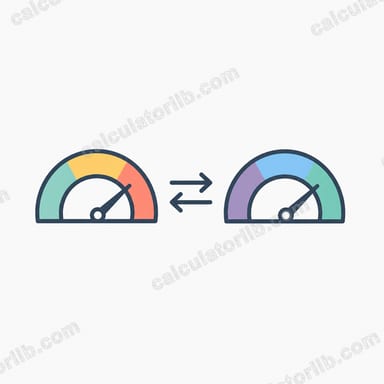

What is the Data Transfer Rate Converter?
This tool converts a data transfer rate from one unit to another. It supports decimal (SI) bit units — bit/s, Kbps, Mbps, Gbps — and the corresponding byte units — B/s, KB/s, MB/s, GB/s. Because internet speeds are usually advertised in megabits per second (Mbps) while file managers report megabytes per second (MB/s), this converter helps you translate between the two without confusion.
How to use it
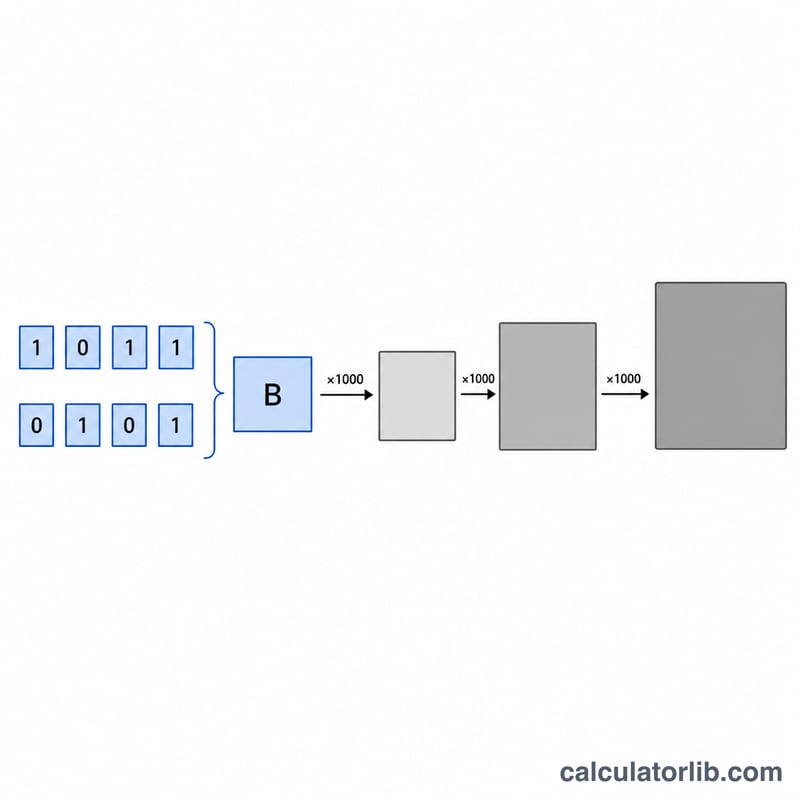
Enter a numeric value, choose the unit you are converting from, and the unit you want the answer in. The calculator first turns your value into bits per second, then divides by the target unit factor. Note that 1 byte = 8 bits, so a 100 Mbps connection equals only 12.5 MB/s of download throughput.
The formula explained
Every unit is expressed as a number of bits per second: bit/s = 1, Kbps = 1,000, Mbps = 1,000,000, Gbps = 1,000,000,000, B/s = 8, KB/s = 8,000, MB/s = 8,000,000, GB/s = 8,000,000,000. The conversion is $$\text{result} = \frac{\text{value} \times \text{factor\_from}}{\text{factor\_to}}$$ These are decimal (×1000) prefixes, which is the standard for networking equipment.
Worked example
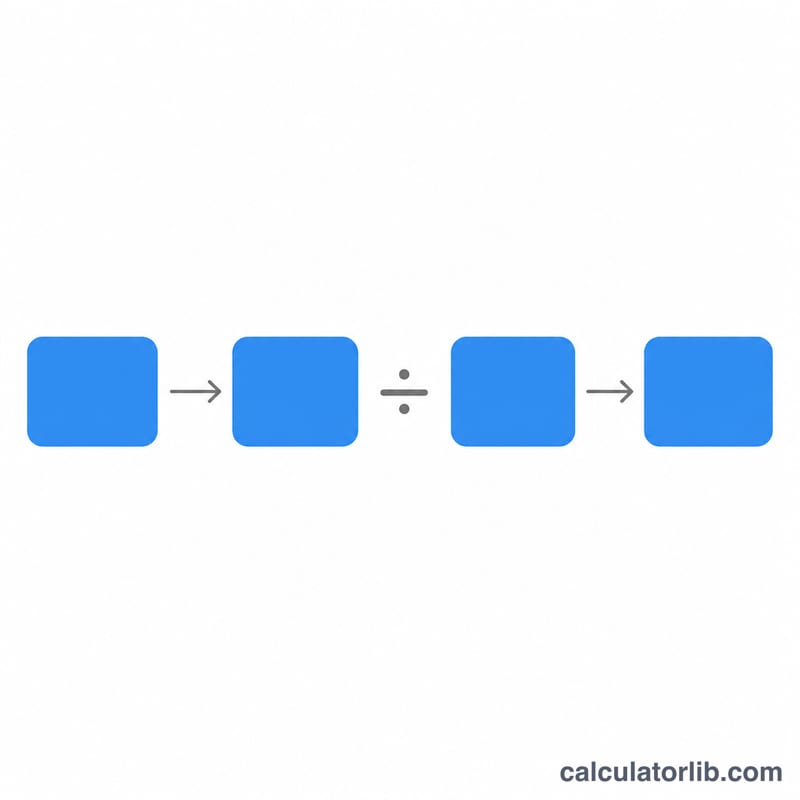
Convert 100 Mbps to MB/s. Step 1: bits/s = \(100 \times 1{,}000{,}000 = 100{,}000{,}000\) bit/s. Step 2: result = \(100{,}000{,}000 \div 8{,}000{,}000 = 12.5\) MB/s. So a 100 Mbps line delivers up to 12.5 megabytes per second.
FAQ
Why is Mbps not the same as MB/s? A byte is 8 bits, so MB/s is 8× larger than Mbps. Always divide Mbps by 8 to estimate MB/s download speed.
Does this use 1000 or 1024? Networking rates use decimal multiples (1 Kbps = 1000 bit/s), so this converter uses 1000-based factors.
Can I convert Gbps to MB/s? Yes — pick Gbps as the source and MB/s as the target. For example, 1 Gbps = 125 MB/s.