
What is the Mbps to MB/s Converter?
Internet plans and network speeds are almost always advertised in megabits per second (Mbps), but file sizes and download managers usually report in megabytes per second (MB/s). Because there are 8 bits in a byte, these two numbers are very different — a "100 Mbps" connection actually downloads at about 12.5 MB/s. This converter does that translation instantly.
How to use it
Enter your connection or transfer speed in Megabits per second (Mbps) — for example the number from your internet plan or a speed test. The calculator divides it by 8 and shows the equivalent speed in Megabytes per second (MB/s), which is the rate you will see when downloading a file.
The formula explained
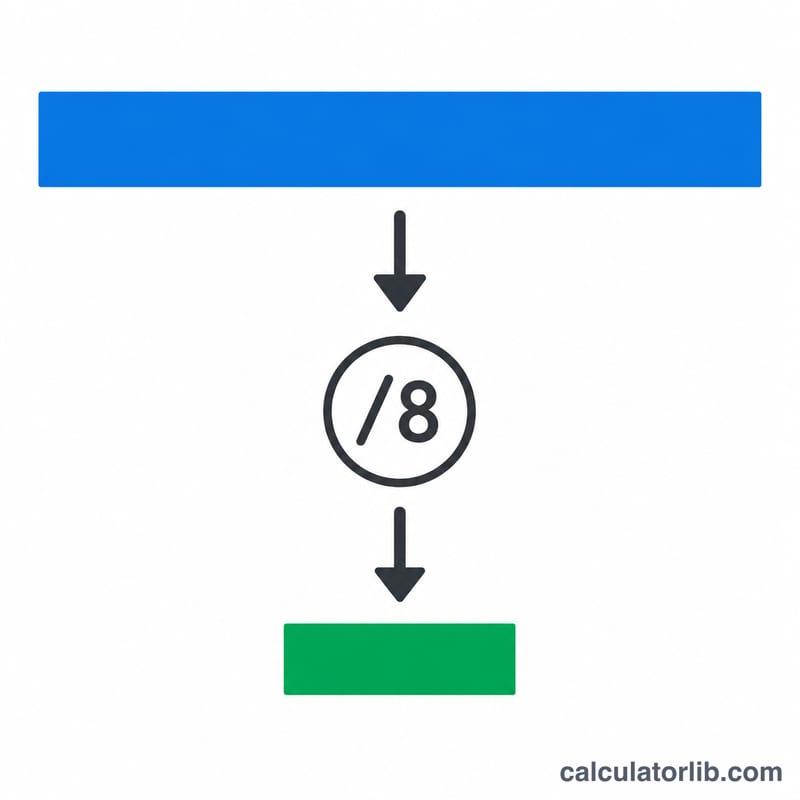
The conversion is a simple division:
$$\text{MB/s} = \frac{\text{Mbps}}{8}$$
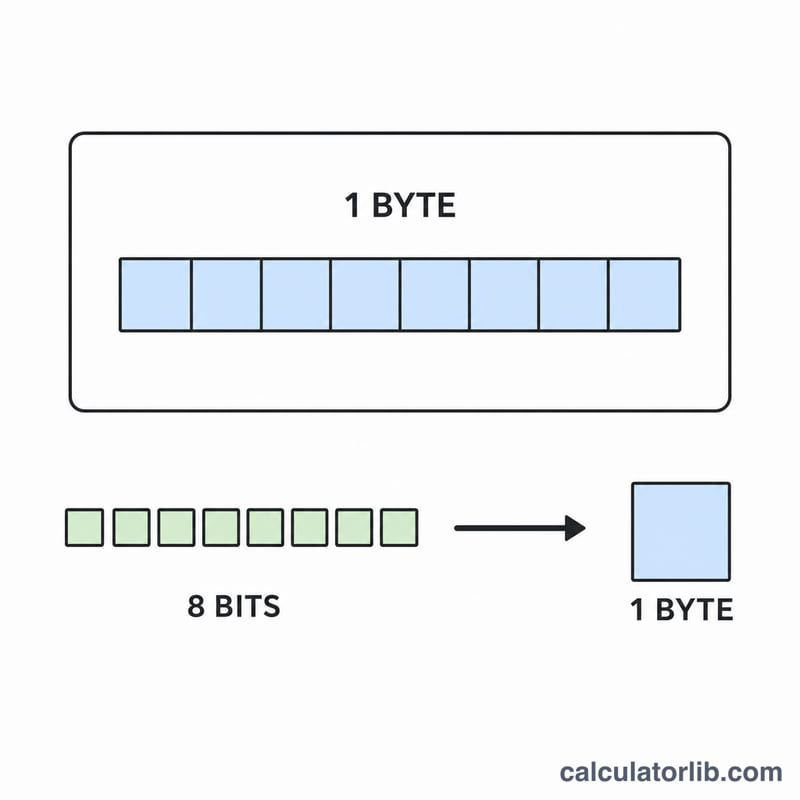
This works because a byte is defined as 8 bits. Network speeds are measured in bits (the small "b"), while storage and files are measured in bytes (the capital "B"). Dividing by 8 moves you from the bit world to the byte world.
Worked example
Suppose your broadband plan is rated at 200 Mbps. Dividing by 8 gives $$200 \div 8 = 25 \text{ MB/s}.$$ So a 1 GB (1000 MB) game would, at full speed, take roughly \(1000 \div 25 = 40\) seconds to download.
FAQ
Why is my download speed so much lower than my plan? Your plan is in megabits; downloads are shown in megabytes, which are 8× larger units. They look slower but represent the same speed.
Is this the same as Mb to MB? Yes — the "per second" applies to both sides, so converting Mbps to MB/s uses the same divide-by-8 rule as converting megabits to megabytes.
Does overhead affect the result? This converter gives the theoretical maximum. Real-world speeds are slightly lower due to protocol overhead, congestion, and Wi-Fi losses.