
What Is the Mbps to Gbps Converter?
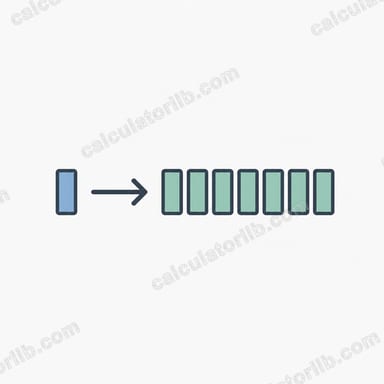
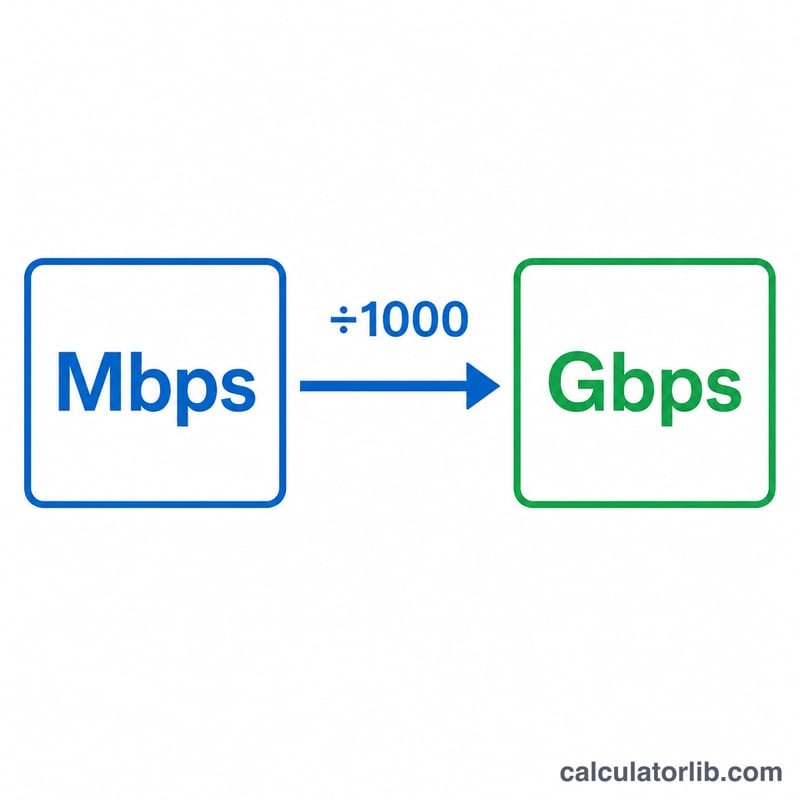
This tool converts data transfer speeds expressed in megabits per second (Mbps) into gigabits per second (Gbps). Both units measure network throughput — how fast data moves across an internet or local connection. Because a gigabit is 1,000 megabits, you simply divide by 1000 to switch from the smaller unit to the larger one. This is a universal unit conversion and applies anywhere in the world.
How to Use It
Enter your speed in Mbps — for example the number quoted on your broadband plan or a speed-test result — then read off the equivalent Gbps value. The converter accepts decimals, so partial speeds like 250.5 Mbps work fine.
The Formula Explained
The relationship between the two units is fixed: $$\text{Gbps} = \frac{\text{Mbps}}{1000}$$ The prefix "giga" is 1,000 times larger than "mega" in the decimal (SI) system used for network data rates. Note that data rates use base-1000 (decimal), unlike storage capacity which sometimes uses base-1024 for "gibibytes". For bandwidth, 1 Gbps always equals 1000 Mbps.
Worked Example
Suppose your fiber plan advertises 940 Mbps. Dividing by 1000 gives 0.94 Gbps:
$$\frac{940}{1000} = 0.94 \text{ Gbps}$$Likewise a 2,500 Mbps (2.5G) connection equals 2.5 Gbps, and a 10,000 Mbps line equals 10 Gbps.
FAQ
Is 1000 Mbps the same as 1 Gbps? Yes. A 1,000 Mbps (often marketed as "1 Gig") plan is exactly 1 Gbps.
Does this convert bits or bytes? Both Mbps and Gbps measure bits per second. To get bytes per second (MBps/GBps), divide by 8 separately.
Why divide by 1000 and not 1024? Network speeds use the decimal SI standard, where giga = 1,000 mega. The 1024 factor applies to binary storage units, not transfer rates.