What is the Kbps to Mbps Converter?
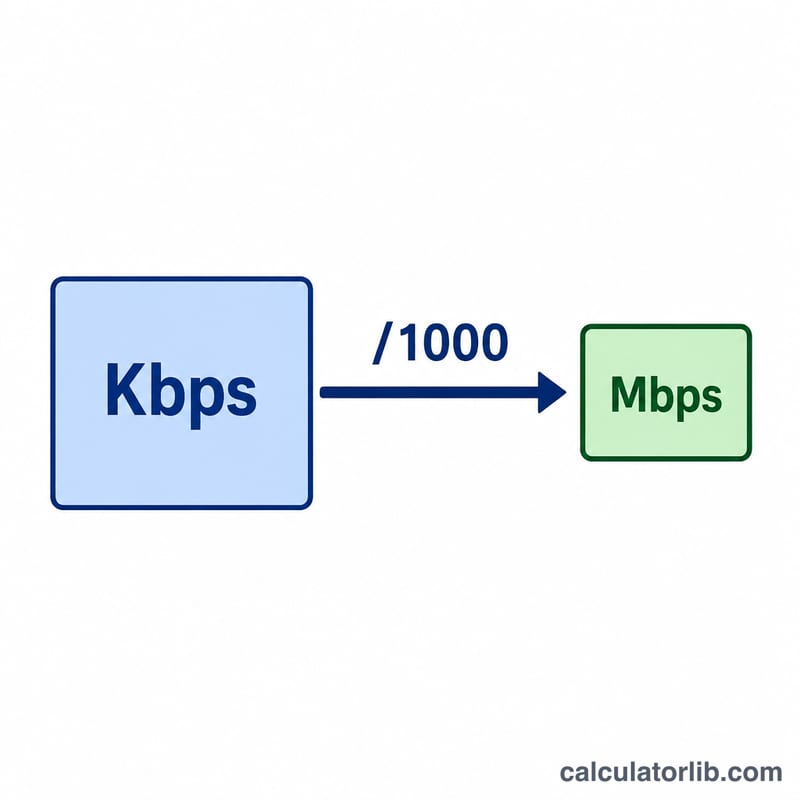
This tool converts a data-transfer rate expressed in kilobits per second (Kbps) into megabits per second (Mbps). Both are common units used to describe internet bandwidth, download speeds, streaming bitrates, and network throughput. Because one megabit equals 1,000 kilobits, converting between the two is a simple division.
How to use it
Enter your speed in Kbps in the input box and the converter instantly shows the equivalent in Mbps. For example, an internet plan advertised as 50,000 Kbps is the same as 50 Mbps.
The formula explained
The conversion uses the decimal (SI) convention common in networking and telecommunications, where the "kilo" prefix means 1,000:
$$\text{Mbps} = \frac{\text{Kbps}}{1000}$$
Note this is the bit-rate (decimal) convention, not the binary 1024 factor used for file-size memory units. For network speeds, providers and standards use 1000.
Worked example
Suppose your connection runs at 8,000 Kbps. Divide by 1000: $$8{,}000 \div 1000 = 8 \text{ Mbps}$$ So 8,000 Kbps equals 8 Mbps.
Typical Bitrates and Speeds in Kbps and Mbps
The table below lists commonly cited approximate bitrates for everyday uses. Actual values vary by service, codec, quality setting and network conditions, so treat them as rough guides rather than fixed standards. This converter uses decimal (SI) units: 1 Mbps = 1,000 Kbps, so \(\text{Mbps} = \text{Kbps} \div 1000\).
| Use case | Approx. Kbps | Approx. Mbps |
|---|---|---|
| Voice call (VoIP) | 64–100 Kbps | 0.064–0.1 Mbps |
| Music streaming | 128–320 Kbps | 0.128–0.32 Mbps |
| SD video | 1,000–3,000 Kbps | 1–3 Mbps |
| HD video (720p/1080p) | 3,000–8,000 Kbps | 3–8 Mbps |
| 4K video streaming | 15,000–25,000 Kbps | 15–25 Mbps |
Example: a 320 Kbps music stream is \(\frac{320}{1000} = \) 0.32 Mbps.
Note: Kbps and Mbps measure bits per second, not bytes. Divide by 8 to estimate bytes per second. Streaming services also need some headroom above the bitrate for a stable connection.
FAQ
Is it 1000 or 1024? For data-transfer rates (Kbps/Mbps), the standard factor is 1000. The 1024 factor applies to binary storage units like KiB/MiB.
How do I convert Mbps back to Kbps? Multiply by 1000. For instance, \(5 \text{ Mbps} = 5{,}000 \text{ Kbps}\).
Are bits and bytes the same? No. Speeds in Kbps/Mbps use bits (lowercase b). To get megabytes per second (MB/s), divide Mbps by 8.