
What is the Flight Carbon Footprint Calculator?
This tool estimates how much carbon dioxide (CO₂) your air travel releases. Aviation is a significant source of greenhouse-gas emissions, and a single long-haul flight can produce more CO₂ per passenger than many people generate in months of daily life. By entering your flight distance, cabin class, number of passengers and whether the trip is round trip, you get a quick estimate of your share of the climate impact.
How to use it
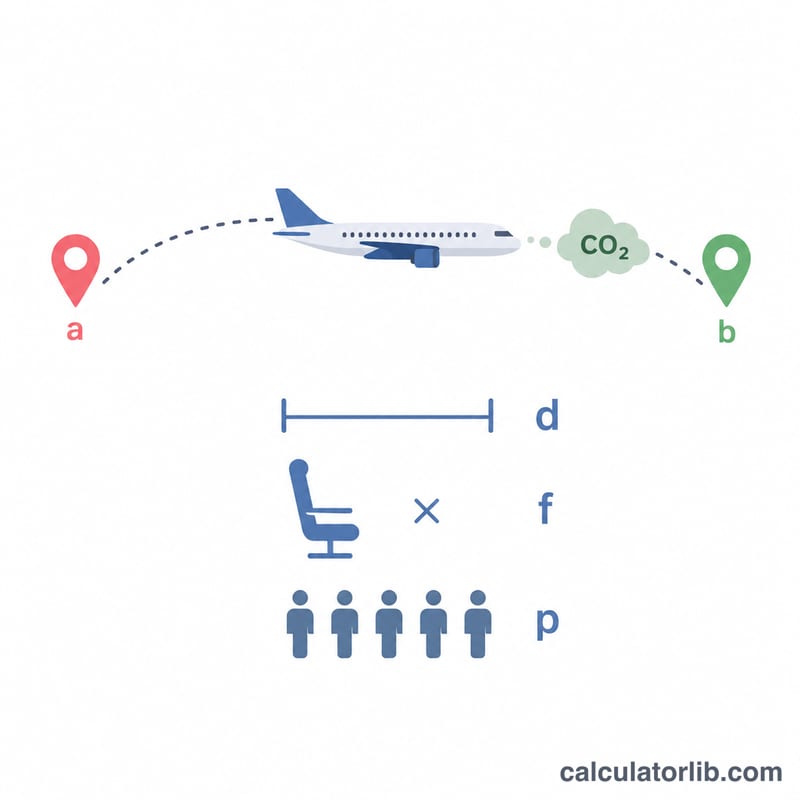
Enter the one-way distance between your origin and destination in kilometres (you can look up great-circle distances online). Choose your cabin class — premium cabins take up more space and therefore carry a higher emission factor. Set the number of passengers travelling on the same tickets, then pick round trip or one way. The calculator multiplies these together to estimate total kilograms of CO₂.
The formula explained
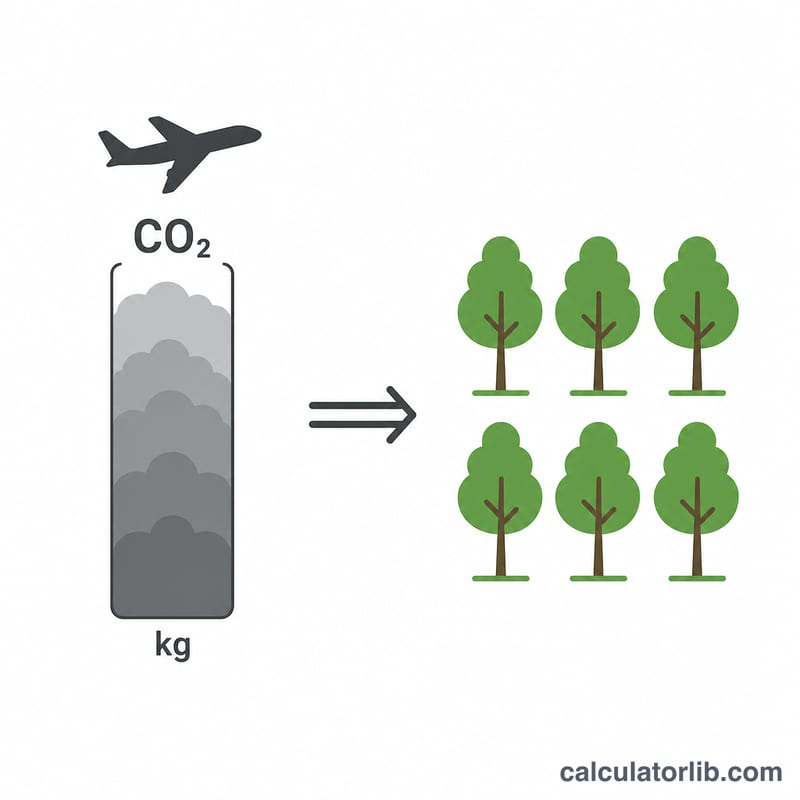
The core equation is $$\text{CO}_2 \text{ (kg)} = \text{distance} \times \text{emission factor} \times \text{passengers}$$ The emission factor reflects kilograms of CO₂ per passenger-kilometre: roughly \(0.115\) for economy, \(0.18\) for business and \(0.46\) for first class. For round trips the distance is doubled. We also estimate the number of mature trees that would need to grow for a year (each absorbing about \(21.77\) kg CO₂) to offset the journey.
Worked example
A round-trip economy flight of 2,000 km one-way for 2 passengers: total distance = \(2{,}000 \times 2 = 4{,}000\) km. $$\text{CO}_2 = 4{,}000 \times 0.115 \times 2 = 920 \text{ kg}$$ or 460 kg per passenger. That equals roughly 42 trees growing for a year to offset.
FAQ
Are these numbers exact? No — they are estimates. Real emissions depend on aircraft type, load factor, weather and routing. Airline and carbon-registry calculators may differ.
Why is first class so much higher? Premium seats occupy more cabin space, so each passenger is allocated a larger share of the aircraft's total fuel burn.
Does this include radiative forcing? No. The basic factors here count CO₂ only; high-altitude non-CO₂ effects can roughly double the true warming impact.