
What This Calculator Does
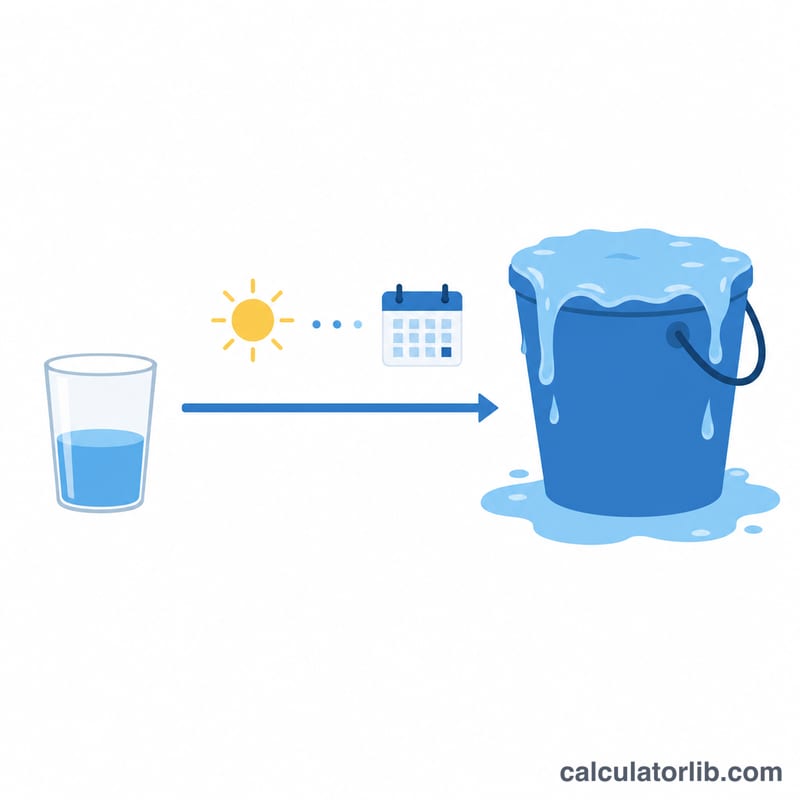
A faucet that drips even slowly can waste a surprising amount of water over a year. This calculator estimates the total water lost by a dripping tap based on two simple inputs: the number of drips per minute and the volume of each drop. It reports the waste per day and per year in both liters and US gallons so you can understand the real cost of an unrepaired leak.
How to Use It
Count the drips from your faucet over one minute and enter that number. Then enter the volume of a single drop in milliliters. A typical water drop is about 0.05 mL (roughly 20 drops per milliliter), which is a good default if you don't know the exact size. Click calculate to see the estimated waste.
The Formula Explained
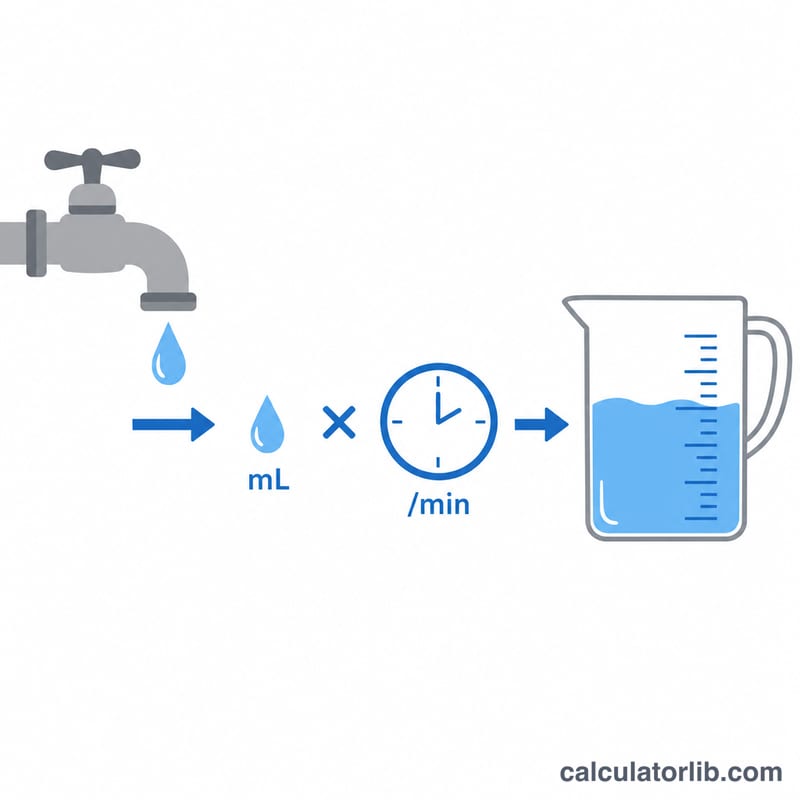
The calculation multiplies the drip rate by the number of minutes in a year, then by the drop volume:
$$\text{Water (L/yr)} = \frac{\text{drips/min} \times 1440 \times 365 \times \text{drop\_volume\_mL}}{1000}$$
There are 1440 minutes in a day and 365 days in a year. Dividing by 1000 converts milliliters to liters. Multiplying liters by \(0.264172\) gives US gallons.
Worked Example
Suppose a faucet drips 10 times per minute and each drop is 0.05 mL. Drips per day = \(10 \times 1440 = 14{,}400\). Drips per year = \(14{,}400 \times 365 = 5{,}256{,}000\). Water = $$\frac{5{,}256{,}000 \times 0.05}{1000} = 262.8 \text{ liters per year}$$ or about 69.4 US gallons.
FAQ
Is a drop really 0.05 mL? Drop size varies with faucet and water pressure, but 0.04–0.05 mL (about 20 drops per mL) is a common estimate.
How do I count drips per minute? Use a stopwatch and count the drips for 60 seconds, or count for 15 seconds and multiply by four.
Does this include the cost of water? No, it estimates volume only. Multiply the annual liters or gallons by your local water rate to estimate cost.