
What Is the Kaya Identity?
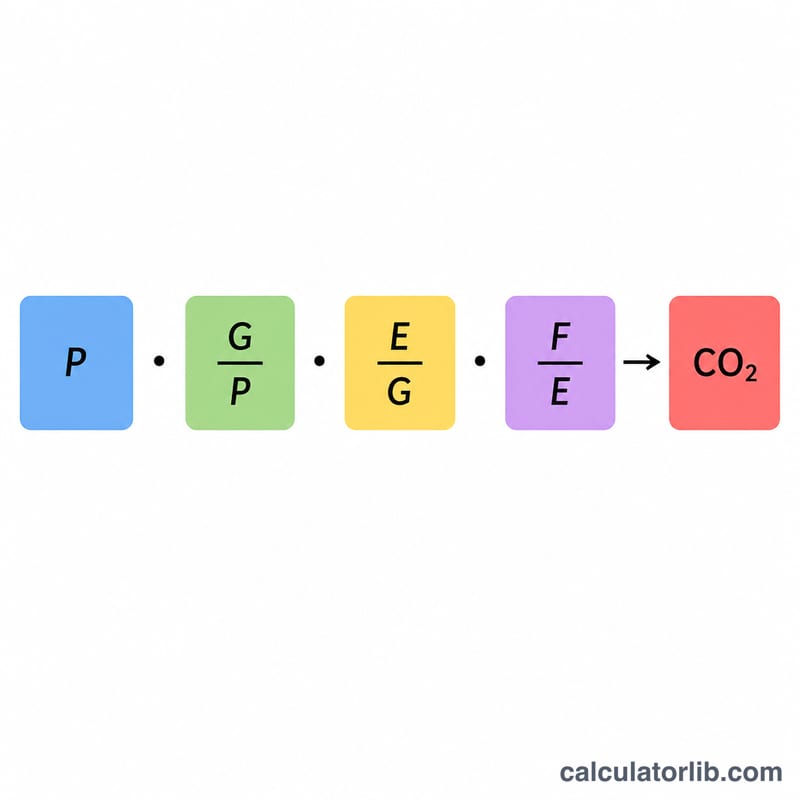
The Kaya identity is a mathematical relationship, proposed by Japanese economist Yoichi Kaya, that expresses total human-caused CO₂ emissions as the product of four driving factors: population, affluence (GDP per person), energy intensity of the economy, and carbon intensity of energy. Because the population and GDP terms cancel algebraically, the identity is always exactly true — its value lies in decomposing emissions into intuitive, policy-relevant drivers used widely by the IPCC.
How to Use This Calculator
Enter the four inputs: total population, GDP per capita (in dollars per person), energy intensity (gigajoules of energy consumed per dollar of GDP), and carbon intensity (tonnes of CO₂ emitted per gigajoule of energy). The calculator multiplies them together to give total annual CO₂ emissions, plus the intermediate total GDP and total energy use.
The Formula Explained
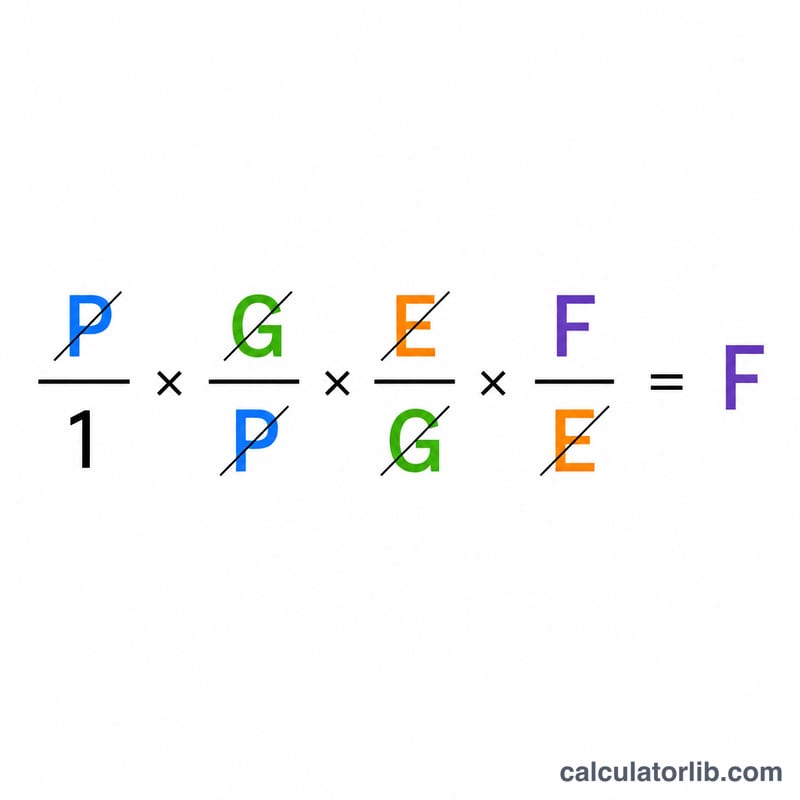
$$\text{CO}_2 = \text{Population} \times \frac{\text{GDP}}{\text{Population}} \times \frac{\text{Energy}}{\text{GDP}} \times \frac{\text{CO}_2}{\text{Energy}}$$ Each ratio captures a lever: economic activity per person, how much energy the economy needs, and how dirty that energy is. Lowering any factor (without raising the others) reduces emissions.
Worked Example
For a country of 1,000,000 people with GDP per capita of $50,000, energy intensity of 0.005 GJ/$, and carbon intensity of 0.07 tCO₂/GJ: total GDP = $50 billion; total energy = 250,000,000 GJ; total CO₂ = 17,500,000 tonnes.
$$1{,}000{,}000 \times 50{,}000 \times 0.005 \times 0.07 = 17{,}500{,}000 \text{ tonnes}$$
FAQ
Are the units fixed? No — the identity holds for any consistent units. Just make sure your energy-intensity and carbon-intensity units cancel correctly so the result is the CO₂ unit you intend.
Why does it always balance? The Population and GDP terms appear in both numerator and denominator and cancel, leaving only \(\text{Energy} \times \frac{\text{CO}_2}{\text{Energy}} = \text{CO}_2\). It is an identity, not an estimate.
Can it predict future emissions? Yes, by projecting each factor forward — this is how scenario analysts model emission pathways.