
What Is the Cryptocurrency Footprint Calculator?
This tool estimates the carbon footprint of cryptocurrency activity by converting transaction volume into kilograms of CO₂ emissions. Proof-of-work networks like Bitcoin consume large amounts of electricity per transaction, and that electricity carries a carbon cost that depends on how clean the underlying power grid is. The calculator is universal — it works for any coin and any region as long as you supply the right inputs.
How to Use It
Enter three values: the number of transactions you want to assess, the energy per transaction in kilowatt-hours (kWh), and your grid emission factor in kg CO₂ per kWh. Bitcoin's energy per transaction is often estimated at several hundred kWh, while the global average grid factor is roughly 0.475 kg CO₂/kWh. Adjust these to match the network and country you care about.
The Formula Explained
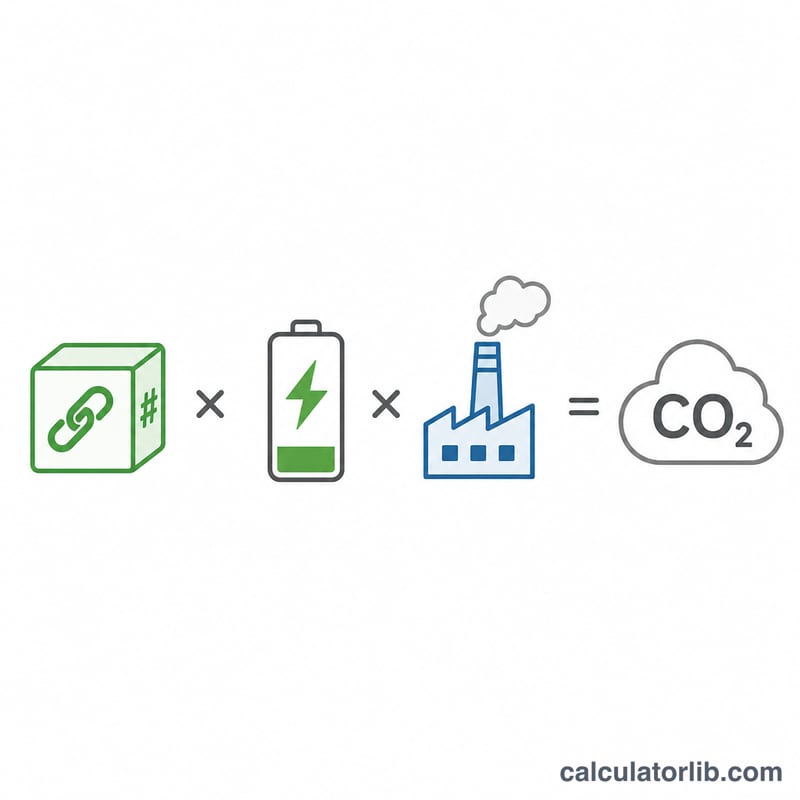
The core equation is:
$$\text{CO}_2\ (\text{kg}) = \text{Transactions} \times \text{Energy/Tx (kWh)} \times \text{Grid Factor (kg CO}_2\text{/kWh)}$$
First the transaction count is multiplied by the per-transaction energy to get total kWh consumed. That energy total is then multiplied by the grid emission factor to convert electricity into carbon dioxide. We also report tonnes (kg ÷ 1000) and an approximate number of trees needed to offset the emissions over one year (about 21 kg CO₂ absorbed per tree per year).
Worked Example
Suppose you analyze 10 Bitcoin transactions at 703 kWh each on the global average grid (0.475 kg CO₂/kWh). Total energy = \(10 \times 703 = 7{,}030\) kWh. CO₂ = \(7{,}030 \times 0.475 =\) 3,339.25 kg, or about 3.34 tonnes — roughly 159 trees' worth of yearly carbon absorption.
FAQ
Where do I find the energy per transaction? Indexes such as the Cambridge Bitcoin Electricity Consumption Index publish estimates; values vary widely between proof-of-work and proof-of-stake coins.
What grid factor should I use? Use your country's published electricity emission factor. Cleaner grids (hydro, nuclear, solar) have far lower factors than coal-heavy grids.
Is this an exact measurement? No. It is an estimate. Real footprints depend on the exact mining mix, hardware efficiency, and energy sources used.