
What is an SLA Downtime Calculator?
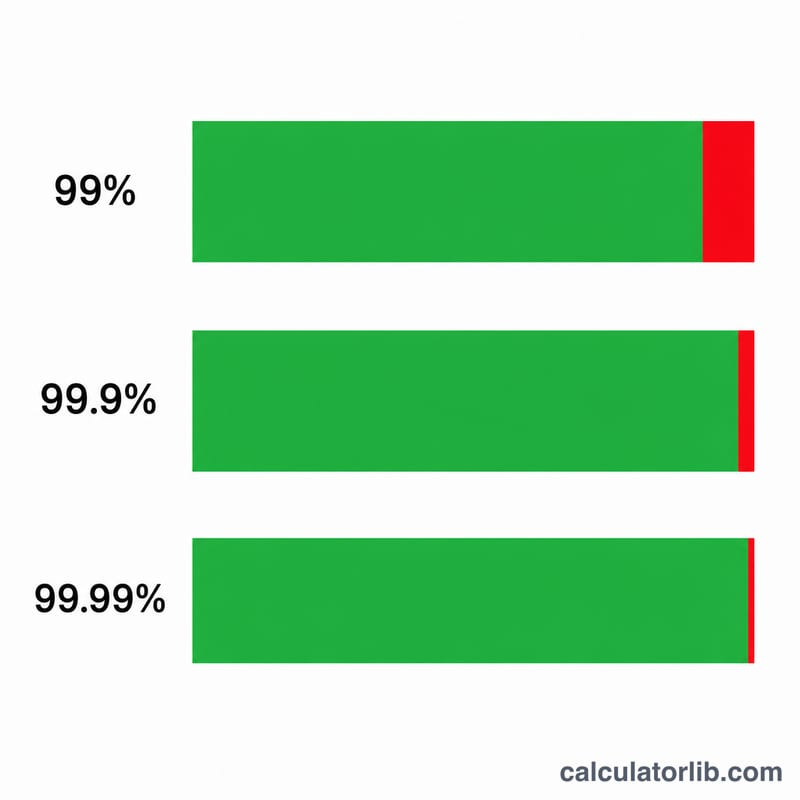
A Service Level Agreement (SLA) defines how available a service must be, expressed as an uptime percentage such as 99.9% ("three nines"). This calculator turns that percentage into the concrete amount of downtime you are allowed before breaching the SLA, over a day, week, month, quarter or year. It is a universal math tool — the numbers apply to any hosting provider, cloud platform or contract worldwide.
How to use it
Enter your target SLA uptime percentage (for example 99.95) and pick the time period you want to measure against. The calculator outputs the maximum allowed downtime in seconds, minutes, hours and days, plus the required uptime. Periods assume a 30-day month, a 91.25-day quarter and a 365-day year.
The formula explained
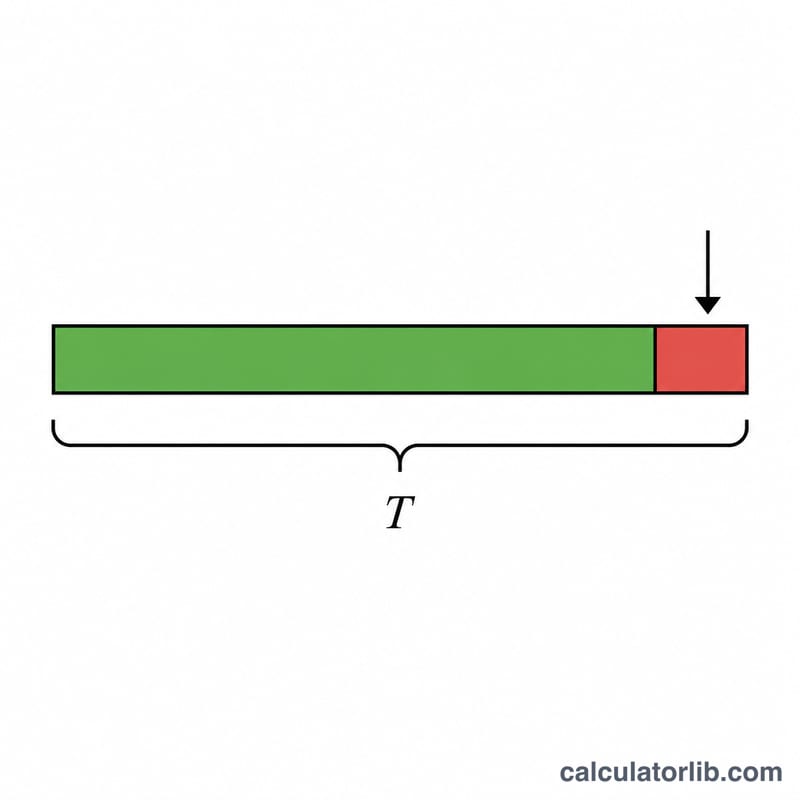
The total period is converted into minutes. Allowed downtime is the period multiplied by one minus the SLA fraction: $$\text{Downtime} = \text{Period} \times \left(1 - \frac{\text{SLA\%}}{100}\right)$$. For a yearly period that is \(525{,}600\) minutes. A 99.9% SLA leaves 0.1% of the period as downtime.
Worked example
For a 99.9% yearly SLA: $$525{,}600 \times (1 - 0.999) = 525{,}600 \times 0.001 = 525.6 \text{ minutes}$$ 525.6 minutes ≈ 8.76 hours ≈ 0.365 days of allowed downtime per year. A stricter 99.99% SLA would allow only 52.56 minutes per year.
FAQ
What do "three nines" and "four nines" mean? They refer to 99.9% and 99.99% uptime respectively. Each additional nine cuts allowed downtime by a factor of ten.
How many minutes are in a year? \(365 \text{ days} \times 24 \text{ hours} \times 60 \text{ minutes} = 525{,}600 \text{ minutes}\).
Does this account for leap years? No — it uses a standard 365-day year. For a leap year multiply by \(366/365\) if you need exact figures.