
What is an SLA uptime calculator?
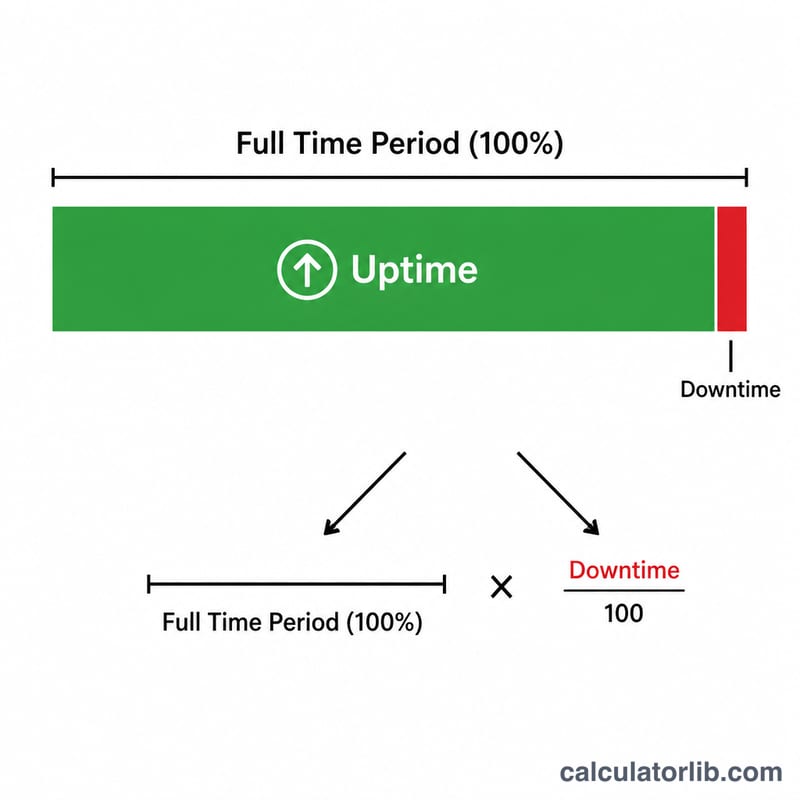
A Service Level Agreement (SLA) states how available a service should be, usually as a percentage such as 99.9% ("three nines"). This calculator converts that uptime guarantee into the maximum amount of allowed downtime over a chosen period — per day, week, month, quarter or year — and expresses it in seconds, minutes, hours and days so you can verify whether your provider is meeting its promise.
How to use it
Enter your SLA percentage (for example 99.95) and pick the period you want to measure. The result shows how much outage time is permitted within that window. Months use 30.4375 days, quarters 91.3125 days and years 365.25 days to average out calendar variation.
The formula explained
The unavailability fraction is simply \(1 - \frac{\text{SLA (\%)}}{100}\). Multiply it by the total length of the period to get the allowed downtime. For minutes, convert the period to minutes first: \(\text{days} \times 24 \times 60\). So for a year, that is 525,960 minutes total.
$$\text{Downtime (min)} = \text{Period Days} \times 1440 \times \left(1 - \frac{\text{SLA (\%)}}{100}\right)$$
Worked example
For a 99.9% SLA measured per year: unavailability = \(1 - 0.999 = 0.001\). A year is \(365.25 \times 1440 = 525{,}960\) minutes. Allowed downtime = \(525{,}960 \times 0.001 =\) 525.96 minutes, which is about 8.77 hours per year.
FAQ
What does "five nines" mean? 99.999% uptime, allowing only about 5.26 minutes of downtime per year.
Does the calculator use 365 or 365.25 days? It uses 365.25 days per year to average for leap years; you can use the per-day option for an exact 24-hour window.
Is planned maintenance counted? That depends on your contract — many SLAs exclude scheduled maintenance windows from downtime totals, so check the agreement terms.