
What is a megapixel?
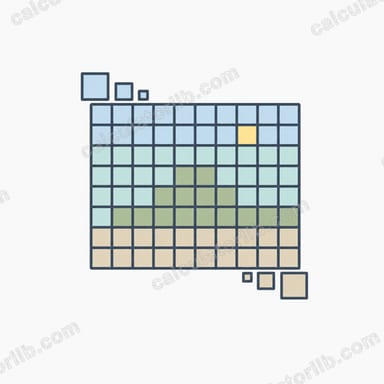
A megapixel (MP) equals one million pixels. It is the standard way to describe how many individual dots an image or camera sensor contains. This Megapixel Calculator converts any width × height pixel resolution into megapixels, so you can quickly compare cameras, screens, scans, and exported images.
How to use this calculator
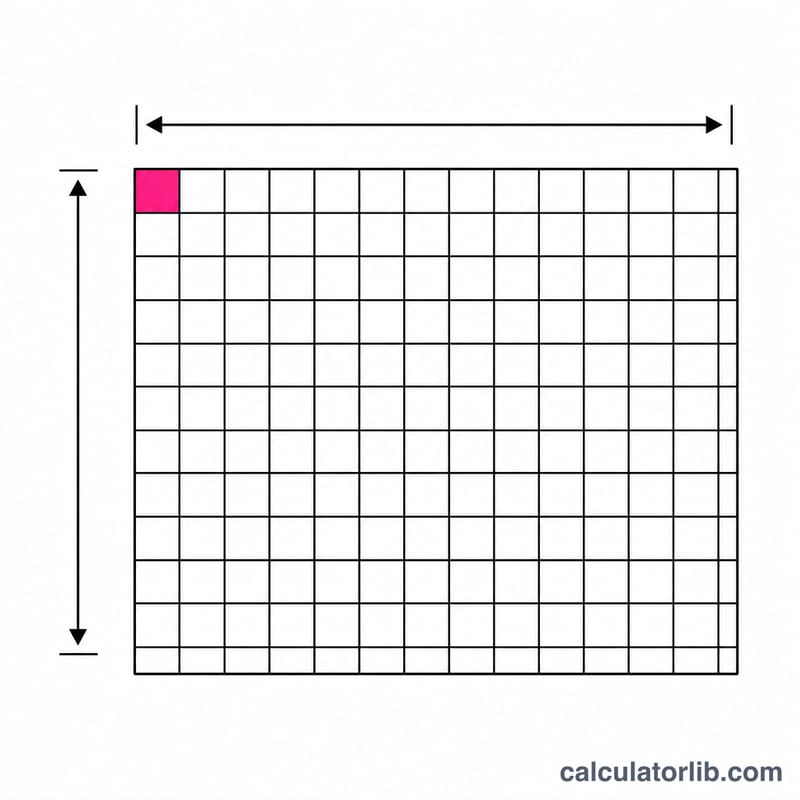
Enter the image width and height in pixels — for example a 4000 × 3000 photo. The calculator multiplies the two values to get the total pixel count, then divides by 1,000,000 to express it in megapixels. It also reports the aspect ratio (width ÷ height) so you can see whether the image is 4:3, 16:9, or another shape.
The formula explained
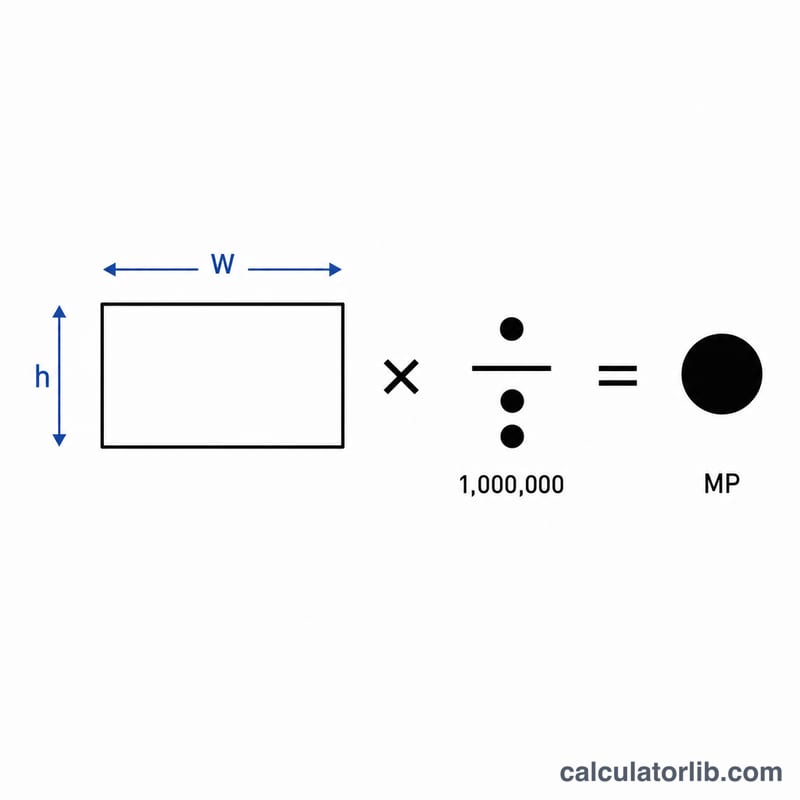
The math is simple: $$\text{MP} = \frac{\text{width} \times \text{height}}{1{,}000{,}000}$$ Because a megapixel is exactly one million pixels, you only need the pixel dimensions. Note that marketed camera megapixels are sometimes rounded, so a "12 MP" camera may produce \(4032 \times 3024 = 12{,}192{,}768\) pixels \(\approx 12.19\) MP.
Worked example
Take a 1920 × 1080 Full HD frame. Total pixels = \(1920 \times 1080 = 2{,}073{,}600\). Megapixels = $$2{,}073{,}600 \div 1{,}000{,}000 = 2.0736 \text{ MP}$$ The aspect ratio is \(1920 \div 1080 = 1.778\), which is the familiar 16:9.
FAQ
Why does my photo say 12 MP but the math gives 12.19? Manufacturers round to a clean marketing number; the true pixel count is the exact figure.
Do more megapixels mean better photos? Not always — sensor size, lens quality, and lighting matter just as much. More MP allows larger prints and cropping.
How many megapixels for printing? Roughly 300 PPI gives photo-quality prints; an 8×10 inch print needs about \(2400 \times 3000 = 7.2\) MP.