

What This Calculator Does
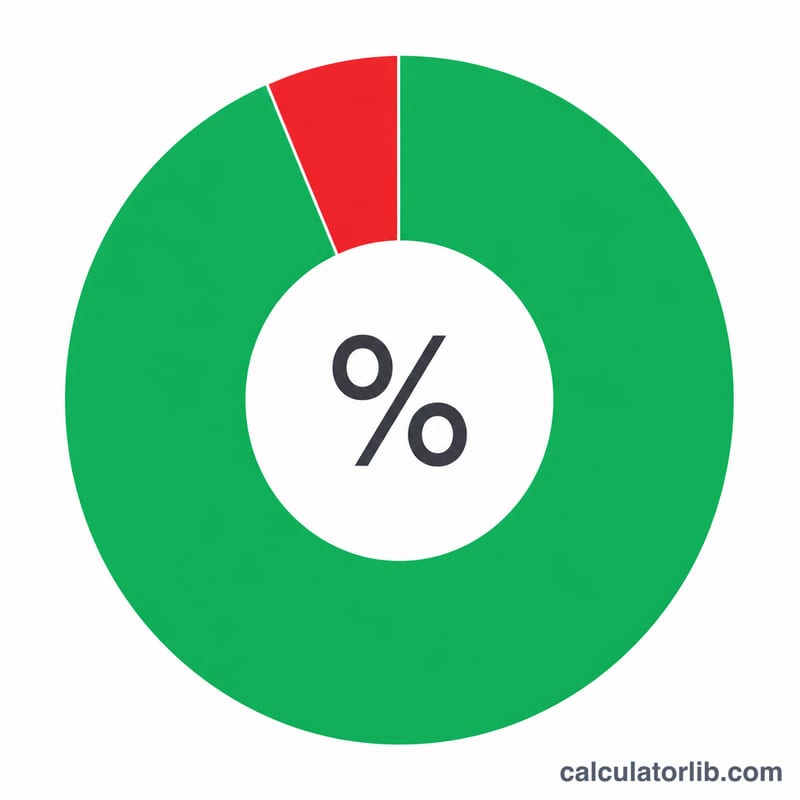
This tool calculates the availability (uptime percentage) of a system, server, or network component from two reliability metrics: MTBF (Mean Time Between Failures) and MTTR (Mean Time To Repair). It is a universal reliability-engineering formula used across IT, telecom, manufacturing, and data-center operations to express how often a system is "up" and ready to serve.
How to Use It
Enter the average operating time between failures (MTBF) and the average time it takes to restore service after a failure (MTTR), both in the same time unit (hours work well). The calculator returns availability as a percentage, the complementary downtime percentage, and the estimated downtime hours per year assuming a 8,760-hour year.
The Formula Explained
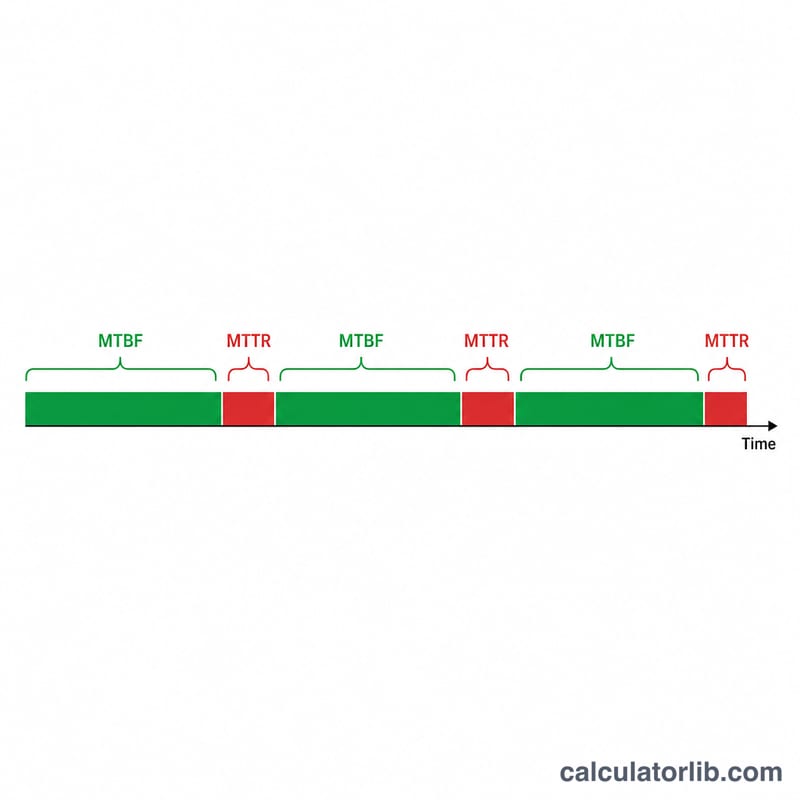
Availability is the fraction of total time a system is operational: Availability = MTBF / (MTBF + MTTR) × 100.
$$\text{Availability} = \frac{\text{MTBF (hours)}}{\text{MTBF (hours)} + \text{MTTR (hours)}} \times 100\%$$A high MTBF (failures are rare) and a low MTTR (repairs are fast) both push availability toward 100%. The denominator represents the full failure-and-repair cycle, so the formula simply measures the share of that cycle spent running.
Worked Example
Suppose a router has an MTBF of 1,000 hours and an MTTR of 4 hours.
$$\text{Availability} = \frac{1000}{1000 + 4} \times 100 = 99.6016\%$$Downtime is 0.3984%, which over a year (8,760 hours) equals about 34.9 hours of outage. To reach the famous "five nines" (99.999%) you would need to cut repair time dramatically or raise MTBF.
FAQ
Is "five nines" hard to achieve? Yes — 99.999% availability allows only about 5.26 minutes of downtime per year, demanding redundancy and very fast recovery.
Can MTBF and MTTR use different units? No. Use the same unit for both (e.g. hours) so the ratio is dimensionless.
Does this include planned maintenance? Basic availability uses unplanned repairs only; include planned outages in MTTR if you want operational availability.