

What is the Uptime / Downtime Calculator?
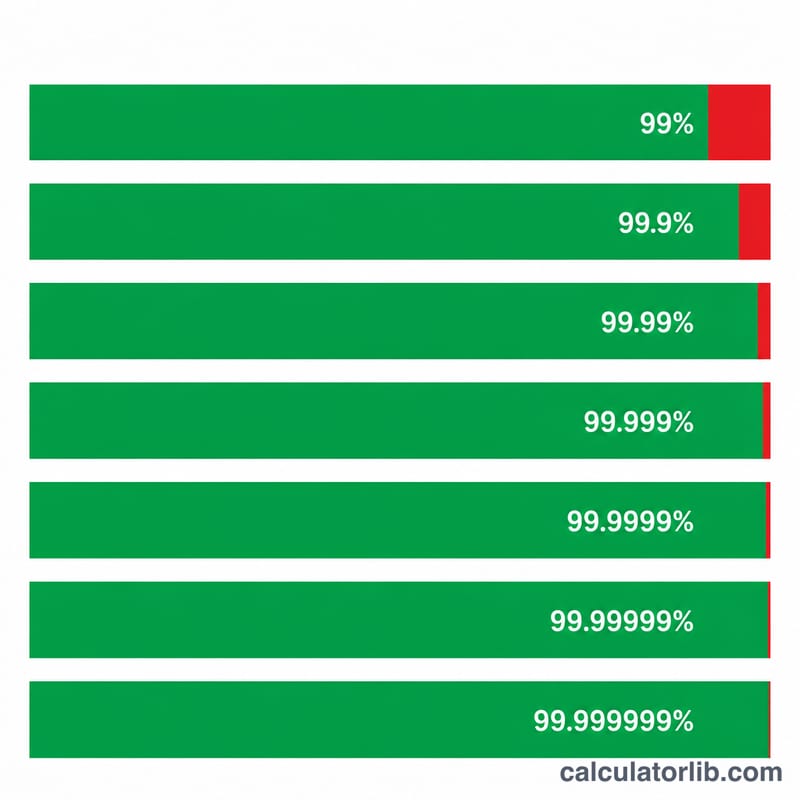
This calculator converts a service-level agreement (SLA) uptime percentage — such as 99.9% ("three nines") or 99.999% ("five nines") — into the maximum amount of downtime allowed over a chosen period. Whether you manage servers, websites, APIs, or any always-on service, knowing your downtime budget helps you plan maintenance windows and hold providers accountable.
How to use it
Enter your target uptime percentage (for example 99.95) and choose the period: per day, week, month, or year. The calculator instantly shows the allowed downtime expressed in days, hours, minutes, and seconds. Months use the average length of 30.4375 days and years use 365.25 days to account for leap years.
The formula explained
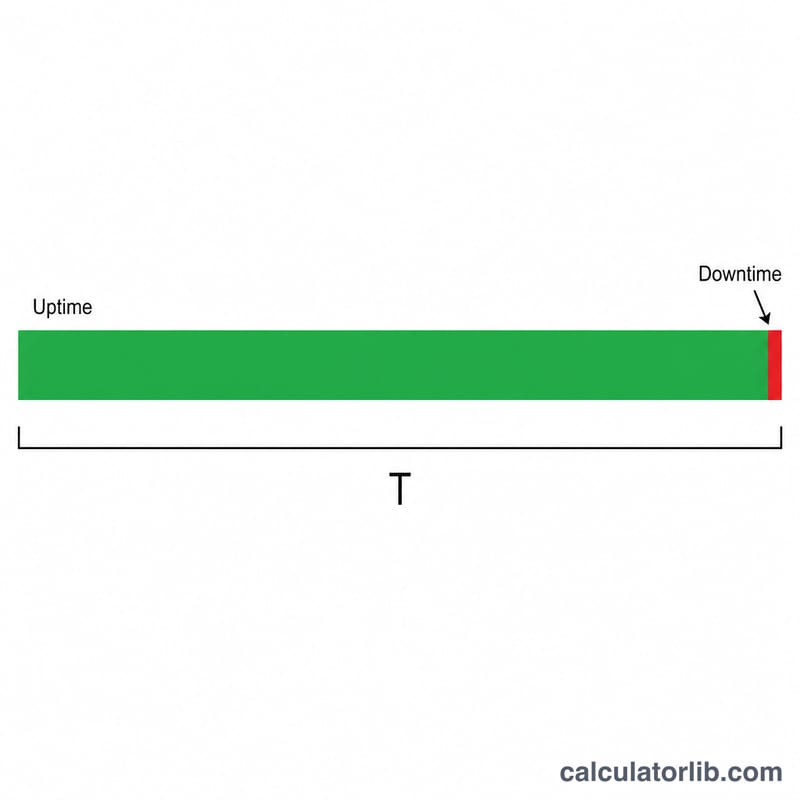
Allowed downtime equals the fraction of unavailability multiplied by the total time in the period: $$\text{Downtime} = \left(1 - \frac{\text{uptime\%}}{100}\right) \times \text{period}$$ Rearranged, observed uptime is $$\frac{\text{total time} - \text{downtime}}{\text{total time}} \times 100$$ Total time is converted to minutes (\(\text{period days} \times 24 \times 60\)) before applying the unavailable fraction.
Worked example
Suppose you promise 99.9% uptime per year. The unavailable fraction is \(1 - 0.999 = 0.001\). A year has \(365.25 \times 24 \times 60 = 525{,}960\) minutes. Allowed downtime $$= 525{,}960 \times 0.001 = 525.96 \text{ minutes} \approx 8.766 \text{ hours} \approx 0.365 \text{ days per year}.$$
FAQ
What does "three nines" mean? It is shorthand for 99.9% availability, allowing roughly 8.77 hours of downtime per year.
Why use 365.25 and 30.4375 days? These averages account for leap years and varying month lengths, giving a fair long-term downtime budget.
How do I check my actual uptime? Use \(U = \frac{\text{total time} - \text{observed downtime}}{\text{total time}} \times 100\). If you had 60 minutes down in a 525,960-minute year, uptime $$= \frac{525{,}900}{525{,}960} \times 100 \approx 99.9886\%.$$