
What Is a Discount Percentage?
A discount percentage tells you how much a price has been reduced relative to its original value. It is the single most useful number when comparing deals, because a "$20 off" tag means very different things on a $40 item versus a $400 item. This calculator converts an original price and a sale price into a clean percentage so you can judge a bargain at a glance.
How to Use It
Enter the original price (the price before the markdown) and the sale price (what you actually pay). The calculator returns the discount percentage, the amount of money you save, and a summary of both prices. It works for any currency since it deals only in ratios.
The Formula Explained
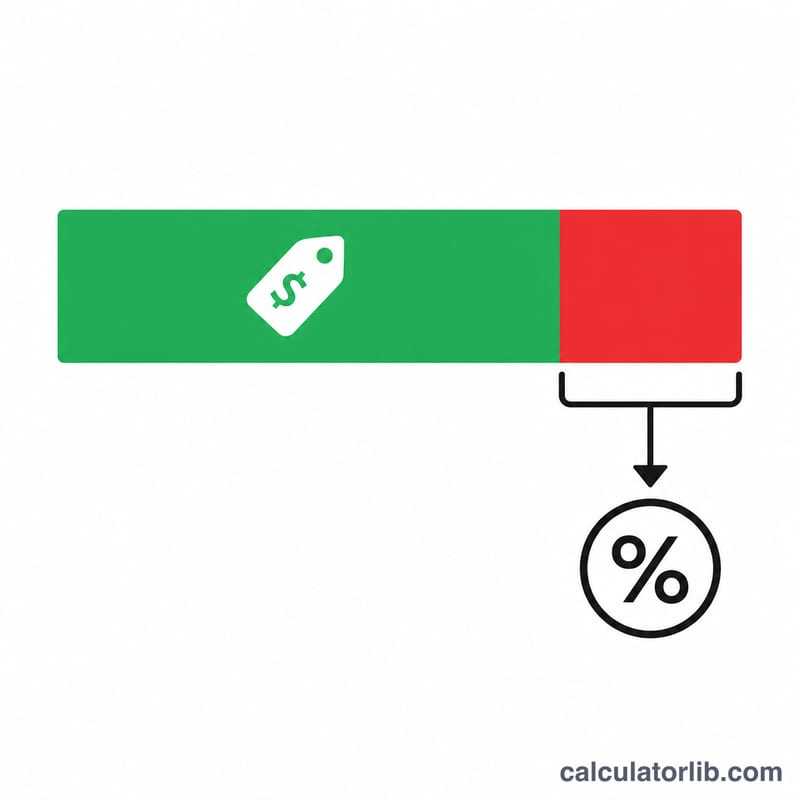
The math is simple: subtract the sale price from the original price to get the amount saved, divide that by the original price, then multiply by 100 to express it as a percentage.
$$\text{discount \%} = \frac{\text{original} - \text{sale}}{\text{original}} \times 100$$
Dividing by the original price (not the sale price) is what keeps the percentage honest — it always reflects the reduction against the starting amount.
Worked Example
Suppose a jacket originally costs $80 and is on sale for $60. The amount saved is \(\$80 - \$60 = \$20\). The discount percentage is $$\$20 \div \$80 \times 100 = 25\%$$ So the jacket is 25% off and you keep $20 in your pocket.
FAQ
What if the sale price is higher than the original? The result will be negative, indicating a price increase rather than a discount.
Does this include tax? No. Enter pre-tax prices for a pure discount comparison; tax is applied after the discount at checkout in most places.
How do I find the sale price from a known percent off? Multiply the original by \((1 - \text{percent}/100)\). For 25% off $80: \(80 \times 0.75 = \$60\).