
What Is the Change of Base Formula?
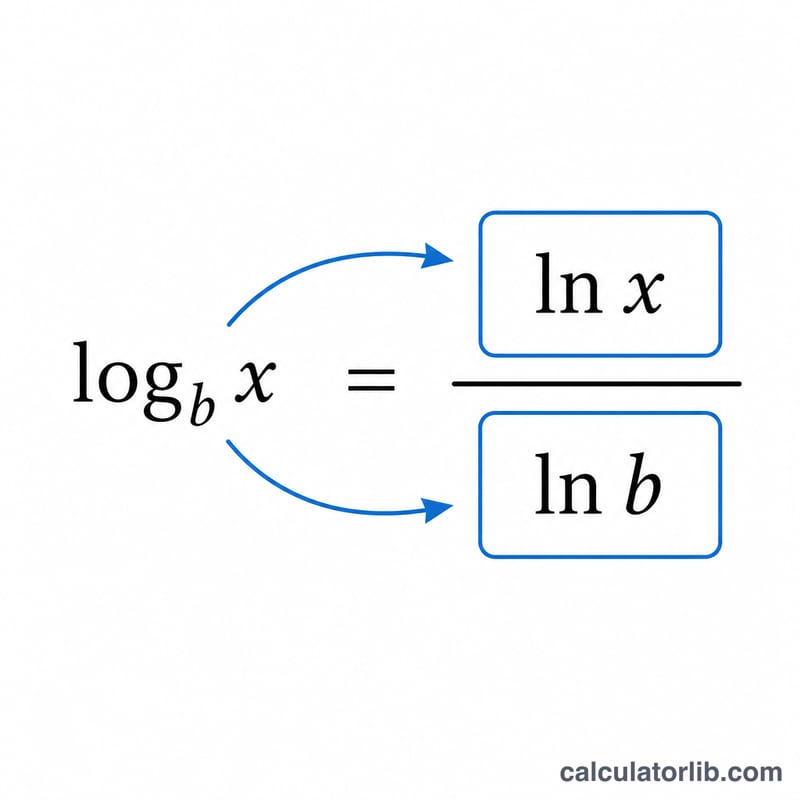
Most calculators and programming libraries only provide two logarithm functions: the natural log (ln, base e) and the common log (log, base 10). The change of base formula lets you compute a logarithm in any base by dividing two logs you already have. It states that \(\log_b(x)\) equals \(\ln(x)\) divided by \(\ln(b)\). This calculator does exactly that — enter the value x and the base b, and it returns \(\log_b(x)\).
How to Use This Calculator
Type the number you want the logarithm of into the Value (x) field, then enter the Base (b). For example, to find log base 2 of 8, set x = 8 and b = 2. The tool also shows the intermediate values \(\ln(x)\) and \(\ln(b)\) so you can follow the arithmetic. The value x must be positive, and the base must be positive and not equal to 1.
The Formula Explained
A logarithm answers the question: "to what power must I raise b to get x?" The change of base identity works because logarithms in different bases are proportional. The change of base formula is:
$$\log_{\text{Base }b} \text{Value }x = \frac{\ln \text{Value }x}{\ln \text{Base }b}$$Dividing \(\ln(x)\) by \(\ln(b)\) cancels out the base-e scaling and leaves the exponent in base b. Any consistent base could be used in both the numerator and denominator — natural log is simply the most convenient choice.
Worked Example
Find \(\log_2(8)\). Using natural logs: \(\ln(8) \approx 2.079442\) and \(\ln(2) \approx 0.693147\). Dividing gives
$$\frac{2.079442}{0.693147} \approx 3$$That makes sense because \(2^3 = 8\).
FAQ
Why can't the base be 1? Because log base 1 is undefined — raising 1 to any power always gives 1, so there is no unique exponent. Dividing by \(\ln(1) = 0\) would also cause division by zero.
Can x be negative or zero? No. The logarithm of zero or a negative number is undefined in the real numbers.
Does it matter whether I use ln or log10? No. As long as you use the same base in both the numerator and denominator, the result is identical.