What the calculator does now
Type the original price and the price you pay: the percent off and the amount you save update as you type. The same tool also works the other way: switch to Price after discount to apply one, two or three discounts and sales tax.
Example: ($80.00 − $64.00) ÷ $80.00 = 20%, so you save $16.00. The numbers you type stay in your browser.
What Is a Discount Percentage Calculator?
A discount percentage calculator tells you how much of a price reduction you are getting when an item is marked down. Instead of guessing whether "$30 off" is a great deal, this tool turns the two numbers you already know — the original price and the sale price — into a clear percentage. It works for any currency, since percentages are unit-free.
The Formula Explained
The math is simple: subtract the sale price from the original price to find the amount of the discount, divide that by the original price, then multiply by 100 to express it as a percentage.
$$\text{Discount \%} = \frac{\text{Original Price} - \text{Sale Price}}{\text{Original Price}} \times 100$$
Dividing by the original price (not the sale price) is the key step — the discount is always measured relative to what you would have paid at full price.
Worked Example
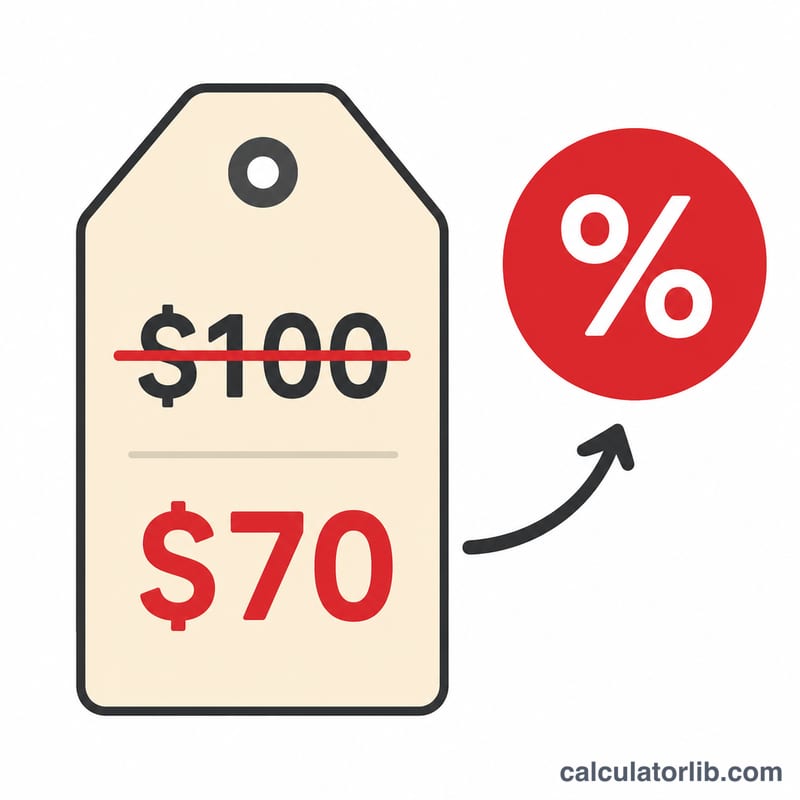
Suppose a jacket originally costs $120 and is on sale for $90. The amount off is \(120 - 90 = \$30\). The discount percentage is $$\frac{30}{120} \times 100 = 25\%$$ So you are saving 25% and keeping $30 in your pocket.
Interpreting the Discount Percentage
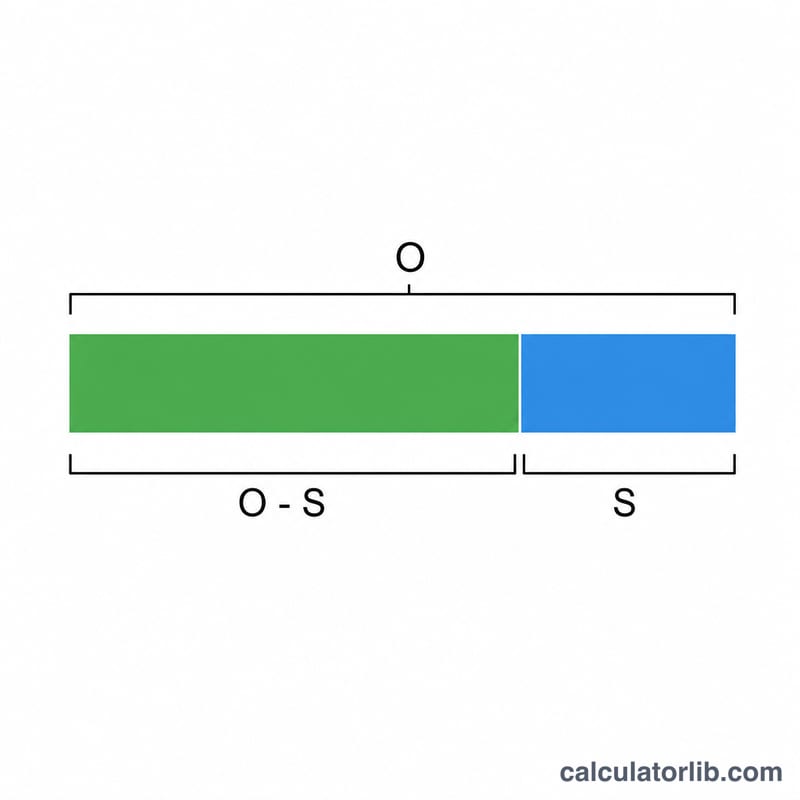
The discount percentage tells you how much cheaper the sale price is compared with the original price, expressed as a share of that original price:
$$\text{Discount \%} = \frac{ \text{Original} - \text{Sale}}{\text{Original}} \times 100$$
What the number means
- 0% – the sale price equals the original price, so there is no change.
- Positive value – the sale price is lower than the original price, which is a markdown. For example, 25% means you pay three quarters of the original price.
- Negative value – the sale price is higher than the original price, so this is actually a price increase, not a discount.
- 100% – the sale price is zero, so the item is free.
The percentage is relative to the original price
Because the discount is measured against the original price, the same amount of money saved gives different percentages on different prices. Saving $10 on a $40 item is \(\frac{10}{40} \times 100 = 25\%\) off, while saving $10 on a $200 item is \(\frac{10}{200} \times 100 = 5\%\) off. A larger percentage does not always mean more money saved, and a larger dollar saving does not always mean a bigger percentage.
Successive discounts do not add up
When a second discount is applied to an already reduced price, it is calculated on the new, lower price. Taking 20% off and then a further 10% off leaves \(0.80 \times 0.90 = 0.72\) of the original price, so the total discount is 28%, not 30%. In general, the combined discount is \(1 - (1 - d_1)(1 - d_2)\), where \(d_1\) and \(d_2\) are written as decimals.
Check the original price
The result is only as meaningful as the original price you enter. If the "original" price is inflated, was only briefly in effect, or is not the price the item was really sold at before, the percentage off will look larger than the real saving. For a fair comparison, use the true prior price or compare the sale price with what other sellers charge.
This is general information about how percentages work, not financial advice.
FAQ
Does this work in any currency? Yes. Percentages and savings are calculated from whatever numbers you enter, so dollars, euros, pounds and others all work the same way.
Why divide by the original price instead of the sale price? A discount is defined relative to the full price you would otherwise pay, so the original price is the correct base.
What if the sale price is higher than the original? The result will be a negative percentage, which means a price increase rather than a discount.