
What Is a Cost of Living Comparison Calculator?
This calculator estimates how much income you would need in a new city to maintain the same standard of living you have today. It uses a cost of living index for each city — a number that summarizes the relative price of housing, food, transport, and other everyday expenses. By comparing the two indexes, you can quickly see whether a job offer or relocation actually leaves you better or worse off.
How to Use It
Enter your current annual income, the cost of living index for your current city, and the index for your destination city. Cost indexes are commonly scaled so that a baseline city equals 100, but any consistent scale works as long as both numbers come from the same source. The calculator returns the equivalent income needed in the destination city, the dollar difference, and the percentage change in cost of living.
The Formula Explained
The core formula is $$\text{Required Income} = \text{Current Income} \times \frac{\text{Destination Index}}{\text{Current Index}}$$. If the destination index is higher than your current index, you will need more income; if it is lower, you can maintain your lifestyle on less. The percentage change is simply the relative difference between the two indexes:
$$\%\,\text{Change} = \frac{\text{Destination Index} - \text{Current Index}}{\text{Current Index}} \times 100$$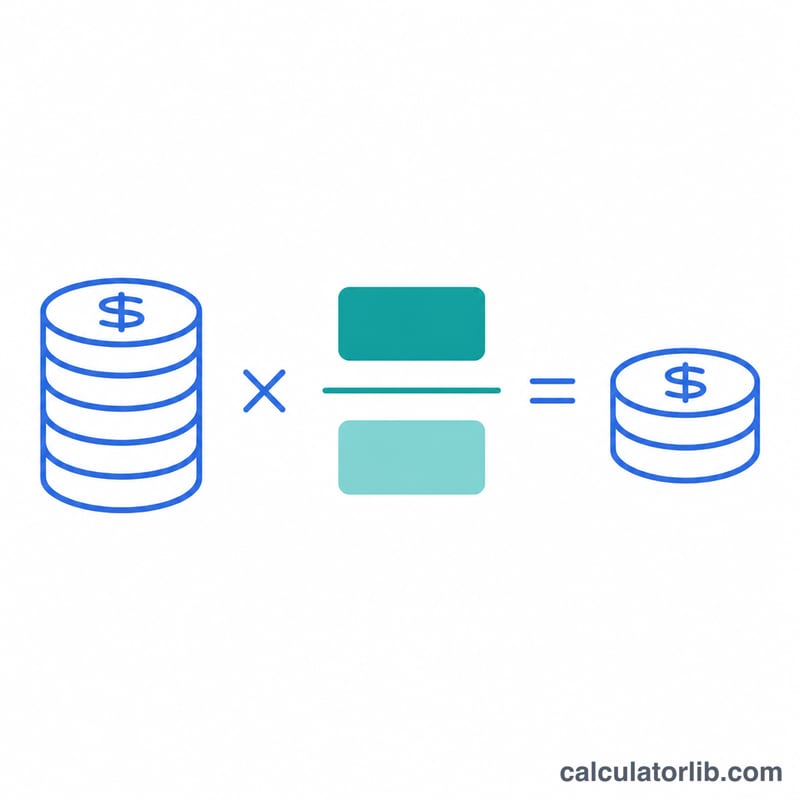
Worked Example
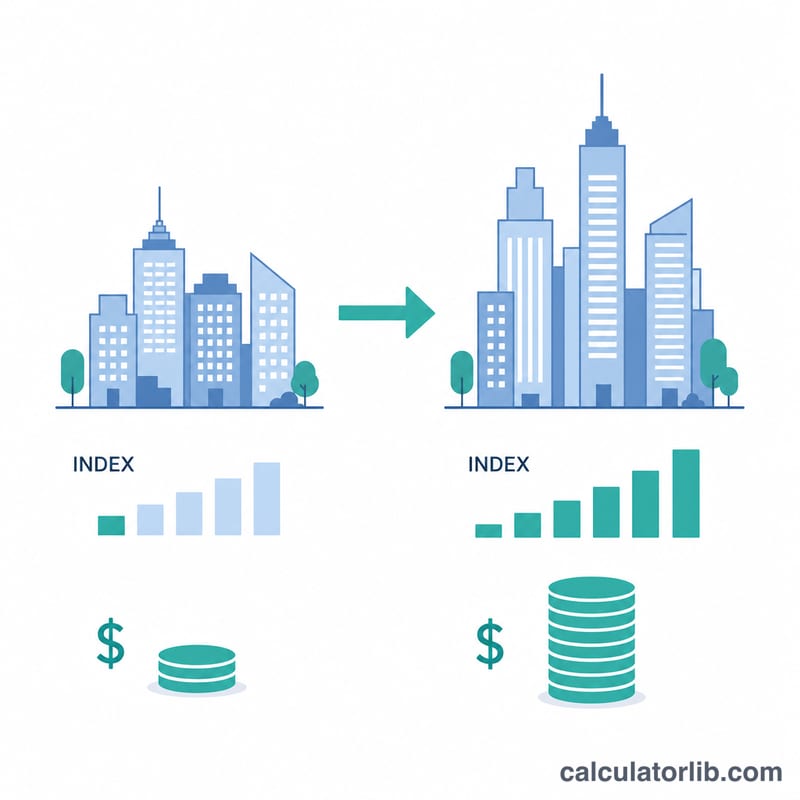
Suppose you earn $60,000 in a city with an index of 100 and you are considering a move to a city with an index of 120. Required income $$= 60{,}000 \times \frac{120}{100} = \mathbf{\$72{,}000}$$ That is $12,000 more than today, reflecting a 20% higher cost of living. If the new offer pays less than $72,000, your purchasing power would actually drop.
FAQ
Where do I find cost of living indexes? Public cost-of-living databases and relocation websites publish city indexes, usually anchored to a national average of 100.
Does this include taxes? No. The index reflects general living costs only; income taxes, which vary by state and country, are not factored in.
What if both cities use different baselines? Make sure both indexes come from the same data source and scale, otherwise the comparison will be inaccurate.